
Matter of time before truth trumps stereotypes
Advertisement
Read this article for free:
or
Already have an account? Log in here »
We need your support!
Local journalism needs your support!
As we navigate through unprecedented times, our journalists are working harder than ever to bring you the latest local updates to keep you safe and informed.
Now, more than ever, we need your support.
Starting at $15.99 plus taxes every four weeks you can access your Brandon Sun online and full access to all content as it appears on our website.
Subscribe Nowor call circulation directly at (204) 727-0527.
Your pledge helps to ensure we provide the news that matters most to your community!
To continue reading, please subscribe:
Add Brandon Sun access to your Free Press subscription for only an additional
$1 for the first 4 weeks*
*Your next subscription payment will increase by $1.00 and you will be charged $20.00 plus GST for four weeks. After four weeks, your payment will increase to $24.00 plus GST every four weeks.
Read unlimited articles for free today:
or
Already have an account? Log in here »
Hey there, time traveller!
This article was published 27/05/2025 (303 days ago), so information in it may no longer be current.
The most frequent statement thrown at those who argue for Indigenous nationhood is that First Nations, Inuit and Métis leaders are corrupt, vile and incompetent.
It’s a stereotype; an oversimplified idea based in little to no reality.
No one is denying there aren’t a few terrible and inept chiefs, presidents and CEOs, but the selfish ones out for power and money are rare and, frankly, don’t last — communities have their own methods of holding leaders accountable.
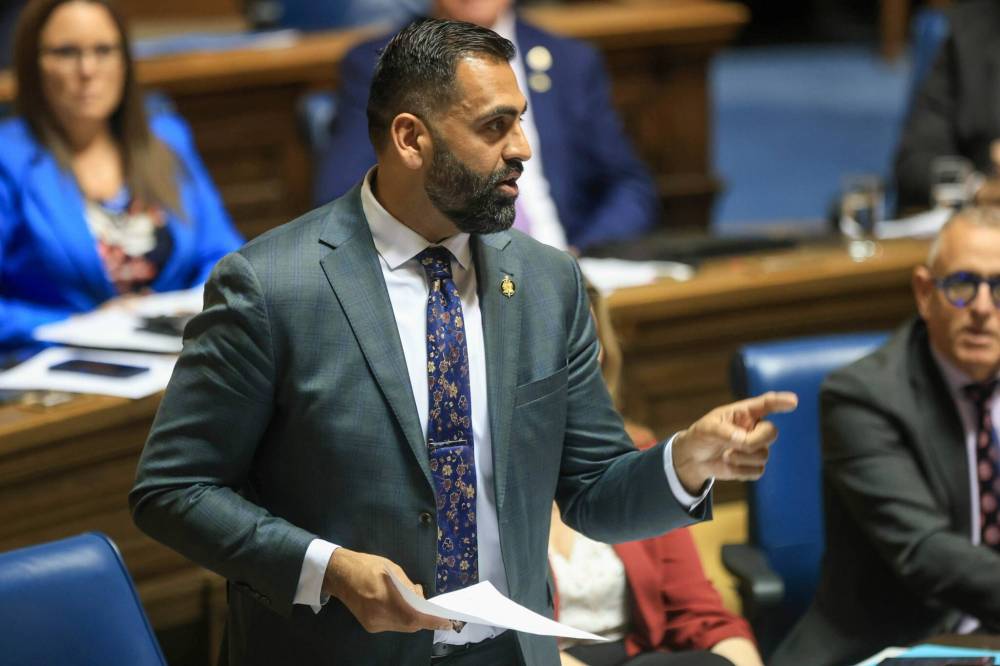
Progressive Conservative Leader Khan Obby Khan speaks in the Manitoba legislature on Thursday. Niigaan Sinclair writes that Khan's decision to share talking points about Premier Wab Kinew's past rather than speak about the recent ethics commissioner report into the Sio Silica project wasn't so hard to understand "if one realizes it's easier to create a stereotype than deal with reality." (Ruth Bonneville/Winnipeg Free Press)
The fact is Indigenous governments are the most supervised institutions in Canada. Problems in Indigenous communities emerge from a lack of funding and human resources, not selfishness or incapability.
Still, the stereotype persists because it obscures the primary and underlying reality of a country that continues to systemically under-commit to a portion of its citizens.
In other words, stereotypes are easier to believe than what’s really happening.
If one clear, concise message has emerged since the beginning of U.S. President Donald Trump’s second term, it is that conservative politics ain’t found in the parties of Ronald Reagan or Brian Mulroney anymore.
On both sides of the border, the era of big-tent, fiscally responsible, small-government conservatism is over — replaced with single-issue, ideologically based, budget-busting governments that seek to control the identities, bodies and minds of their citizens.
Any discussion of Trump must include a list of empty, meaningless promises alongside a litany of nonsensical, brazen, corrupt and cruel acts.
The promises have included invading Greenland, “taking back” Panama, making Canada the 51st state and renaming the Gulf of Mexico.
Trump also accepted a US$400-million personal gift of a plane from Qatar, hosted a US$148-million crypto fundraising dinner and agreed to a US$40-million “licensing” deal to produce a documentary on his wife. Let’s not forget his criminal convictions and the public humiliation of world leaders in the Oval Office.
This doesn’t stop at Trump either.
Last week’s Republican-backed “big, beautiful bill” gifts trillions of dollars in tax breaks to upper-class Americans while raising the country’s debt ceiling and cutting hundreds of millions in medical and food assistance to pay for it all.
With more than US$3 trillion about to be added to the national debt and billions in Trump’s pockets, the bill could be the most corrupt law passed in U.S. history.
Even more extreme is what else is hidden inside the bill: a list of ideological policies that promote gun use, a plan to incentivize the targeting of immigrants, and dropping clean energy programs.
It’s almost as if Republicans want to, in one fell swoop, paint themselves with one brush and rebrand their political stripe overnight.
Looking north, Canadian conservatives are finding use in this playbook.
Adopting the stereotype of western separatism is precisely what Alberta Premier Danielle Smith is doing when she stokes the fire of anger over the federal election.
A distracting stereotype is precisely what she needs as she deals with allegations of corruption in her government related to health-care contracts for private surgeries.
Virtually everywhere in Canada, conservatives are also rejecting big-tent, fiscally responsible policies for anti-democratic, ideological and micro-managing ideas.
One need look no further than the 2023 Manitoba election campaign by Heather Stefanson’s Progressive Conservative government — where Indigenous women’s bodies, parental rights and LGBTTQ+ rights were discussed far more than budgets, the economy and health care.
Now, it turns out the Stefanson government was trying to obscure something else. Last week, Manitoba’s ethics commissioner found Stefanson, former finance minister and deputy premier Cliff Cullen and former economic development minister Jeff Wharton all violated the Conflict of Interest Act by trying to rush approval of the southern Manitoba Sio Silica project after losing the 2023 provincial election.
“By attempting to have the project licence issued in the transition period without the consent of the incoming NDP government,” ethics commissioner Jeffrey Schnoor concluded in his investigation, “Ms. Stefanson, Mr. Cullen and Mr. Wharton contravened the caretaker convention and thereby acted improperly.”
As a result, Schnoor recommended Stefanson be fined $18,000, Cullen be fined $12,000 and Wharton be fined $10,000.
Stefanson denied the allegation in a statement from her lawyer. Cullen has yet to issue a statement, while Wharton — the only one of the three to still hold political office — apologized in the legislature last week.
PC Leader Obby Khan responded by removing Wharton from his shadow cabinet. At a committee meeting a day earlier, the Tory leader wouldn’t delve into the report in any detail in response to Kinew’s questions, and instead rattled off a series of talking points about the premier’s past.
It was a weird strategy, but perhaps not, if one realizes it’s easier to create a stereotype than deal with reality.
The bottom line is, at some point, stereotypes always get exposed for what they are. And the truth emerges.
» Niigaan Sinclair is Anishinaabe and is a columnist at the Winnipeg Free Press.