
Why astrology and tarot cards still appeal to us
Advertisement
Read this article for free:
or
Already have an account? Log in here »
We need your support!
Local journalism needs your support!
As we navigate through unprecedented times, our journalists are working harder than ever to bring you the latest local updates to keep you safe and informed.
Now, more than ever, we need your support.
Starting at $15.99 plus taxes every four weeks you can access your Brandon Sun online and full access to all content as it appears on our website.
Subscribe Nowor call circulation directly at (204) 727-0527.
Your pledge helps to ensure we provide the news that matters most to your community!
To continue reading, please subscribe:
Add Brandon Sun access to your Free Press subscription for only an additional
$1 for the first 4 weeks*
*Your next subscription payment will increase by $1.00 and you will be charged $20.00 plus GST for four weeks. After four weeks, your payment will increase to $24.00 plus GST every four weeks.
Read unlimited articles for free today:
or
Already have an account? Log in here »
Hey there, time traveller!
This article was published 30/06/2025 (195 days ago), so information in it may no longer be current.
More than 30 per cent of Americans believe in some sort of esoteric knowledge and regularly consult astrology, tarot readers or fortune tellers, according to a recent report by the Pew Research Centre.
Even though the survey says these Americans are doing so “just for fun” and claim they rely on the information gained by divination “only a little,” the persistence — and apparent rise — of these practices suggests something deeper is at play.
People have always turned to divinatory methods to search for unanswered questions and to gain additional knowledge that could help them to prepare for the future, especially in times of uncertainty. For example, searches for “tarot cards” increased by more than 30 per cent during the pandemic.
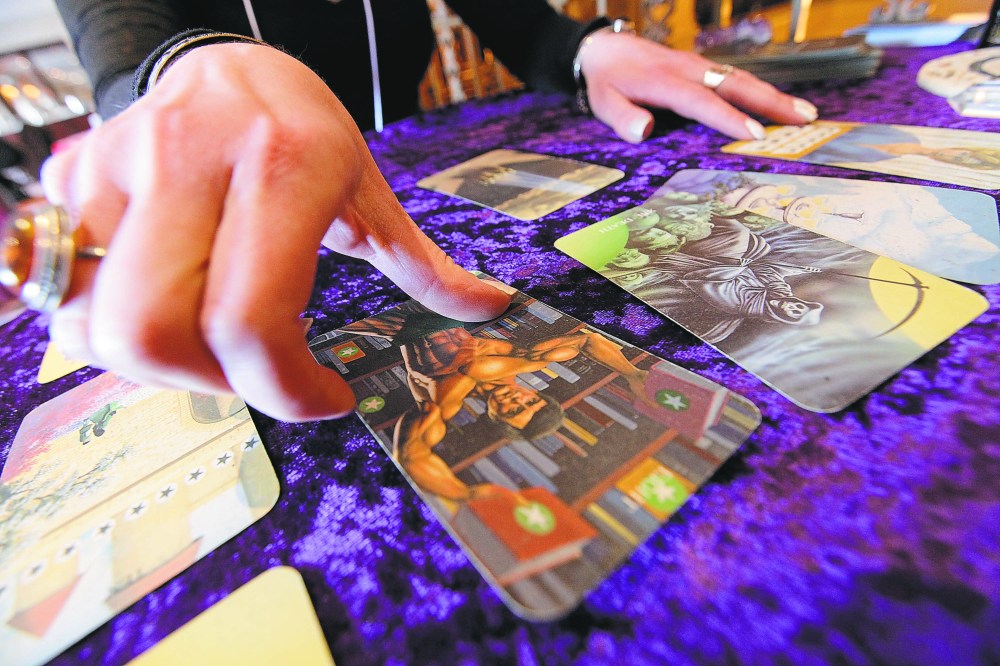
I study ancient divination, but to better understand how diviners work, I have observed contemporary diviners at work and talked with them about their practices. They say their clients request tarot consultations more frequently than they did in the past.
WHAT IS DIVINATION?
Anthropologists define “divination” methods as “practice(s) that seeks to foresee or foretell future events or discover hidden knowledge usually by the interpretation of omen or by the aid of supernatural powers.”
Divination methods, including tarot and astrology, offer a way to ask questions when other systems fail to provide answers. These questions can be highly personal and difficult to address in a formal religious setting. The divinatory answers allow people to feel they’ve gained insight, which in turn gives a perception of control over an uncertain future.
Apart from astrology and tarot, some of the best known divination methods include: the interpreting of dreams, reading coffee cups or tea leaves, observing animals and nature, reading palms and other body features such as nose shape and eye placement.
When a diviner uses things, such as cards, tea leaves, dice or shells, the connecting thread to many of these methods is that people cannot control the signs they produce. For example, divination consultants typically mix the tarot card deck to make sure the result are randomized. People should not manipulate the results.
DIVINATION AS ALTERNATIVE WAYS OF KNOWING
Pew Centre data reveals that young people, women and LGBTQ Americans are among the most likely to consult divinatory methods. Religious studies professor Marcelitte Failla has also written about contemporary Black women who have reclaimed the tarot deck to creatively address their spiritual needs.
Many people turn to religion when they face the unknown in their lives. They address their insecurities in worship, asking for divine help.
But there have always been people who did not have access to organized religion. Divinatory practices can be especially appealing to those who have been excluded from traditional religion and had to come up with alternative ways to address uncertainties.
They perhaps lived in remote areas and could not attend worship sites such as temples. Or possibly, they were excluded from organized religion for identity reasons. For example, women regularly stayed home to care for children and sick. Sometimes, they were denied access because of their bodily “impurities,” menstruation or recent childbirth.
LGBTQ+ individuals were also denied access. In the U.S., discrimination against LGBTQ+ individuals remains one of the leading reasons for leaving traditional religious institutions. In Canada, the churches’ discriminatory treatment of different sexual minorities has been one of the top reasons people dissolve membership.
DIVINATION IN TIMES OF UNCERTAINTY
In an age marked by ongoing anxiety, political instability and waning trust in institutions, centuries-old divination rituals offer alternative ways for folks to seek entertainment but also to gain a sense of insight, agency and connection. What may seem like harmless fun can also serve as a serious response to a chaotic world. Divinatory practices can provide both spiritual exploration and emotional validation.
It’s understandable that a new situation, like the COVID-19 pandemic, triggered anxiety and uncertainty for people.
People continue to experience more anxiety than they did before the pandemic. Some of the main concerns include world politics, job security and personal finances.
As we try to make sense of the new, confusing and constantly changing situations, many create different theories, some questionable. Some people turn to alternative approaches like divination to make sense of the world.
TAROT: THINKING THROUGH EMOTIONS
People are checking out tarot readings on online platforms. And many social media accounts feature tarot.
Besides increasing political insecurity, another reason for the increased interest in tarot may be the visual aspect. Increased interest in the decorated cards may be a reflection of our highly visual culture. Interest in the cards with images may reflect interest in other images we watch. They are like photos with messages.
The fascination with tarot may also speak about a need to control the consultation as a diviner and their client see exactly the same thing. The images in the cards are also symbolic, and they can be interpreted in different ways.
That means rather than providing a straightforward answer to a question, the cards are tools that can help think through one’s emotions and feelings.
Tarot is not a religion. The object that is consulted is paper, not an image of the divine or a symbol of transcendence. This lack of alignment with any particular religion allows different people to consult tarot as a spiritual practice.
In principle, the cards can be consulted anywhere without particular preparations. The only material one needs is a deck of cards. The accessible materiality may be adding to their popularity.
PLAYFUL ASPECTS OF DIVINATION
Many divinatory methods include a playful aspect. For instance, the objects used for the lot oracle — pebbles, stones, four-sided knucklebones or dice — are the same ones people used for playing board games.
Ancient images show people consulting the objects or playing, suggesting the boundaries of some of the divinatory methods were always fluid.
As randomizing is an important element of divinatory consultation, the new insights various methods produce can be both surprising and entertaining.
» Hanna Tervanotko is an associate professor in religious studies at McMaster University. This column was originally published at The Conversation Canada: theconversation.com/ca.