
China and U.S. plot pathways to AI dominance
Advertisement
Read this article for free:
or
Already have an account? Log in here »
We need your support!
Local journalism needs your support!
As we navigate through unprecedented times, our journalists are working harder than ever to bring you the latest local updates to keep you safe and informed.
Now, more than ever, we need your support.
Starting at $15.99 plus taxes every four weeks you can access your Brandon Sun online and full access to all content as it appears on our website.
Subscribe Nowor call circulation directly at (204) 727-0527.
Your pledge helps to ensure we provide the news that matters most to your community!
To continue reading, please subscribe:
Add Brandon Sun access to your Free Press subscription for only an additional
$1 for the first 4 weeks*
*Your next subscription payment will increase by $1.00 and you will be charged $20.00 plus GST for four weeks. After four weeks, your payment will increase to $24.00 plus GST every four weeks.
Read unlimited articles for free today:
or
Already have an account? Log in here »
In late July, the world’s two superpowers in artificial intelligence (AI) laid out their nearterm strategies. The plans diverge on how to achieve tech supremacy. They also both contain many contradictions and are based on numerous bold assumptions.
Yet, whichever country best executes their imperfect AI roadmap will gain major advantages. And not only in re-shaping the global economy, but also tilting the military balance of power in their favour.
The Trump administration’s new AI Action Plan takes a predictably ultranationalist approach. “America is the country that started the AI race,” Trump said in a speech the evening it was published. “And as president of the United States, I’m here today to declare that America is going to win it.”
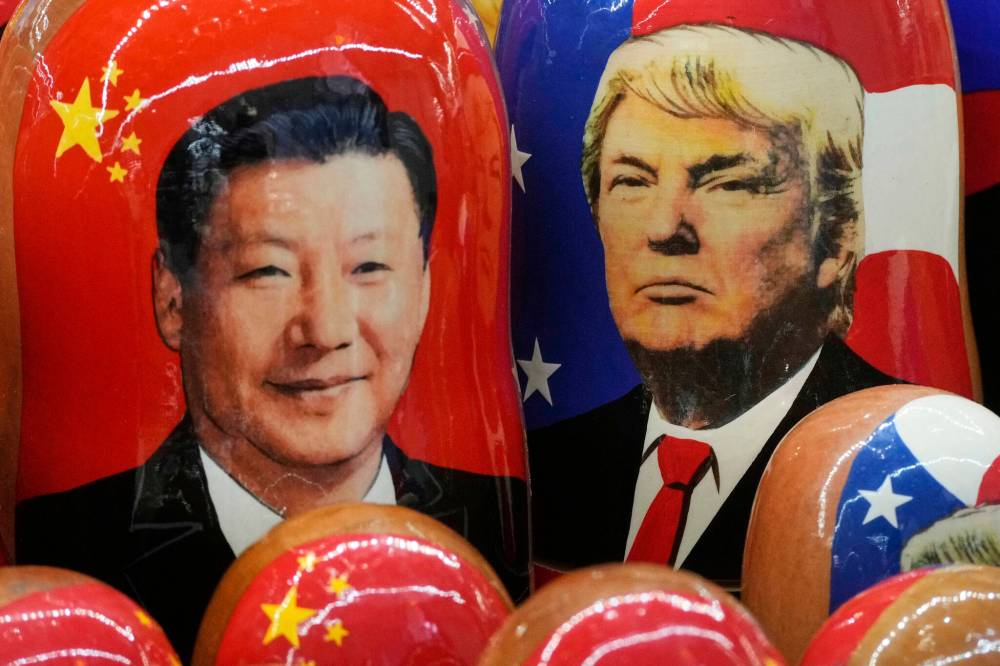
China is aiming to take the lead in the battle for AI supremacy. Traditional Russian wooden dolls called Matryoshka depict China’s President Xi Jinping and U.S. President Donald Trump at a souvenir shop in St. Petersburg, Russia, Nov. 21. (The Associated Press)
To do so, the White House intends to give U.S. tech giants far more leeway. “The action plan, at its highest level, reads just like a wish list from Silicon Valley,” an executive at the AI Now Institute, a non-partisan research organization, told media outlet Defense One.
Existing government guardrails will be rolled back and “woke” safety measures will disappear. Federal funds will be withheld from states attempting to regulate AI on their own. Environmental laws that impede data centre construction are on the chopping block. Protectionist trade policies at home will be paired with efforts to champion American companies abroad.
Vague details for mitigating national security risks arising from cutting-edge models only appear on the manifesto’s final two pages. Nevertheless, many experts have praised the plan. In particular, for committing the U.S. to unleashing domestic AI innovation, emphasizing digital liter-acy in the workforce and building enormous new computing power for American companies.
Although, the strategy doesn’t specify any new funding. The brash anti-diplomacy of Trump’s second act has also already done lasting damage. America’s friends, including Canada, are increasingly motivated to wean themselves off U.S. technology.
“Even longstanding allies and partners are framed as mere markets to be captured in the interests of global American supremacy,” says Kat Duffy, a senior fellow at the Council on Foreign Relations. “Ultimately, when it comes to global engagement, the plan sings a zero-sum tune.”
A populist crusade against America’s universities and foreign workers is chasing away vital talent as well. Washington’s heavy-handed tariff regime will aggravate the cost of expanding domestic digital infrastructure.
China, meanwhile, retains a stranglehold on the critical minerals market. And in many ways, the nation of 1.4 billion has already leapfrogged America in embracing AI in its economy and society. Beijing now intends to harness Chinese products and expertise to bolster its growing soft power throughout the developing world.
Released on Jul. 26 during this year’s annual summer tech conference in Shanghai, China’s “global action plan” on AI proposes to help developing nations utilize Chinese technology for their own purposes. China already offers a full package of IT hardware, software, training and financing to nations in Africa, Asia, the Middle East and Latin America via its Digital Silk Road initiative.
A key selling feature going forward will be how client states can seamlessly integrate high-performance, open-source Chinese tools into local systems that are based on Chinese networks.
DeepSeek’s AI reasoning model, for example, is already outcompeting Silicon Valley’s closedsource, subscription-based AI products across the Global South. Developing nations thus gain greater flexibility to improve their health care, education and workforce training programs — all while entrenching Chinese technology in their domestic industries.
Indeed, the Trump administration recognizes this gravely threatens America’s ambitions. The AI Action Plan thus presses U.S. firms to pivot to creating more open-source models.
Beijing also proposes setting up a new entity to facilitate international collaboration on AI development. This comes after President Xi Jinping in 2023 launched the China-led Global AI Governance Initiative, based on claims of wanting to advance safe, human-centred systems.
However, China’s benevolent rhetoric shouldn’t be taken at face value. It’s the same country that’s harnessed AI to craft the world’s most fearsome surveillance state. The northwest region of Xinjiang, especially, has been rendered a digital gulag for Uyghur Muslims and other minorities. And China is busy exporting these dystopian technologies to dozens of countries worldwide.
“Some global AI industry leaders are concerned that Chinese open generative models could spread Chinese Communist Party propaganda to users by censoring or distorting information on Chinese history, global politics, and human rights issues,” warn two senior fellows at the Atlantic Council.
All told, if either China or the U.S. truly “win” the AI race, it’ll probably equate to a loss for almost everyone else.
» Kyle Hiebert is a Montreal-based political risk analyst and former deputy editor of the Africa Conflict Monitor. This column was previously published in the Winnipeg Free Press.