
Star Power mirrors real life
Advertisement
Read this article for free:
or
Already have an account? Log in here »
We need your support!
Local journalism needs your support!
As we navigate through unprecedented times, our journalists are working harder than ever to bring you the latest local updates to keep you safe and informed.
Now, more than ever, we need your support.
Starting at $15.99 plus taxes every four weeks you can access your Brandon Sun online and full access to all content as it appears on our website.
Subscribe Nowor call circulation directly at (204) 727-0527.
Your pledge helps to ensure we provide the news that matters most to your community!
To continue reading, please subscribe:
Add Brandon Sun access to your Free Press subscription for only an additional
$1 for the first 4 weeks*
*Your next subscription payment will increase by $1.00 and you will be charged $20.00 plus GST for four weeks. After four weeks, your payment will increase to $24.00 plus GST every four weeks.
Read unlimited articles for free today:
or
Already have an account? Log in here »
Hey there, time traveller!
This article was published 10/08/2025 (228 days ago), so information in it may no longer be current.
It’s interesting how some things never change.
As a young university student, back so long ago, in my first years of volunteering for an international development group in Winnipeg, one of the ways we engaged with students to make them aware of global issues such as poverty, was to bring a role-playing or simulation game to their classrooms.
Now, more than 50 years later, we could take the same game, Star Power, to any classroom and it would still be relevant.
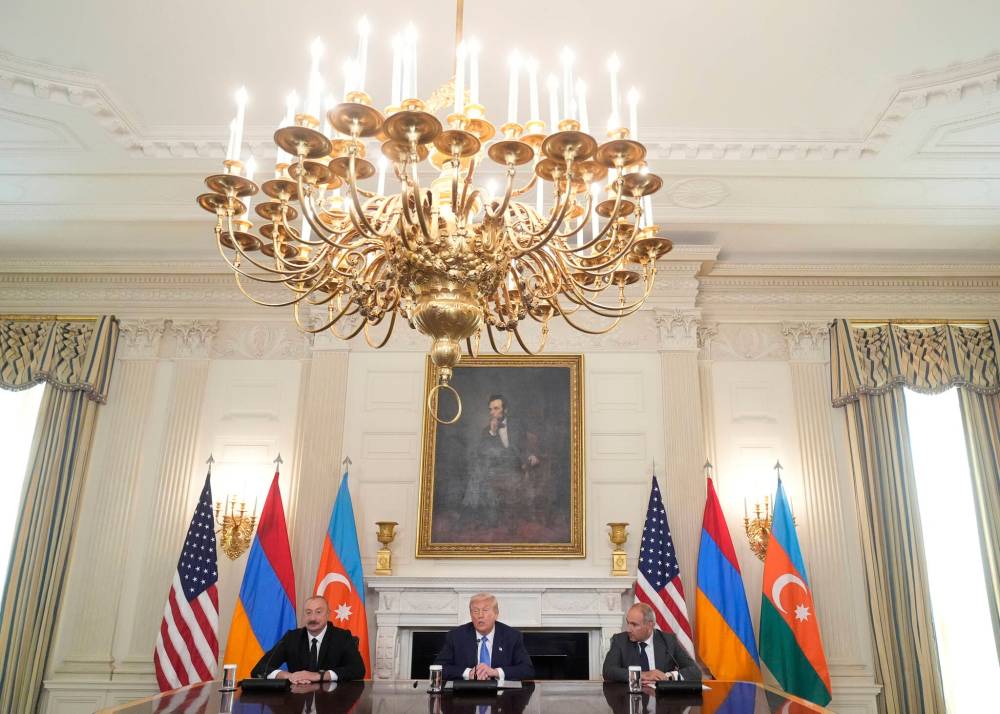
President Donald Trump (centre) speaks during a trilateral signing with Azerbaijan’s President Ilham Aliyev, left, and Armenia’s Prime Minister Nikol Pashinyan in the State Dining Room of the White House on Friday in Washington. Military might, political power and accumulated wealth put some people ahead of others, Zack Gross writes, but a simple game suggests why that might be. (The Associated Press)
Here is how the game was played. A small number of people in the class (or church group, service club, etc.) were designated as the Squares. A larger group were set aside as the Circles, and a third group, by far the largest, were hived together in the room as the Triangles. Each person was given an envelope with large poker chips of different colours (red, blue, green), each holding a different value.
Unknown to the players, the small group of Squares received the highest valued tokens, the Circles got a middling amount, and the Triangles got the lowest valued tokens. One member of each of the Circles and Triangles, however, received a generous amount in their envelope. With me so far?
Then, we instructed the players to get out there with the others in the room and trade tokens, trying to improve their scores. Mayhem ensued. After a few minutes of that activity, we recorded everyone’s total on the blackboard and, of course, one could see that the Squares were way ahead.
After a second round of trading, we added the new individual totals to their previous ones, and one could see that even if people at the bottom maintained their numbers, they were still falling further behind those at the top. If you had a two-round point accumulation of ten plus ten, then you scored twenty. But, if you had even results but with 50 plus 50, then you were up to 100!
The players planted in the Circles and Triangles with larger amounts usually convinced their groups that they should be sent up to the Squares with the idea that they would advocate for their poorer groups. Sometimes that is what they would do, while other times they would just join the wealthier group and forget their origins. Then the Squares, as the richest and, we would say to them obviously the most able, would be given the privilege (responsibility?) of making the trading rules for the rest of the game.
Most often, this “leadership” group would enact rules to further increase their financial standing. Occasionally, but less often, the Squares would opt to improve the lives of the poorer members in the room.
I probably played this game a hundred times over the years with a variety of groups throughout Southern Manitoba, in small towns to the big city. We would sometimes enhance the experience by serving meals to the Squares, snacks to the Circles, and nothing to the Triangles. Sometimes, people would get quite upset by the game, other times it was just a fun experience and a new way to learn.
In debriefing Star Power with participants afterwards, depending on age group and daily lives, lots of interesting comments were made. Some students would equate the Star Power experience to their home lives or their relations with friends. Young people might see the power of their parents as a difficulty or feel that they really needed more allowance! Working people would see issues that arose at work, or in their community, or in the wider world. Of course the most frequent comment was “The rich get richer and the poor…!”
But one might also hear from some participants that those who are well off had attained that position because of their hard work and smart brains. To this we would point out that, at least in the game, it was a set-up — nobody in the game had actually “earned” having more high-value tokens. It was more of an inheritance, or privilege in real life that we are born into because of our class status or, in a global context, because we live in a wealthy, more democratic and progressive country.
Today in our world, we can see that military might, political power and accumulated wealth still put some people — a small group — ahead, in every way, of the rest. Whether in the hot spots in today’s news — Eastern Europe, the Middle East, Africa — or in the political turmoil with our trading partners, it is a challenge to bring about just and sustainable change in the face of might, wealth and power.
Star Power is just a game, and maybe doesn’t get played that much anymore, but it’s message is still relevant.