
Plastic cleanup is more vital than ever
Advertisement
Read this article for free:
or
Already have an account? Log in here »
We need your support!
Local journalism needs your support!
As we navigate through unprecedented times, our journalists are working harder than ever to bring you the latest local updates to keep you safe and informed.
Now, more than ever, we need your support.
Starting at $15.99 plus taxes every four weeks you can access your Brandon Sun online and full access to all content as it appears on our website.
Subscribe Nowor call circulation directly at (204) 727-0527.
Your pledge helps to ensure we provide the news that matters most to your community!
To continue reading, please subscribe:
Add Brandon Sun access to your Free Press subscription for only an additional
$1 for the first 4 weeks*
*Your next subscription payment will increase by $1.00 and you will be charged $20.00 plus GST for four weeks. After four weeks, your payment will increase to $24.00 plus GST every four weeks.
Read unlimited articles for free today:
or
Already have an account? Log in here »
Hey there, time traveller!
This article was published 17/08/2025 (222 days ago), so information in it may no longer be current.
Representatives at the recent United Nations conference in Geneva have once again failed to negotiate a binding global treaty to tackle plastic pollution. The Switzerland gathering was the sixth round of talks in less than three years and was held after countries failed to reach agreement at a 2024 meeting in South Korea. Chair of the negotiating committee, Luis Vayas Valdivieso, said countries will now work on finding a date and location for another meeting.
Plastic pollution is a global crisis. An estimated 23 million metric tons of plastic waste enters global aquatic ecosystems annually. This massive amount is expected to more than double by 2030 if we don’t change our relationship with plastic. To avoid this fate, we cannot focus just on prevention or cleanup — all actions to tackle plastic pollution must occur together.
Urgent and co-ordinated action is needed to reduce plastic production, redesign plastics to manage toxic chemicals and increase recyclability, improve waste management systems and clean up pollution.
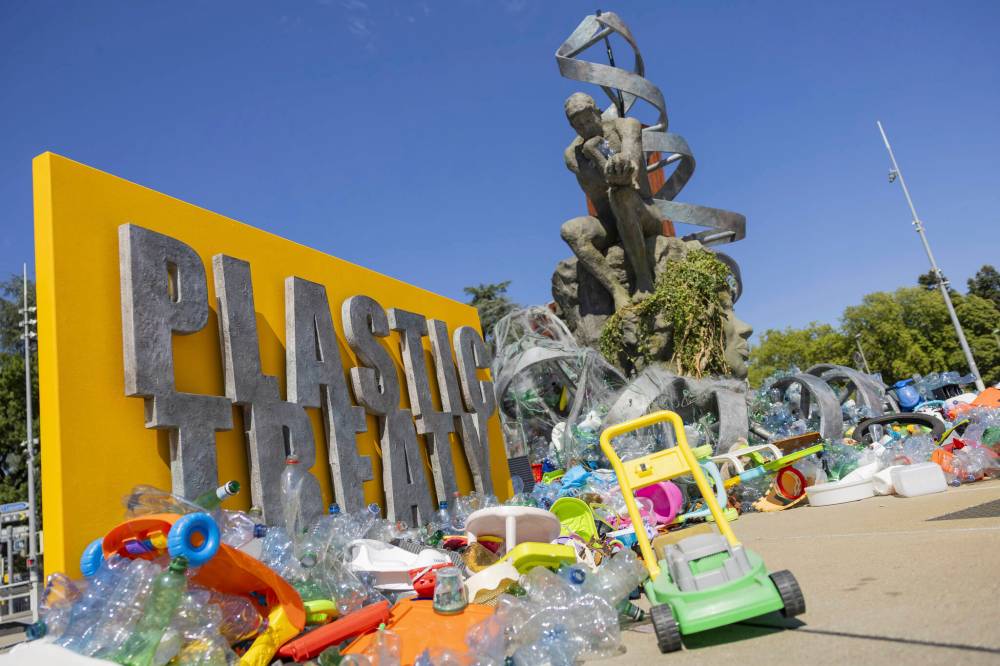
Plastic items are seen next to an artwork by Canadian artist and activist Benjamin Von Wong, titled “The Thinker’s Burden” created especially for the Plastics Treaty negotiations, on Place des Nations in front of the European headquarters of the United Nations in Geneva, Switzerland on Aug. 4 before the second segment of the fifth session of the Intergovernmental Negotiating Committee on Plastic Pollution. The talks failed bring a binding global treaty on plastic pollution. (The Associated Press)
Among these strategies, cleanup — recovering plastic waste from the environment — is often considered a lower priority compared to prevention at the source. Preventing plastic pollution is imperative, but we must not forget that plastic left in the environment does not disappear. It persists, accumulates, breaks apart into micro- and nanoplastics and continues to cause harm.
As long as we are producing plastics there will be leakage into the environment. As such, cleanup is needed to mitigate ecological, economic and social impacts of plastic pollution now and in the future.
SCALING UP CLEANUP SOLUTIONS
Cleanup efforts are most often carried out by hand through volunteers. These can range from a couple of people cleaning their local park or beach to large groups coming together for an event.
Cleanups remove millions of kilograms of trash from the environment each year. However, with plastic pollution becoming an ever-growing problem, we need to increase cleanup efforts by orders of magnitude.
International collaboration is necessary to tackle this global problem. At the University of Toronto Trash Team, we came together with Ocean Conservancy to found the International Trash Trap Network (ITTN), a global network of local groups working together to clean up plastic pollution using trash traps.
WHAT IS A TRASH TRAP?
Trash traps are technologies designed to clean up plastic waste from aquatic ecosystems. They range in design from simple river booms to roaming robots that clean beaches.
Trash traps are increasingly used to supplement manual cleanup efforts. They can work around the clock to target pollution, both on land and in waterways, cleaning areas that are unsafe or inaccessible for humans.
Some trash traps can also clean up small plastic waste, such as microplastics, that humans often miss as they are difficult to see.
With every trash trap program in the network, local stakeholders come together to clean up plastic waste, monitor local sources and pathways, engage and inform communities about the issue, and contribute to an open-source global cleanup database to inform and motivate upstream solutions to prevent plastic pollution.
The ITTN serves as a platform for anyone using a trash trap to share their local impact and facilitate knowledge exchange to motivate and empower global action to clean up, monitor and prevent plastic pollution.
BENEFITS OF CLEANUP EFFORTS
Although cleanup primarily addresses the symptoms of plastic pollution, it can address the root causes through its additional benefits. Citizen scientists have recorded data on the weight and count of items they collect during cleanup events. This is evident in the extensive datasets compiled by organizations such as Ocean Conservancy, which has logged 40 years of data from volunteer-led International Coastal Cleanup events.
Using this data, we can better understand local sources of pollution, identify prominent pollutants and prioritize specific solutions that will have the greatest impact. Policies to reduce single-use plastic consumption in Canada, and in U.S. states like California and Maryland, have been developed based on evidence from cleanup data.
Cleanup data collection is a means for developing baselines and to measure policy efficacy. In the United States, shoreline cleanup data was recently used to demonstrate that plastic bag policies significantly reduced the proportion of plastic bags in shoreline litter.
Cleanup also serves as a powerful platform for public communication about plastic pollution. A significant driver of our plastic pollution crisis is human behaviour. As such, we must also consider how public understanding and perception of plastic pollution affects behaviour change and support for policy change.
Bringing communities together to clean up and share information facilitates community engagement and inspires hope. What’s more, by allowing individuals to encounter the problems caused by plastic pollution firsthand, this experience often changes their perspective on the issue from being just another news story to a reality.
The hands-on nature of cleanup empowers communities to act, reduce the issue and motivates calls for social and policy change.
Although cleaning your local park, beach or waterway might seem like a small act, it is an important tool for reducing plastic pollution, increasing awareness and informing polices that have lasting impact.
By strategically increasing cleanup efforts, we can target areas of greatest impact, incite behavioural change, and collect and share monitoring data. This can inform baselines, trends over time, reduction targets and solutions for plastic pollution — reducing the harm of plastic pollution while we work locally and globally to prevent it.
» Chelsea Rochman is an assistant professor of ecology and evolutionary biology, University of Toronto. Britta Baechler is adjunct professor, Department of Physical & Environmental Sciences, University of Toronto. Hannah De Frond is a research scientist and International Trash Trap Network manager, University of Toronto. This column was originally published at The Conversation Canada: theconversation.com/ca.