
Child care is infrastructure, too
Advertisement
Read this article for free:
or
Already have an account? Log in here »
We need your support!
Local journalism needs your support!
As we navigate through unprecedented times, our journalists are working harder than ever to bring you the latest local updates to keep you safe and informed.
Now, more than ever, we need your support.
Starting at $15.99 plus taxes every four weeks you can access your Brandon Sun online and full access to all content as it appears on our website.
Subscribe Nowor call circulation directly at (204) 727-0527.
Your pledge helps to ensure we provide the news that matters most to your community!
To continue reading, please subscribe:
Add Brandon Sun access to your Free Press subscription for only an additional
$1 for the first 4 weeks*
- Enjoy unlimited reading on brandonsun.com
- Read the Brandon Sun E-Edition, our digital replica newspaper
*Your next Free Press subscription payment will increase by $1.00 and you will be charged $20.95 plus GST for four weeks. After four weeks, your payment will increase to $24.95 plus GST every four weeks.
Read unlimited articles for free today:
or
Already have an account? Log in here »
Hey there, time traveller!
This article was published 07/11/2025 (317 days ago), so information in it may no longer be current.
Why is Prime Minister Mark Carney’s budget pressing the pause button on early learning and child care?
Carney believes he is “protecting” the $10-a-day child-care program — but with its substantial shortages and unsatisfied families, staying still means going backwards.
The budget says Carney will continue the child-care funding that was already committed before he became prime minister — around $8 billion per year that extends federal transfers to provinces and territories for five years, mostly for operating funding, but about $150 million per year for the next couple of years for capital. It also notes more than 900,000 children benefit from the $10-a-day program so far.
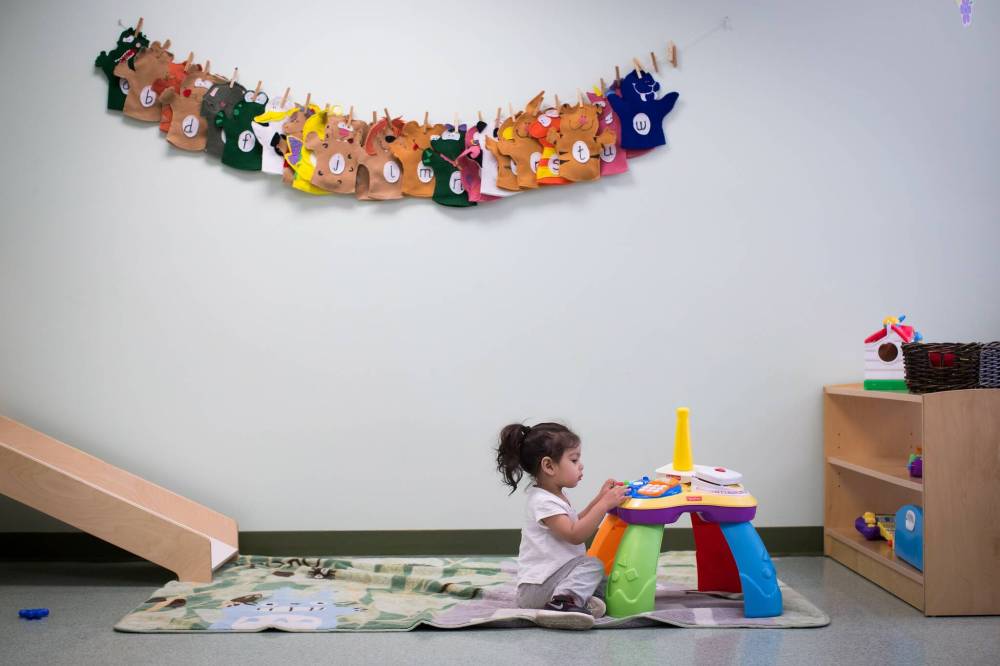
A young girl plays at a CEFA (Core Education and Fine Arts) early learning daycare franchise, in Langley, B.C. (The Canadian Press files)
However, the Liberal electoral platform promised 100,000 new spaces by 2031 on top of the 250,000 already promised by 2026. It also promised good wages for early educators, expansion of child care in public infrastructure and linking child care with housing developments that receive federal funds. None of this gets so much as a mention in the budget.
The Liberal platform also said the $10-a-day child-care program “has become a core part of Canada’s social infrastructure. We cannot let it be taken away or weakened.” But that may be what is happening.
ACCESS TO HIGH-QUALITY CARE
The goal of the federal government’s early learning and child-care program was “to ensure that all families have access to high-quality, affordable and inclusive early learning and child care no matter where they live.”
Canada is still a long way from that goal. True, there are more than 900,000 children currently in licensed child care at drastically reduced fees compared to 2021, and that is a big accomplishment.
But according to my analysis of Statistics Canada data from the 2023 Canadian Survey on Early Learning and Child Care, when looking at the number of children on waiting lists for child care outside Quebec, Canada needs about 278,000 more child-care spaces.
To take a different metric, if looking instead at the goal of providing spaces for 59 per cent of all children aged zero to five (written into a number of the federal-provincial child-care agreements), Canada would need about 384,000 more child-care spaces. Whichever way you look at it, Canada needs to invest a lot more in building child care to meet its goals.
Prior to the budget, larger provinces were already complaining that existing federal funding levels are too low to support existing spaces, let alone additional expansion or higher wages.
Canada’s Auditor General has also found that fewer than half of the spaces promised over the first five years have been created.
QUALITY OF EXPANSION MATTERS
This is a time of pivotal decisions for Canada in building its early learning and child-care system — and we should heed policy and outcome lessons from Quebec.
The Parti Québecois launched Quebec’s child-care program in 1997 and rapidly built up non-profit and family child-care capacity to provide $5-a-day child care to Quebecers. But when Liberal Jean Charest became premier, there were only spaces for about 50 per cent of children and waiting lists were long.
Charest invited in the private sector by providing parents with a tax credit to fund their child-care spending. That allowed for-profit operators to enter the market and charge whatever fee the market would bear.
Child-care capacity grew quickly, because parents were desperate for a space. But as Quebec’s auditor general found, the quality and staffing of these new centres were very poor.
RELYING ON FOR-PROFIT EXPANSION
Profit-making and good quality child care don’t really go together; the federal program takes this into account. So far, the federal government has insisted that the expansion of child care should take place predominantly in the non-profit, public and family child-care sectors.
But it hasn’t provided enough capital support for non-profits, so some provinces want to emulate Charest and rely mostly on for-profit expansion.
According to the 2021 federal budget, $10-a-day early learning and child care is “a plan to drive economic growth, secure women’s place in the workforce, and give every Canadian child the same head start.” These objectives would seem to align quite well with Carney’s budget priorities.
EMPLOYMENT RATES AFFECTED
Take mothers’ employment for instance. In Quebec, more than 85 per cent of mothers with children are employed. In Canada as a whole, that number is 79.2 per cent.
If Canada moved up to Quebec’s employment rate, there would be more than 220,000 additional women in the workforce, more money in families’ pockets and more tax money in federal and provincial coffers.
This is the same point Stephen Poloz, then the governor of the Bank of Canada, made back in 2018, arguing that if the rest of Canada mimicked Quebec’s child-care system, it could raise Canada’s potential output by tens of billions of dollars per year.
UNLOCK LOAN PROGRAM
What do I think Carney should do? If there isn’t enough funding for new agreements to be signed with provinces and territories, reduce the priority placed on continuing to lower fees for everyone.
The top priority right now should be improving access for those who are not yet served. Make capital money available for expanding non-profits.
Child-care expansion should be as high a priority for public capital investment as housing and other infrastructure. Unlock the $1-billion loan program promised in last year’s federal budget through Canada Mortgage and Housing Corporation for non-profit child care.
Manage waiting lists to make access more fair. Make sure low- and middle-income families gain access by ensuring them room on the waiting lists and making sure child-care subsidy systems are not cancelled. Encourage non-profit and public expansion on public lands. Encourage provinces and territories to at least match total federal dollars.
The prime minister should be inspired by the new mayor of New York City — universal child care is both popular and economically positive.
He needs to find some federal dollars for continued investment in early learning and child care.
» Gordon Cleveland is an associate professor emeritus in economics at the University of Toronto. This column was originally published at The Conversation Canada: theconversation.com/ca