
Trump’s peace deal would leave Ukraine vulnerable
Advertisement
Read this article for free:
or
Already have an account? Log in here »
We need your support!
Local journalism needs your support!
As we navigate through unprecedented times, our journalists are working harder than ever to bring you the latest local updates to keep you safe and informed.
Now, more than ever, we need your support.
Starting at $15.99 plus taxes every four weeks you can access your Brandon Sun online and full access to all content as it appears on our website.
Subscribe Nowor call circulation directly at (204) 727-0527.
Your pledge helps to ensure we provide the news that matters most to your community!
To continue reading, please subscribe:
Add Brandon Sun access to your Free Press subscription for only an additional
$1 for the first 4 weeks*
- Enjoy unlimited reading on brandonsun.com
- Read the Brandon Sun E-Edition, our digital replica newspaper
*Your next Free Press subscription payment will increase by $1.00 and you will be charged $20.95 plus GST for four weeks. After four weeks, your payment will increase to $24.95 plus GST every four weeks.
Read unlimited articles for free today:
or
Already have an account? Log in here »
Hey there, time traveller!
This article was published 07/12/2025 (229 days ago), so information in it may no longer be current.
United States President Donald Trump’s envoy, Steve Witkoff, and a key adviser to Russian President Vladimir Putin, Kirill Dmitriev, recently agreed to a 28-point peace plan to end the war in Ukraine.
Such an agreement, on the surface, would be cause for good news. The human toll of the conflict, although shrouded in secrecy by both Russia and Ukraine, is high.
Just one problem: the U.S. and Russia did not include Ukraine in the deliberations. Not only is that patronizing, no matter how the Trump administration has sought to spin it, but it means the agreement reflects Russian demands and goals for the war.
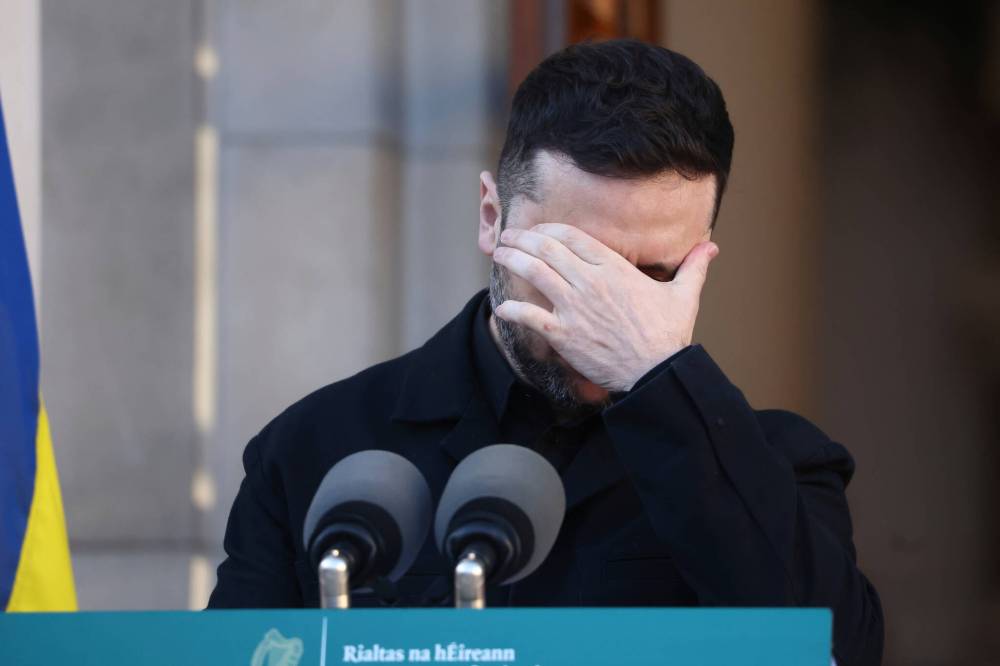
Ukraine’s President Volodymyr Zelenskyy reacts as during a joint news conference with the Irish Taoiseach Micheal Martin in Dublin, Ireland, on Dec. 2. (The Associated Press)
As such, not only is the deal a non-starter, but it also puts Ukraine in the unenviable position of saying no to a mercurial American president.
THE SEARCH FOR PEACE
Since Russia’s full-scale invasion of Ukraine in February 2022, there have been several initiatives seeking peace.
One of the earliest efforts took place in Turkey soon after the invasion. Despite Russia’s efforts to portray Ukraine’s withdrawal from the talks as being American-led, what ultimately scuttled the peace process were revelations of Russian atrocities in the Kyiv suburb of Bucha.
In the aftermath of this failure, both Russia and Ukraine reverted to pursuing their own goals for the conflict. For Ukraine, this meant the complete restoration of its territory from Russian occupation. Ukraine’s failed summer 2023 counter-offensive, however, dashed hopes for a quick victory.
Since this failure, both Ukraine and Russia have accepted that a war of out-manoeuvring one another for a rapid victory is unlikely. Instead, the war in Ukraine is now a protracted, attrition-based conflict.
In such a scenario, the role of outside support is critical. Ukraine has advocated for American participation in peace negotiations, but the talks leading to the 28-point peace plan signalled the Americans were siding with Russia and acceding to Russian demands.
Ukrainian officials have since met with both European and American officials to chart another path forward.
THE PLAN’S MANY PROBLEMS
Ukraine’s supporters have rightfully argued that the 28-point peace plan heavily favours Russia. The plan’s bias was so evident that U.S. Secretary of State Marco Rubio reportedly told senators it represented a Russian “wish list,” although he later denied saying that.
There are multiple provisions that make the deal unworkable from a Ukrainian perspective.
The first is that under the plan, Ukraine must cede all of Donetsk and Luhansk in the eastern reaches of the country to Russia. While Russia has seized Luhansk in its entirety, key portions of Donetsk remain under Ukrainian control.
Ukraine’s control of these parts of Donetsk goes beyond symbolic value. These areas consist of terrain and fortifications that are ideal for defensive operations. If Ukraine surrendered this territory to Russia, central Ukraine would be left vulnerable to rapid Russian assaults in the future.
ACCEPTING A BAD DEAL?
Ukrainian officials have struck a delicate balance since Trump announced his peace plan. If Ukrainian officials outright reject it, Trump will probably abandon Ukraine at a moment of need. If Ukraine fully acquiesces, it will be left vulnerable to future aggression. It’s also doubtful any officials who sign the Russia-friendly agreement will survive politically.
Ukrainian officials have consequently cultivated their ties with European officials while playing for time on the more contentious issues in the plan. Specifically, President Volodymyr Zelenskyy has said that the territorial aspects of the proposed agreement are the most troublesome.
Realistically, Ukraine isn’t likely to recover areas like Crimea. But Trump asking Ukrainian officials to surrender territory they have not yet lost in Donetsk is a bridge too far.
Unfortunately, Trump appears desperate to reach an agreement, regardless of the cost, judging by the people he has placed in charge of negotiating with Russia — Witkoff and Jared Kushner, the president’s son-in-law.
Witkoff and Kushner are most notably involved when Trump wants results, regardless of the consequence.
Since entering politics in Trump’s first term, Witkoff has been an apologist for Russia and its actions. This stance has not changed in Trump’s second term. In fact, it appears Witkoff coached Russia on how to ingratiate itself to Trump, seemingly placing Russian interests above American.
Kushner’s past diplomacy efforts appear to have enriched him personally, something that does not bode well for the required neutral stance in Russia-Ukraine talks.
A LOST MOMENT
Unfortunately for Ukraine, these peace plan complications could not come at a worse time for their war efforts. While Russia pummels Ukrainian cities and is claiming it’s seized the city of Pokrovsk in eastern Ukraine, Ukrainians are simultaneously making sustained attacks on the Russian energy industry.
Direct disruption of Russian energy is perhaps the one area where Ukrainian pressure could affect Putin’s war efforts.
Trump’s attempts to achieve a peace deal at any cost, however, could scuttle any Ukrainian breakthroughs.
» James Horncastle is and assistant professor and Edward and Emily McWhinney Professor in International Relations at Simon Fraser University. This column was originally published at The Conversation Canada: theconversation.com/ca.