
Governments can do more to address affordability anxiety
Advertisement
Read this article for free:
or
Already have an account? Log in here »
We need your support!
Local journalism needs your support!
As we navigate through unprecedented times, our journalists are working harder than ever to bring you the latest local updates to keep you safe and informed.
Now, more than ever, we need your support.
Starting at $15.99 plus taxes every four weeks you can access your Brandon Sun online and full access to all content as it appears on our website.
Subscribe Nowor call circulation directly at (204) 727-0527.
Your pledge helps to ensure we provide the news that matters most to your community!
To continue reading, please subscribe:
Add Brandon Sun access to your Free Press subscription for only an additional
$1 for the first 4 weeks*
- Enjoy unlimited reading on brandonsun.com
- Read the Brandon Sun E-Edition, our digital replica newspaper
*Your next Free Press subscription payment will increase by $1.00 and you will be charged $20.95 plus GST for four weeks. After four weeks, your payment will increase to $24.95 plus GST every four weeks.
Read unlimited articles for free today:
or
Already have an account? Log in here »
When people who haven’t seen or spoken to each other in a while cross paths, the conversation often begins with questions such as, “How have you been?” or “How is the family?” or “What are you up to these days?”
Recently, I’ve noticed some other questions that seem to pop up in the conversation: “How high is your water bill these days?” and “How much have your property taxes gone up?” and “How much are you paying for groceries these days?”
The questions, and the answers they elicit, reflect the concern that many of us are feeling about the rising cost of so many things, our ability to pay those higher prices, and whether the situation will ever get better. It points to the fact that many among us fear they are approaching their financial breaking point, unable to afford even the necessities of life.
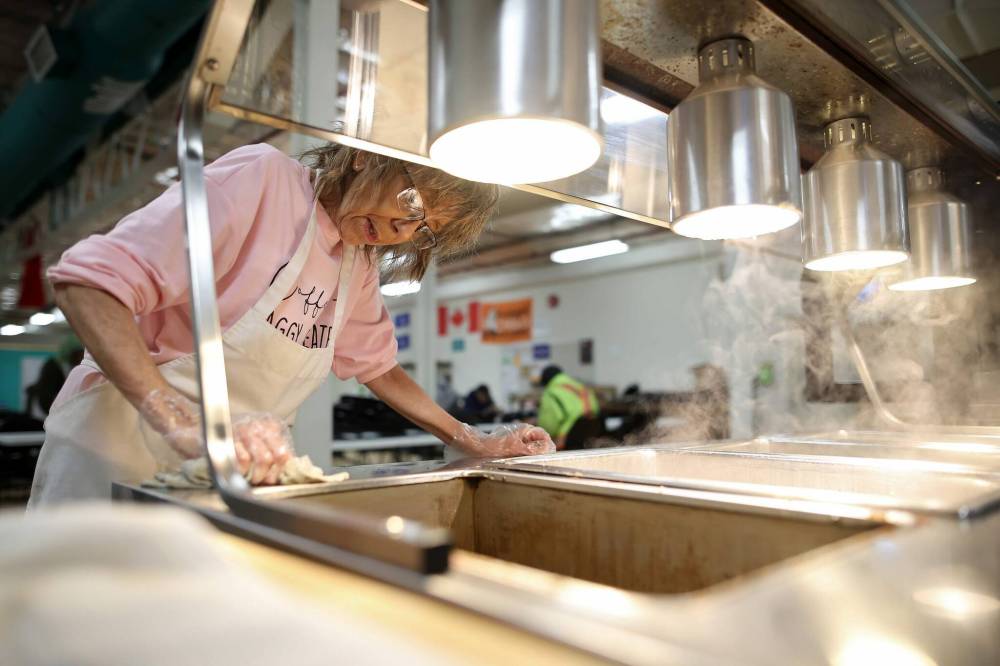
Volunteer Lauree Hampton cleans after serving lunch at Helping Hands Centre of Brandon, Inc. The soup kitchen has served more than 51,000 meals this year, up from 46,000 in 2024, reflecting the community’s growing food insecurity. (Tim Smith/The Brandon Sun)
That is the rate-shock reality here in Brandon, where property owners are struggling with dramatically higher water bills and property taxes — and the likelihood of even higher taxes and water bills in 2026 — combined with higher prices for so many other items.
Brandonites are not alone in their anxiety. A poll released by Nanos Research this week revealed that 42.5 per cent of Canadians identify grocery prices as their main financial concern heading into 2026, with another 37.5 per cent listing it as their second-ranked concern. Here on the Prairies, the level of concern regarding increased grocery bills is even higher, with 50.1 per cent of respondents pointing to it as their top worry.
As if that isn’t enough, the Nanos poll also found that housing costs were the primary concern of almost 17 per cent of respondents and were ranked second by another 34 per cent. That adds up to more than half of the population worried about the cost of housing.
In addition to the Nanos poll numbers, a poll released by the Angus Reid organization this week found that 36 per cent of Canadians say they are worse off financially this year than last year, while 25 per cent believe they will be worse off next year.
That poll also found that 44 per cent of households earning less than $100,000 annually are finding it either difficult or very difficult to feed their families. For families earning under $50,000 each year, the percentage is even higher, at 52 per cent.
Finally, a poll released last week by Abacus Data revealed that “Financially, a majority (54 per cent) say they are nearing a personal tipping point — and 10 per cent say they have already crossed it. Young Canadians, low-income households and those experiencing extreme precarity are especially likely to report they are at or near crisis … 48 per cent say they are barely hanging on.”
Those of you who have studied psychology will likely recall that Abraham Maslow’s “hierarchy of needs” identifies food and shelter as two of the most fundamental needs of every human being, more important than safety, love, belonging and self-esteem. And yet, in a country as wealthy as Canada, we are seeing a terrifying — and potentially growing — percentage of citizens who worry about their ability to afford even the most basic of necessities.
That no doubt explains why record levels of Canadians are now forced to rely on food banks in their communities to feed themselves and their families, including here in Brandon. It also explains the general fatigue and anxiety that many Canadians are feeling about their current situation, and the fear they feel for their future.
It’s a bleak situation, and it’s fair to ask what our elected representatives are doing to address it.
The Kinew government deserves credit for attempting to ban measures that restrict or prevent the use of land for a grocery store or supermarket, but it can do a lot more to address anti-competitive business behaviour that is making life less affordable for Manitobans.
For example, there are many other commercial properties that have been left to sit vacant rather than be occupied by a business competitor, including shuttered bank and credit union branches, closed gas stations and numerous retail spaces. The province could enact legislation that prohibits contracts and/or conduct that keeps competitors out of those properties.
Beyond that, a large portion of affordability anxiety among Manitobans is being caused by higher property taxes (both city and school) and water bills. That concern can be reduced by the province providing a fairer, more adequate level of funding for local governments and school divisions.
Local governments, including the City of Brandon, could also do more to address commercial properties that are closed for long-extended periods of time for no valid reason. Just as many local governments are passing bylaws aimed at derelict housing properties, local governments could also be implementing measures and penalties to prevent commercial properties from sitting empty.
Finally, both levels of government could be doing a better job of ensuring that Manitobans are getting better value for their tax dollars. The politicians keep telling us they are running “lean” governments, but there is plenty of evidence to the contrary. It’s time for our governments to work harder to deliver better services at a lower cost, and use those savings to lessen our tax burden.
If governments took those steps, it wouldn’t solve the affordability problem, but it would help to reduce the anxiety it is causing for so many of us.