
No sign of deficit management in second-quarter fiscal report
Advertisement
Read this article for free:
or
Already have an account? Log in here »
We need your support!
Local journalism needs your support!
As we navigate through unprecedented times, our journalists are working harder than ever to bring you the latest local updates to keep you safe and informed.
Now, more than ever, we need your support.
Starting at $15.99 plus taxes every four weeks you can access your Brandon Sun online and full access to all content as it appears on our website.
Subscribe Nowor call circulation directly at (204) 727-0527.
Your pledge helps to ensure we provide the news that matters most to your community!
To continue reading, please subscribe:
Add Brandon Sun access to your Free Press subscription for only an additional
$1 for the first 4 weeks*
*Your next subscription payment will increase by $1.00 and you will be charged $20.00 plus GST for four weeks. After four weeks, your payment will increase to $24.00 plus GST every four weeks.
Read unlimited articles for free today:
or
Already have an account? Log in here »
Manitoba’s latest fiscal update should have landed like a cold splash of water. Instead, it was greeted with a familiar shrug, excuses and the usual political rhetoric from the Kinew government.
On Monday, the NDP government revealed the province is now expected to post a deficit of just over $1.6 billion this year, more than twice what was projected in the spring budget.
That is not a minor mid-year wobble. It is a serious deterioration in the province’s finances, and it exposes a deeper problem than wildfires or droughts alone.
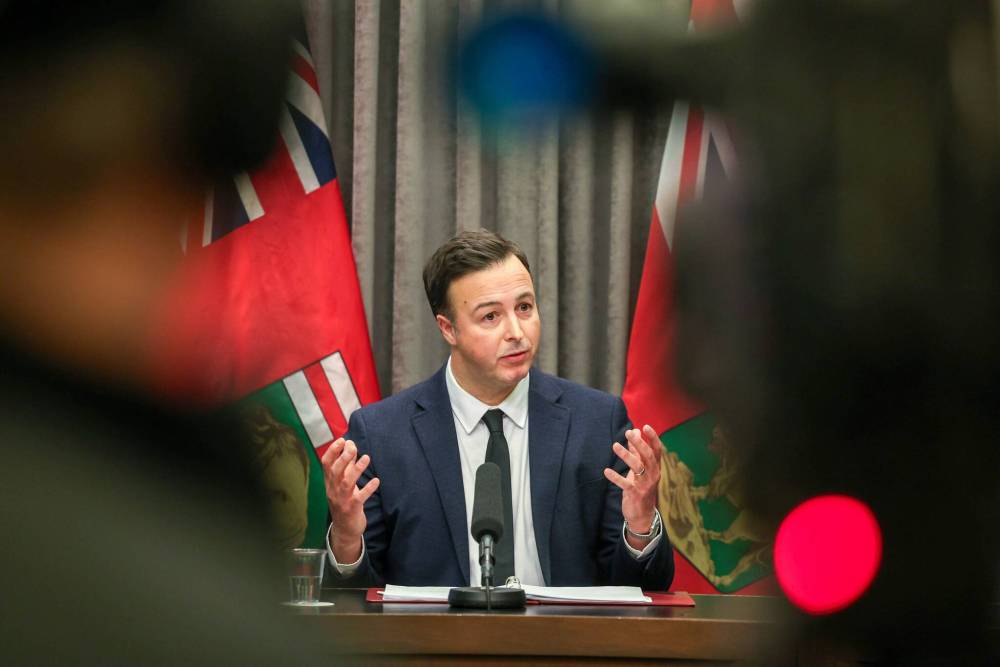
Finance Minister Adrien Sala (Ruth Bonneville/Winnipeg Free Press files)
Yes, those factors matter. But the second-quarter numbers also show a government that appears unwilling — or unable — to adjust its spending as circumstances change. And that is where fiscal management starts to look less like bad luck and more like neglect.
The second-quarter report for 2025-26, released Monday, shows the province now forecasting a deficit of $1.661 billion. That is $867 million worse than Budget 2025 projected just a few months ago.
The government is right about one thing: extraordinary events drove much of the increase. Manitoba experienced one of the worst wildfire seasons on record in 2025, incurring more than $370 million in additional costs related to fire suppression and supporting evacuees.
At the same time, drought conditions have hammered Manitoba Hydro. As of the end of the second quarter, water flows were projected to be near levels last seen in 1988-89 — the second lowest on record. The result is a projected net loss of $464 million at Hydro this year, a negative variance of $684 million compared to the budget.
Those are not trivial pressures. Any government would struggle to absorb them.
But here is the inconvenient detail buried in the report: even after excluding wildfire costs, Manitoba is still staring at a projected deficit of $1.437 billion. That should raise eyebrows. It means the province’s fiscal problem is not just about fires and drought. It is also about what the government chose not to do once it became clear those costs were spiralling.
Budgeting does not end the day a spring budget is tabled. It is supposed to be an ongoing process, with governments adjusting spending and priorities as revenues rise or fall and unexpected costs emerge.
When the economy slows and revenues come in lower than expected, spending should be reassessed. When emergencies blow holes in the budget, governments are expected to find savings elsewhere to limit the damage.
The second-quarter numbers offer little evidence that is happening in Manitoba.
Spending continues to rise, even as economic growth slows and revenues soften. Tariffs, trade uncertainty and risks associated with wildfires have reduced Manitoba’s projected GDP growth for 2025-26 from 1.7 per cent to 1.1 per cent.
A slower economy means weaker revenue growth, yet there is no corresponding signal of restraint on the spending side.
The most obvious place to look is bureaucratic spending, particularly in health care.
This is not an argument for cutting front-line services, which remain under strain.
But administrative and back-office costs have grown steadily for years, and meaningful efforts to rein them in have been notably absent. If ever there were a time to slow that growth, this would be it.
Instead, the impression left by the second-quarter update is that spending largely continued on autopilot, even as fiscal conditions deteriorated.
The longer-term implications are also troubling. Net debt is now forecast to be $1.56 billion higher than projected in the 2025 budget.
As a result, Manitoba’s net debt-to-GDP ratio is expected to rise to 38.2 per cent in 2025-26, up from the 36.9 per cent forecast in the spring. Higher debt reduces flexibility, increases borrowing costs and leaves less room to respond when the next crisis inevitably arrives.
Eventually, growing debt attracts the ire of credit-rating agencies. If Manitoba is not careful, it could get hit with a credit-rating downgrade (as it did under a previous NDP government over a decade ago). That would further increase the cost of borrowing.
The economic outlook does little to ease those concerns. The Conference Board of Canada’s five-year provincial outlook, released earlier this month, forecasts a decline in business investment in Manitoba, driven largely by reduced spending on machinery and equipment.
None of this is to deny the reality of wildfires or drought. Manitobans understand those events come with enormous costs. What they should also expect is evidence their government is actively managing the fallout — by restraining spending where possible, reprioritizing programs and making tough decisions rather than letting deficits balloon.
The second-quarter report suggests that kind of fiscal management has been virtually non-existent.
» Tom Brodbeck is a Winnipeg Free Press columnist.