
Poilievre key to Liberal hopes
Advertisement
Read this article for free:
or
Already have an account? Log in here »
We need your support!
Local journalism needs your support!
As we navigate through unprecedented times, our journalists are working harder than ever to bring you the latest local updates to keep you safe and informed.
Now, more than ever, we need your support.
Starting at $15.99 plus taxes every four weeks you can access your Brandon Sun online and full access to all content as it appears on our website.
Subscribe Nowor call circulation directly at (204) 727-0527.
Your pledge helps to ensure we provide the news that matters most to your community!
To continue reading, please subscribe:
Add Brandon Sun access to your Free Press subscription for only an additional
$1 for the first 4 weeks*
*Your next subscription payment will increase by $1.00 and you will be charged $20.00 plus GST for four weeks. After four weeks, your payment will increase to $24.00 plus GST every four weeks.
Read unlimited articles for free today:
or
Already have an account? Log in here »
If a federal election were held today, the Liberal Party would likely win to form another minority government, but with a reduced number of seats. That’s the current projection by the respected 338canada.com website, which has a solid track record for political prognostication.
Based on the results of several polls over the past few weeks, the website projects that the Liberals would win 156 seats, a 15-seat drop from the 171 seats it currently holds, while Conservatives would win 142 seats, which is the same number of seats they currently hold.
Under that same projection, the Bloc Québécois would increase its seat count to 31 from its current 22, while the NDP would increase from seven to 12. The Green Party would double its seat total, from one to two.
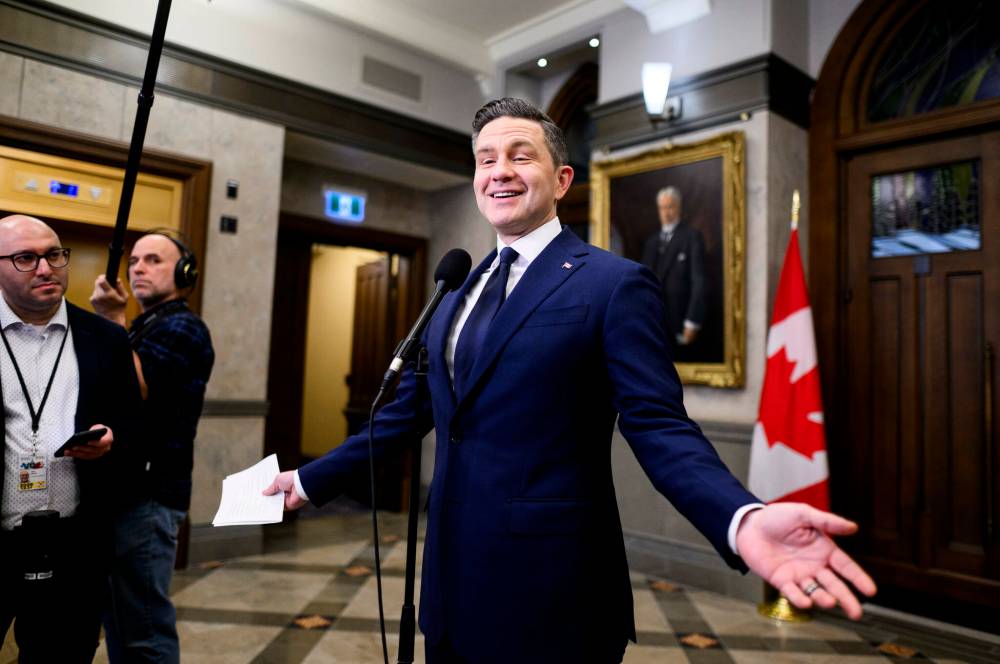
Federal Conservative Leader Pierre Poilievre speaks in the Foyer of the House of Commons on Parliament Hill in Ottawa last month. (The Canadian Press files)
Those projections likely surprise many Canadians, given the widespread perception that Prime Minister Mark Carney is doing a good job as PM. The reality, however, is that most polls have found the Liberals and Conservatives to be basically tied in voter support — within the margin of error for each of those polls — since October.
For example, a Nanos Research poll released this past Tuesday found that the Liberals were holding a slim lead over the Conservatives, by a 38.4 to 34.7 difference. The margin of error for that poll, however, was three per cent, which means the parties could be tied, or even that the Tories are actually leading.
That same poll found that 48.6 per cent of respondents prefer Carney as Canada’s PM, compared to just 27.6 per cent who prefer Conservative Leader Pierre Poilievre for the job.
Those numbers lead to an obvious question: How can the two parties be effectively tied for voter support, with the Liberals likely to lose seats if an election were held now, when many of those same voters prefer Carney for PM over Poilievre?
There are several components to the answer, beginning with the fact that the Liberals have been in power for more than a decade and a significant number of voters believe it’s time for a different party to lead the country for a while.
Call it Liberal fatigue if you will, but many Canadians don’t see a lot of differences in the two parties’ policies. To them, the Liberal-Tory contest is basically a Coke versus Pepsi choice, and they want to try the alternative.
Second, support for the Conservatives has been solidly at 30 per cent or higher for the past number of years. In the 2021 federal election, for example, the Tories received 33.74 per cent of all votes cast across the country — more than the 32.62 per cent received by the Liberals.
The support the Tories have now is only marginally higher than it was five years ago, which confirms that the party has a very loyal, committed base of supporters. The Liberals, on the other hand, are still carrying baggage from the Trudeau years and that is likely costing them some support.
That leads to an important, yet obvious third point: Mark Carney is much more popular than his party, while Poilievre continues to be much less popular than his party. That means that Carney’s presence as Liberal leader is likely winning the party support it wouldn’t otherwise have.
Conversely, Poilievre’s relative unpopularity is costing his party votes. That is costing them some seats, while putting a number of what should be safe Tory seats at risk.
If a different, more likeable person was Conservative leader — someone like Rona Ambrose, for example — the Tories likely would have a huge lead in the polls. The fact they are trailing the Liberals, however, is almost entirely because more than seven in 10 Canadians don’t want Poilievre to be their prime minister.
Those factors lead to two important points. First, the current polling data and projections explain why the Liberals are rumoured to be pushing hard to convince more MPs from other parties to cross the floor of the House of Commons and join the Liberal caucus. Adding a few more MPs that way is a far easier path to a majority, delaying the risk, hassle and cost of an election until at least 2029.
Beyond that point, the current poll numbers also explain why it is a mistake for Liberal supporters to be hoping for Poilievre’s removal as Conservative Party leader at the CPC convention that will be held at the end of this month. That’s because his continued role as Tory leader gives the Liberals their best chance of winning the next election.
Conversely, why would Conservatives be fighting to retain Poilievre as party leader when there is clear evidence that he gives the Liberals their best hope of winning the next election? Poilievre loyalists may believe he has earned the right to lead the party into the next election, but ordinary Canadians — the people who decide elections — clearly disagree.
With all of that in mind, it will be fascinating to watch Poilievre fight for his survival as Conservative leader, when it should be obvious to his party’s members that he is the biggest obstacle preventing them from winning the next election.