
Why strength training matters — at any age
Advertisement
Read this article for free:
or
Already have an account? Log in here »
We need your support!
Local journalism needs your support!
As we navigate through unprecedented times, our journalists are working harder than ever to bring you the latest local updates to keep you safe and informed.
Now, more than ever, we need your support.
Starting at $15.99 plus taxes every four weeks you can access your Brandon Sun online and full access to all content as it appears on our website.
Subscribe Nowor call circulation directly at (204) 727-0527.
Your pledge helps to ensure we provide the news that matters most to your community!
To continue reading, please subscribe:
Add Brandon Sun access to your Free Press subscription for only an additional
$1 for the first 4 weeks*
*Your next subscription payment will increase by $1.00 and you will be charged $20.00 plus GST for four weeks. After four weeks, your payment will increase to $24.00 plus GST every four weeks.
Read unlimited articles for free today:
or
Already have an account? Log in here »
Getting out of a chair shouldn’t be a struggle. Yet for many older adults, simple everyday movements like this become increasingly difficult as our muscles break down and weaken with age, a process called sarcopenia. The consequences build quietly: trouble climbing stairs, more hospital visits and, eventually, losing the ability to live independently.
The encouraging news is that you do not need long workouts or heavy training to push back. Even modest amounts of strength training can meaningfully preserve muscle and maintain your ability to move with confidence.
Building a buffer
Being hospitalized or immobilized for short periods of time can have profound consequences for our muscles. During these short (around five days) and sometimes longer periods of inactivity and immobilization, we lose muscle and get weaker.
The bad news is that it’s hard to get that muscle and strength back, particularly as we age. Therefore, prevention is always better than a cure. However, sometimes accidents or illnesses just can’t be avoided. This is why we need to create a bit of a buffer or “muscle savings account.”
Here’s an uncomfortable truth: you will lose muscle during periods of immobilization, whether from illness, surgery or injury. The loss is inevitable. What’s not inevitable is whether you can afford that loss. If you’re already low on muscle mass, losing even a small amount can push you over the edge from independence to dependence. The same loss that barely affects someone with a larger amount of muscle can leave someone with less muscle unable to function independently.
This matters especially as we age, because older adults don’t bounce back the way younger people do. A 20-year-old loses muscle in the hospital and regains it within weeks. A 70-year-old might never get it back. That’s why building a buffer shouldn’t be thought of as optional; it’s essential insurance for your future independence.
Here’s how age-related muscle loss typically unfolds: it’s not a gentle slope but a staircase going down step by step. You’re stable for months or years, then something happens — a fall, a surgery, pneumonia — and you drop to a new, lower level. Then another incident, another drop. Each time you lose muscle, and never fully regain it.
Maybe you’ve seen this in your own family. “Everything changed after that fall.” “Dad was never the same after his knee surgery.” These stories share a common thread: insufficient muscle reserves meeting an inevitable health challenge.
The good news? This trajectory isn’t set in stone. The muscle you build now determines whether future setbacks become temporary obstacles or permanent limitations.
Maintaining strength
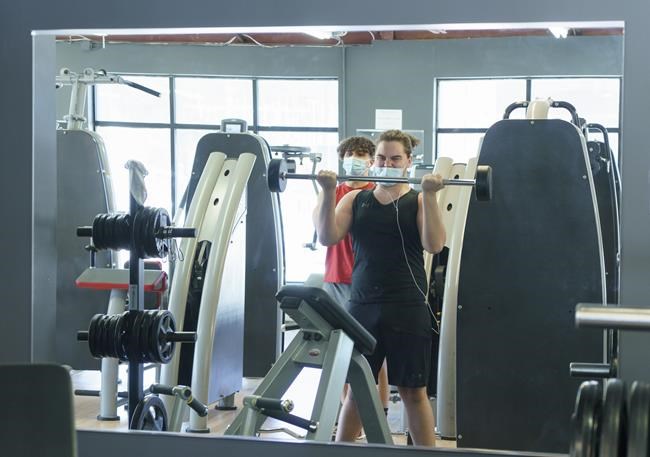
Physical activity, specifically strength training, is key to maintaining and increasing muscle mass and strength. Strength training refers to lifting weights, either dumbbells, workout machines or resistance bands.
Remaining physically active (walking, gardening and the like) as we age is crucial for our heart and brain health, and helps prevent the development of Type 2 diabetes. However, there are some unique and specific benefits to strength training.
Moving weights and other types of resistance training emphasizes the development of power and strength, which are crucial in daily activities like climbing stairs or lifting a heavy bag of groceries, and in reducing fall risk. Resistance training is irreplaceable in this respect.
Despite this, only 42 per cent of Canadians over age 65 follow strength training guidelines, a gap that leaves many vulnerable to the muscle loss that can make daily activities a struggle.
Heavy vs. lighter weights: can a little be enough?
Some people may be thinking, “Lifting heavy weights in a gym full of muscular young folks is just not for me, thanks.” But what if you don’t need to lift heavy weights to maintain or even gain muscle?
Our research and that of others consistently demonstrates that you don’t have to lift heavy weights to gain muscle and strength. Heavier weights offer a slight advantage for strength gains, but lighter weights work remarkably well, enough to make a real difference in your daily life.
A good indicator to know if a weight is heavy enough, is to see if you are fatigued after 20-25 repetitions. If you can do more than 25 repetitions, you should probably go slightly heavier in weights. This weight will be different from person to person and from time to time.
Here’s encouraging news: Stuart Phillips’ exercise metabolism research group at McMaster University found that one weekly session of lighter-weight strength training builds both muscle and strength.
Yes, more sessions produce faster results, but the most important threshold isn’t between adequate and excellent; it’s between zero and one. A single weekly workout shifts you from declining muscle mass to actually gaining ground, building the buffer that safeguards independence as you age.
Keep in mind that a range of 20-25 repetitions is most likely an ideal range for lighter weight strength training. Anything lower than that might not have the same beneficial effects.
To maximize gains with lighter weights, you’ll eventually want to train to voluntary failure, which means until you physically can no longer complete the exercise with appropriate form.
But here’s what beginners need to hear: don’t worry about that just yet. Your first workout doesn’t need to be perfect or exhausting. It just needs to happen. As you build confidence and consistency, you can push harder. And making that first workout happen can be easier than you think. A basic set of dumbbells or resistance bands means you can begin today, at home, without a gym membership or intimidating equipment.
The bottom line is simple. One strength session per week beats zero. Lighter weights beat no weights. Starting imperfectly beats never starting at all. The muscle buffer you build now, however gradually, is insurance against the loss that comes with age and illness. Your future self, still climbing stairs and carrying groceries independently, will thank you for beginning today.
» Tom Janssen is a PhD candidate at McMaster University. Matthew Lees is a postdoctoral fellow in the department of kinesiology at McMaster University. This column was originally published at The Conversation Canada: theconversation.com/ca