
Separatism harder than it sounds
Advertisement
Read this article for free:
or
Already have an account? Log in here »
We need your support!
Local journalism needs your support!
As we navigate through unprecedented times, our journalists are working harder than ever to bring you the latest local updates to keep you safe and informed.
Now, more than ever, we need your support.
Starting at $15.99 plus taxes every four weeks you can access your Brandon Sun online and full access to all content as it appears on our website.
Subscribe Nowor call circulation directly at (204) 727-0527.
Your pledge helps to ensure we provide the news that matters most to your community!
To continue reading, please subscribe:
Add Brandon Sun access to your Free Press subscription for only an additional
$1 for the first 4 weeks*
- Enjoy unlimited reading on brandonsun.com
- Read the Brandon Sun E-Edition, our digital replica newspaper
*Your next Free Press subscription payment will increase by $1.00 and you will be charged $20.95 plus GST for four weeks. After four weeks, your payment will increase to $24.95 plus GST every four weeks.
Read unlimited articles for free today:
or
Already have an account? Log in here »
Over the past several days, in response to the horrible events that are unfolding in Minnesota, a growing number of posts have appeared on social media from people claiming to be Minnesotans, asking if they can visit Canada for a few days of peace, or even move here.
More recently, there have been posts suggesting Minnesota should leave the U.S. and become part of Canada. In fact, there was a newspaper cartoon posted on social media websites two days ago that showed a map with Minnesota being part of Canada.
It would be easy to write a column suggesting, in a mostly tongue-in-cheek way, that the governments of Manitoba and Ontario should reach out to Minnesotans and their state government, and formally invite the state to become part of Canada.
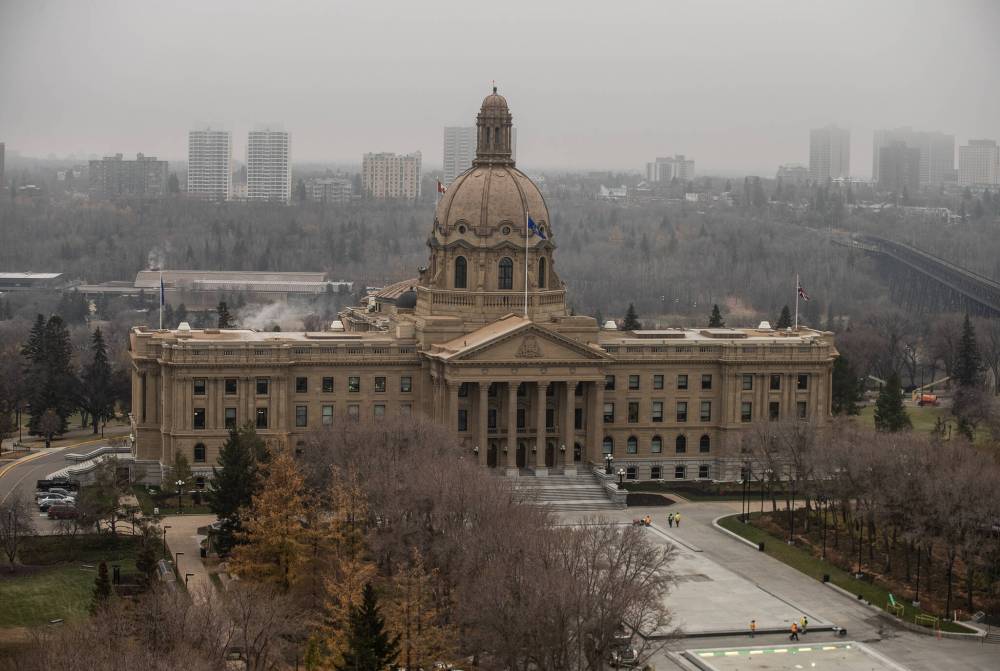
The Alberta legislature in Edmonton is shown in October 2024. (The Canadian Press files)
You could argue that adding Minnesota as Canada’s 11th province would be great for Canada. We would get billions of dollars in annual economic activity, another port, an NFL team, another NHL team, the Mayo Clinic, several great cities and the head offices of numerous international corporations.
You could also suggest that high-profile, highly publicized efforts to make Minnesota Canadian would be a fair, one-fingered response to months of statements by U.S. President Donald Trump and his supporters that Canada should become America’s 51st state.
You could also suggest that the majority of citizens in several other states — California, Oregon, Washington, New Hampshire, Vermont and Maine in particular — might also be interested in getting away from the Trump craziness by becoming part of Canada.
You could do all of that, but it would only be adding to the misinformation and confusion that is already out there. Even worse, you would be creating unrealistic hopes and expectations among frustrated and/or fearful Americans.
The hard reality is that there is no realistic path for any state to unilaterally decide to leave the U.S., let alone join Canada. The U.S. Constitution includes neither a mechanism for a state to secede, nor a provision for a single state to become an autonomous nation within the United States. Basically, you’re stuck.
In other words, Americans can’t just hold a referendum or pass a law in their state and suddenly become Canadians. The last time states attempted to leave the U.S., the result was a civil war that caused the deaths of approximately 700,000 soldiers and countless civilians.
Even if Minnesota wanted to become part of Canada, and there were no American impediments preventing it from doing so, there would still be a lengthy process to be navigated in Canada before it could become a Canadian province.
An amendment to the Canadian constitution would be required, and that would need the approval of the federal Parliament and at least seven of the 10 provinces representing, in total, more than half of Canada’s population. If successful, that would then be followed by formal negotiations to specify the new province’s rights and obligations. The entire process would likely take years to complete, with Minnesotans stuck in some form of political limbo during all that time.
Given that reality, the prospect of one or more U.S. states becoming Canadian provinces should be seen as an impossible pipe dream. There are too many barriers preventing it from happening, and we should not be encouraging Canadians and/or Americans to think otherwise.
Here in Canada, as in the U.S., a province cannot unilaterally separate. Rather, there is a multi-stage process that must be followed, beginning with a clear expression by citizens of that province of their desire to separate. That “expression” would most likely be done via a referendum in which the question must be clear and unambiguous.
If such a referendum received majority support in the province, that would then trigger negotiations between the federal government, the provincial governments and likely Indigenous groups as well, on a range of critical issues. Those issues would include the division of assets and liabilities, any changes to the borders of the province, the rights, interests and territorial claims of Indigenous peoples, as well as the protection of minority rights.
If those negotiations eventually yield an agreement, a constitutional amendment would then be required to ultimately approve the separation. That amendment would only become effective, however, after receiving the approval of Parliament and seven provinces that together compromise more than 50 per cent of the nation’s population.
With all of those stages in mind, it is obvious that no province can simply walk away from Canada without first going through a years-long process, and there is no guarantee that the proposed separation will ultimately be authorized.
Those are the spin-free facts, without any of the ill-willed spin and disinformation we see so much of these days. It means that a small minority of Albertans and Quebecers may long for their respective provinces to become independent nations, but it would be a very steep climb for that to ever happen.
Similarly, if Americans have had enough of the turmoil created by the Trump administration, having their respective states join Canada or any other nation is not a realistic, plausible option available to them. If they don’t like what’s happening in their country, the place for them to fix that problem is the ballot booth.