
Police body-worn cameras and Brandon’s 2026 budget
Advertisement
Read this article for free:
or
Already have an account? Log in here »
We need your support!
Local journalism needs your support!
As we navigate through unprecedented times, our journalists are working harder than ever to bring you the latest local updates to keep you safe and informed.
Now, more than ever, we need your support.
Starting at $15.99 plus taxes every four weeks you can access your Brandon Sun online and full access to all content as it appears on our website.
Subscribe Nowor call circulation directly at (204) 727-0527.
Your pledge helps to ensure we provide the news that matters most to your community!
To continue reading, please subscribe:
Add Brandon Sun access to your Free Press subscription for only an additional
$1 for the first 4 weeks*
*Your next subscription payment will increase by $1.00 and you will be charged $20.00 plus GST for four weeks. After four weeks, your payment will increase to $24.00 plus GST every four weeks.
Read unlimited articles for free today:
or
Already have an account? Log in here »
The City of Brandon will hold a special council meeting on Monday to discuss the proposed 2026 municipal budget. According to the city, one of the “major” proposed investments concerns the “implementation of police body cameras.”
The public has been invited to provide feedback to the proposed budget. Residents can either meet informally with the mayor and council and city administration in the city hall foyer to discuss their concerns and/or register to formally present to city council.
The Brandon Police Service is asking the city to approve an additional $1.3 million in funding.
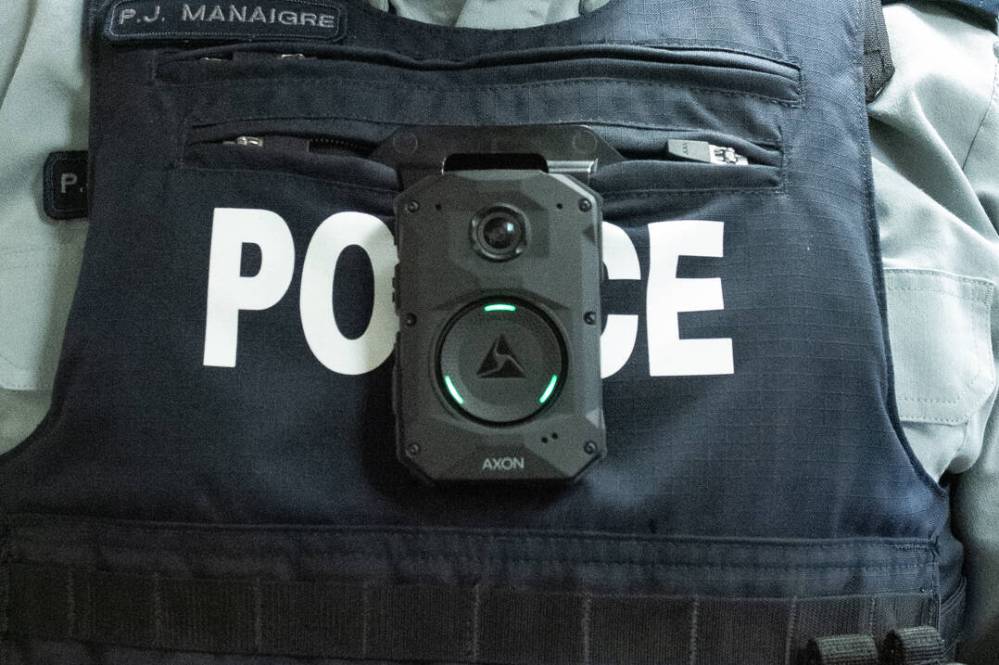
Sgt. Paul Manaigre, media relations officer with D Division, wears one of the body cameras the RCMP have deployed across Manitoba in this 2024 photo. Brandon University professor Christopher J. Schneider writes that Brandonites should voice any concerns about the Brandon Police Service's body-camera program during the city's budget process. (Svetlana Mlinarevic/The Carillon files)
Regarding the implementation of Brandon’s body-camera program, there are some matters that the public should consider and perhaps discuss with city officials.
Much of the increase in proposed funding to the Brandon Police Service is attributed to costs directly associated with the creation of a digital evidence management system for the storage and handling of body-camera footage.
It is near certain that Axon Enterprises will receive the contract, having been awarded contracts with a number of Canadian police agencies including the RCMP and Toronto Police Service. Axon is an American company that has far-reaching control over digital technology in policing, with near complete control over the global body-camera market. In our politically volatile climate, there are additional concerns that our policing and justice system is being monopolized by a single American company.
Axon is a publicly traded company and as such is motivated by sales and profits for its shareholders. Central to Axon’s plans to maintain market control and profitability is its Evidence.com platform, a cloud-based digital evidence management system that works on a subscription model, much like a cellphone provider.
A significant concern over such market domination is Axon’s ability to raise prices, which can lead to increased police budgets in times of austerity.
Will Brandonites who will subsidize Brandon’s body-camera program be provided with the opportunity to agree to the terms and conditions offered, subscription options, duration period, etc., of a proposed digital evidence management system that a potential service provider may offer to the Brandon Police Service?
Having the public consent to the terms of a digital evidence management system contract would be both transparent and democratic but would also give a clearer sense of annual operating costs and some but not all the anticipated increases in the Brandon Police Service budget moving forward. A relative unknown is the hiring of more staff to manage digital evidence as operational needs expand and body-camera recordings increase.
The Brandon Police Service funding request presently includes three additional staff members for its proposed digital evidence management system. However, it is uncertain if three positions will be enough in the long term. Several police agencies in the U.S. have had to hire additional personnel to maintain their body-camera programs leading to unanticipated costs.
Recurring software purchases are another issue. Consider a 2024 Calgary Police Service (CPS) body-worn camera evaluation report that offered dozens of recommendations “with varying financial implications,” stressing that “some recommendations, such as software purchases, may carry significant unbudgeted costs.”
Perhaps most importantly, the cost versus public benefit of digital evidence management systems remains unknown. There is the widespread belief that this technology will lead to improvements in police transparency and accountability. Brandon Police Service Chief Tyler Bates reiterated as much last week, suggesting that the “digital evidence management process … enhance[s] the accountability and transparency that we’re after.”
Body cameras generate a vast amount of digital evidence (video), most of which is not reviewed by police or ever seen by the public. According to an earlier 2020 CPS report, for instance, between May 2019 and October 2020, officers recorded more than 880,000 videos, or about 195,000 hours. None of this footage was released to the public, even in situations where formal request for release were made in the interests of transparency.
In terms of accountability, the 2024 CPS evaluation result summary noted that “the current Axon software functionality does not allow measuring compliance [and] measuring BWC activation compliance continues to be a challenge.” If a police service is unable to track body camera activation compliance among its officers, then any semblance of accountability is moot.
Merely investing in body-camera technology alone will not create more transparency or accountability, and this cannot be assumed. It is how the technology is used and the policies which govern them that will be critical to determining the efficacy of this technology.
Body-camera programs are expensive and can demonstrably increase police budgets. It seems perfectly reasonable then to encourage and allow direct public involvement in the procurement of a financially tenable digital evidence management system as a good first step toward transparency.
» Christopher J. Schneider is professor of sociology at Brandon University. His most recent book (with Erick Laming) is “Police Body-Worn Cameras: Media and the New Discourse of Police Reform” (Routledge, 2026).