
How unions work to improve lives
Advertisement
Read this article for free:
or
Already have an account? Log in here »
We need your support!
Local journalism needs your support!
As we navigate through unprecedented times, our journalists are working harder than ever to bring you the latest local updates to keep you safe and informed.
Now, more than ever, we need your support.
Starting at $15.99 plus taxes every four weeks you can access your Brandon Sun online and full access to all content as it appears on our website.
Subscribe Nowor call circulation directly at (204) 727-0527.
Your pledge helps to ensure we provide the news that matters most to your community!
To continue reading, please subscribe:
Add Brandon Sun access to your Free Press subscription for only an additional
$1 for the first 4 weeks*
*Your next subscription payment will increase by $1.00 and you will be charged $20.00 plus GST for four weeks. After four weeks, your payment will increase to $24.00 plus GST every four weeks.
Read unlimited articles for free today:
or
Already have an account? Log in here »
In my role as the president of the Manitoba Federation of Labour, an organization made up of over 30 unions and labour bodies that represent more than 130,000 workers throughout the province, I spend a lot of time speaking with Manitoba workers, including those who are members of unions and those who are not.
And it is always interesting to learn more about what Manitobans know about unions.
When I speak with workers about why they think unions are important, several common themes emerge.
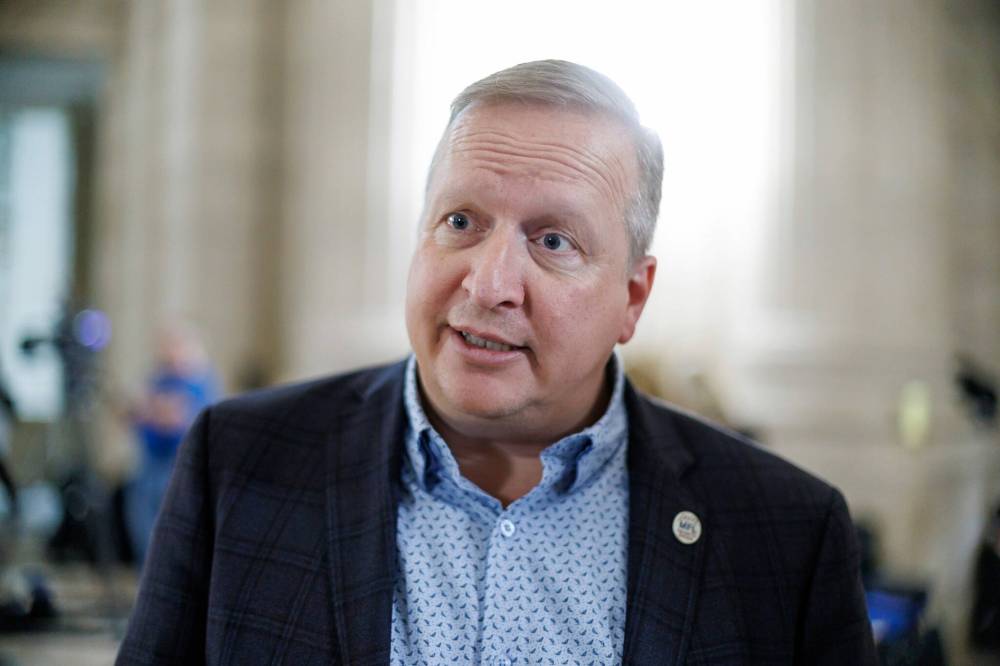
Manitoba Federation of Labour president Kevin Rebeck writes on the importance of unions. (File)
These include the fact that unions provide better wages that help workers pay the mortgage and support their families, that unionized workers are more likely to have a workplace pension and a good benefits plan and how health and safety issues are prioritized in unionized workplaces. The ability of unionized workers to take part in the democratic process of negotiating and voting on their collective agreement also comes up.
Another theme that comes up a lot when talking with workers about unions is the job security that unions provide, and they usually mean job security in a fundamental way: preventing people from being fired arbitrarily by their employer.
Workers also often mention that they want consistency and fairness with how their employer treats them, not the favouritism so many workers experience in non-unionized settings.
But something that people often do not know is that unions are legally required to represent all their members, including in issues of workplace disputes with employers.
In fact, our province’s Labour Relations Act makes specific mention of this requirement, under the principle of something called the Duty of Fair Representation.
As the exclusive bargaining agent for its members, unions are required to represent all employees in the bargaining unit fairly, honestly and without discrimination, meaning their actions cannot be arbitrary, discriminatory or in bad faith. This ensures that every member, regardless of status or what they have been accused of, receives fair advocacy from the union in advancing their case against an employer.
If a union fails to uphold this duty, it can be fined by the Manitoba Labour Board for committing an unfair labour practice.
While some members of a union might not agree with the case being advanced by a co-worker or fellow union member, the union has a legal obligation to represent that member fairly and without prejudice. This is an important legal balance between the collective rights of union members and the individual rights of specific workers.
Across North America, unions are undergoing a renewed sense of public interest and support. The well-regarded Gallup polling firm in the U.S. has been tracking support for labour unions in that country since 1936, and its most recent survey of Americans’ views shows that 68 per cent approve of unions, numbers that are in line with the high levels of public support for unions during the Great Depression, 1950s and 1960s. These numbers also show a resurgence in public support for unions since the low point starting in the 2000s (dipping to 48 per cent in 2009).
Here in Canada, data on support for unions is a bit harder to come by, but we do know that in 2024 a national survey conducted by GQR Canada for the Canadian Labour Congress found that 62 per cent of Canadians believed belonging to a union is a good thing.
As the cost of housing, groceries and income inequality continues to rise and workers feel their jobs are under threat, either from artificial intelligence or the tariff tantrums thrown by U.S. President Donald Trump, it makes sense that workers have increasingly seen unions in a positive light.
Unions boost wages and empower workers to achieve meaningful improvements in their working conditions and in their ability to support their families.
Increased public awareness and interest in unions is a good thing, especially at a time when work feels increasingly precarious and life is so much more expensive.
And the Manitoba Federation of Labour is always happy to help workers learn more about what unions are and what they do, including how unions can help make their work better.
» Kevin Rebeck is the president of the Manitoba Federation of Labour. This column previously appeared in the Winnipeg Free Press.