
ICE pullback shows limits of Trump scare tactics
Advertisement
Read this article for free:
or
Already have an account? Log in here »
We need your support!
Local journalism needs your support!
As we navigate through unprecedented times, our journalists are working harder than ever to bring you the latest local updates to keep you safe and informed.
Now, more than ever, we need your support.
Starting at $15.99 plus taxes every four weeks you can access your Brandon Sun online and full access to all content as it appears on our website.
Subscribe Nowor call circulation directly at (204) 727-0527.
Your pledge helps to ensure we provide the news that matters most to your community!
To continue reading, please subscribe:
Add Brandon Sun access to your Free Press subscription for only an additional
$1 for the first 4 weeks*
- Enjoy unlimited reading on brandonsun.com
- Read the Brandon Sun E-Edition, our digital replica newspaper
*Your next Free Press subscription payment will increase by $1.00 and you will be charged $20.95 plus GST for four weeks. After four weeks, your payment will increase to $24.95 plus GST every four weeks.
Read unlimited articles for free today:
or
Already have an account? Log in here »
Hey there, time traveller!
This article was published 06/02/2026 (247 days ago), so information in it may no longer be current.
Thanks to United States President Donald Trump, 2026 is shaping up to be an age of angst as groups and countries retreat turtle-like into protective economic and cultural shells. We’re trusting very few and are suspicious of many. As is generally the result of such tactics, the perpetrator is creating an environment of divide and conquer.
The global and local anxiety being created by Trump are illustrated by the Edelman Trust Barometer Global Report. It reveals the results of a 2025 survey of 33,000 respondents in 28 countries.
The results show that trust in institutions of all description, and our “shared reality,” has created a “crisis of grievance.” This in turn has produced a “heightened insularity, a reluctance to trust anyone who’s different from you.”
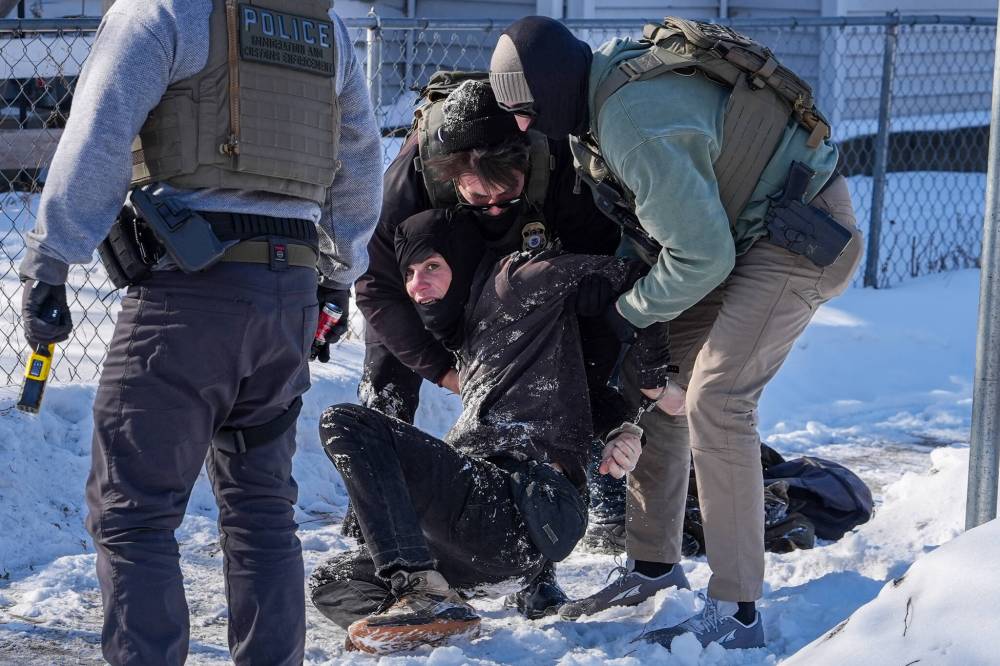
A person is detained by U.S. federal agents in Minneapolis on Tuesday. (The Associated Press)
But Trump’s draconian anti-immigration agenda — enforced through masked, violent and unaccountable Immigration and Customs Enforcement (ICE) agents — appears to be fuelling active and successful citizen collaboration.
In the aftermath of the slayings in Minneapolis of two civilians, Renee Good and Alex Pretti, and the mass protests that ensued, Trump’s border czar has announced he’s withdrawing 700 ICE agents from the city. Trump himself has also indicated his administration is backing down from its hardline tactics.
THE SIMMERING STATE OF PROTEST VIOLENCE
A disturbing finding in the Edelman survey is that 40 per cent of respondents approve of one or more hostile actions to bring about change. This includes “attacking people online, intentionally spreading disinformation, threatening of committing violence, damaging public or private property.”
This willingness to take hostile action is the highest I have seen in my 45 years of research into public order and protest. It is far higher than numbers found in the 2017-22 World Values Survey of 102 countries that asked five questions about political action.
In that survey, only 35 per cent globally said they “might” get involved in a peaceful protest, while 46 per cent “would never.” In Canada, 48 per cent said they would get involved in a peaceful protest; 29 per cent would never. In the U.S., 55 per cent of respondents reported they “might” and 34 per cent wouldn’t.
The Edelman report states that “as fears rise, trust goes local.” This means that as change becomes a bigger feature in our lives, the circle of trust shrinks. Organizational psychologists like Canada’s Jason Walker note that this turn of the emotional screw can create paranoia, emotional stress and workplace/home-life violence.
One way to gauge rising fear and public anger is through Google Trends. Throughout January 2026, more people worldwide than at any point in the past five years — including during the darkest months of the COVID-19 pandemic — searched on the phrases “I fear change” and “I am angry.”
The U.S. led all countries on Google Trends, registering a score of 100 — the maximum value on the platform’s index, which indicates the highest relative search interest among all locations measured. The only other country matching this level of fear of change search was the Philippines, which is going through its own political and social turmoil.
In Cincinnati, Ohio, searches on “I am angry” were hitting close to 90 on the index following Good’s slaying in Minneapolis on Jan. 7. Ohio is where the National Guard shot and killed four unarmed students and wounded nine others who were protesting the Vietnam War in 1970.
FEAR, DISTRUST GROWING
Surveys and web searches expose a world of growing protective isolationism; it’s a lot more difficult to bring a collective, trusted resistance together.
Canadian Prime Minister Mark Carney recently warned that “a world of fortresses will be poorer, more fragile and less sustainable.” But in extolling the virtues of collectivism and mutual trust, Carney underplayed the fact that, unfortunately, fear and protectionism are often more powerful than trust.
Decades of public order research by myself and colleagues, as well as extensive academic research about public order and protest, has revealed a predicable pattern.
As I found in my book “The Age of Outrage,” when people are afraid, their fear can turn to boiling anger. That anger then becomes an emotional catalyst for action, either collectively or singularly, passively or violently, to fix things.
In fact, fear, anger and a demand for action can instil the collectivism and mutual trust missing in the Edelman survey. That could be what’s currently happening with the anti-Trump and anti-ICE protests throughout the U.S.
The challenge is that large public protests are a very delicate, potentially volatile formula for change. Collective protests require drama and a saturation of news and social media coverage to raise awareness and support. But protest support can quickly evaporate if the public sees acts of violence and destruction by even a minority of demonstrators (one TV news shot of a burning building or smashed storefront window will usually do the trick).
TRUMP WAS BETTING ON FEAR
Amid the anti-ICE protests, Trump was betting that fear and chaos would prevail. He and his operatives continually seeded the public consciousness with language like “domestic terrorists,” “weaponized her vehicle” and “paid agitators” to describe the victims of ICE agents and other anti-ICE protesters. So far, Trump’s propaganda campaign is failing.
Trump didn’t count on the many peaceful anti-ICE protests and viral videos of the slayings of Good and Pretti that revealed the administration’s lies about their deaths. The over-zealousness of masked ICE agents has resulted in an uncomfortable drop of public support for the president.
Trump’s penchant for sowing fear is now in danger. If the “ICE Out” protests and strikes continue in their generally peaceful way, public fear, anger and a demand for public safety won’t be directed at demonstrators, but at violent federal ICE officers.
How can protesters continue to build public support? My decades of research point to a consistent pattern among successful movements: a C.O.R.E. profile. Protesters remain committed, communicative, organized, resourceful and experienced — and above all else, non-violent.
What’s happening in the U.S. right now illustrates that public law-and-order initiatives are a double-edged sword. Just as over-zealous and violent protesters can quickly sour public opinion for their cause, so can the over-reaction of law enforcement and other authorities to peaceful protests — a lesson Trump is currently learning the hard way.
» Eli Lawrence Sopow is an adjunct professor of organizational psychology at Adler University in Vancouver, B.C. This column was originally published at The Conversation Canada: theconversation.com/ca