
A tale of two leadership styles
Advertisement
Read this article for free:
or
Already have an account? Log in here »
We need your support!
Local journalism needs your support!
As we navigate through unprecedented times, our journalists are working harder than ever to bring you the latest local updates to keep you safe and informed.
Now, more than ever, we need your support.
Starting at $15.99 plus taxes every four weeks you can access your Brandon Sun online and full access to all content as it appears on our website.
Subscribe Nowor call circulation directly at (204) 727-0527.
Your pledge helps to ensure we provide the news that matters most to your community!
To continue reading, please subscribe:
Add Brandon Sun access to your Free Press subscription for only an additional
$1 for the first 4 weeks*
*Your next subscription payment will increase by $1.00 and you will be charged $20.00 plus GST for four weeks. After four weeks, your payment will increase to $24.00 plus GST every four weeks.
Read unlimited articles for free today:
or
Already have an account? Log in here »
The fault line that runs through Canadian politics today isn’t right or left, urban or rural, English or French, or even Liberal or Conservative. It is our border with the United States. Like the Sorting Hat of Harry Potter fame, Canadians are sorting the parties and leaders based on standing up to and negotiating with U.S. President Donald Trump.
Both Prime Minister Mark Carney and Opposition Leader Pierre Poilievre have struggled mightily to manage the Trump gorilla act. Success remains elusive. Both have settled on distance as the best strategy.
Having tried to secure an early economic and security deal with Trump with multiple encounters, Carney now engages him gingerly and episodically. Drive-by chats at international summits rather than direct Oval Office visits are preferred.
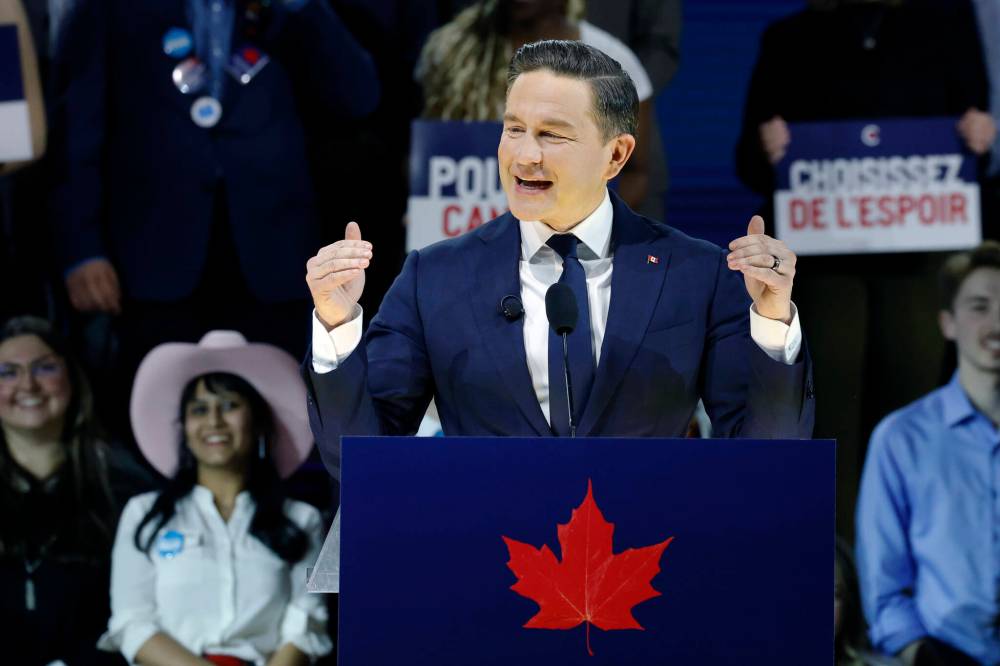
Conservative Party Leader Pierre Poilievre delivering his keynote address at the party’s national convention in Calgary, Jan. 30. David McLaughlin argues that Poilievre’s refusal to address the Trump-shaped elephant in the room has cost him dearly with voters. (The Canadian Press files)
Poilievre has always kept Trump at a distance. Even when many Maple-MAGAs in his party enjoyed the Great Disruptor’s ascendancy, Poilievre could hardly bring himself to say his name. That cost him with Canadians who figured since he didn’t have anything particularly bad to say about Trump, he just wouldn’t mention him at all.
That reflex was on full display during the Conservative Party leader’s convention speech last weekend in Calgary. The American president’s name was missing in action. Zero direct reference and only an oblique passing to “unfair and unresolved U.S. tariffs and diplomatic distractions and disruptions from down south.”
Still, he did pronounce his Canadianism, that “united and strong Canadians will bow before no nation anywhere on earth.”
While trumpeting his Canadian nationalism, Canadian voters continue to notice that Poilievre cannot bring himself to make the Trump pivot. Even former Conservative prime minster Stephen Harper has come out strong for retaliation against the U.S. on tariffs, saying in a speech marking the 20th anniversary of his election, that “Canada must adapt to new geopolitical realities.
To be clear, these realities mean we must reduce our dependence on the U.S.”
Carney couldn’t have said it better. Carney adroitly pivoted a year ago against Trump to win an election. He used last month’s Davos speech to burnish these credentials even further, without once mentioning his name. The prime minister has gained a current polling advantage as a result. Not mentioning Trump’s name now doesn’t hurt Carney because of what he said last year. It hurts Poilievre because of what he didn’t say last year.
Poilievre missed the opportunity to speak to Canadians, not just conservatives, that night and begin to make up the ground he lost before, during, and since the last election. There’s a reason for this. Conservatives are instinctively more pro-American than Liberals. The legacy of Brian Mulroney’s free trade agreement looms large in the pantheon of Conservative achievements. Mr. Poilievre reflects that instinct. And so does much of his caucus.
Enter Jamil Jivani, the Ontario Conservative MP for Bowmanville-Oshawa North in Ontario.
JJ went off to D.C. to meet JD. Famously college buds with Vice-President JD Vance, Jivani is on a self-selected mission in the U.S. capital “to help build bridges of communication between our two countries.” He wants to “re-establish the special relationship,” between the two countries.
This is no altruistic missionary venture to make up with an old ally. Jivani wants an American trade deal that obviates the need to make out with an old adversary: China. A restored political and economic relationship with the U.S. means “we don’t need to go further with China.” Representing a riding deep in the heart of Canada’s auto industry being ravaged by Trump’s tariffs, this is understandable.
But it also reflects the how Liberals and Conservatives see Canada in the world today. Our prime minister, a former global central banker with deep international networks, sees Canada from a global perspective. His is an outside-in lens, watching how the world has changed with Trump and what Canada must do as a result.
The Conservative leader, who has never travelled outside Canada in his role, sees the world from a solely Canadian perspective. It’s an inside-out lens, where foreign policy flows from domestic considerations, beginning with how he and his party view other regimes, other values, and other actions. He is all about black-and-white choices in a world where grey is the best colour you can sometimes get. Except Trump, then shades of grey are the colour palette from which he paints.
Inside-out versus outside-in leads to different foreign policy choices. Where Liberals declare Canada’s old relationship with the U.S. as “over” and the need to forge new trading relationships, including with China, Conservatives seek to re-establish the U.S. “special relationship” and criticize expanded trade with China.
Canadians may like the strong anti-Trump language, but we also like CUSMA. Dumping on Trump will hardly endear us with this mercurial president as we begin formal trade renegotiations. If the prime minister fails to deliver a satisfactory trade deal with the United States with resulting economic carnage, then the opposition leader’s approach to Trump and the U.S. may yet seem measured and wise.
For now, the political fault line in Canada is that it’s all Trump’s fault. And it’s the Conservative leader who remains on the wrong side of that line.
» David McLaughlin is a former clerk of the executive council and cabinet secretary in the Manitoba government. This column originally appeared in the Winnipeg Free Press.