
Recycling is not just a local issue
Advertisement
Read this article for free:
or
Already have an account? Log in here »
We need your support!
Local journalism needs your support!
As we navigate through unprecedented times, our journalists are working harder than ever to bring you the latest local updates to keep you safe and informed.
Now, more than ever, we need your support.
Starting at $15.99 plus taxes every four weeks you can access your Brandon Sun online and full access to all content as it appears on our website.
Subscribe Nowor call circulation directly at (204) 727-0527.
Your pledge helps to ensure we provide the news that matters most to your community!
To continue reading, please subscribe:
Add Brandon Sun access to your Free Press subscription for only an additional
$1 for the first 4 weeks*
*Your next subscription payment will increase by $1.00 and you will be charged $20.00 plus GST for four weeks. After four weeks, your payment will increase to $24.00 plus GST every four weeks.
Read unlimited articles for free today:
or
Already have an account? Log in here »
It might come as a surprise to some that recycling is a global, not just a local, and a controversial, issue. I remember when people first became aware of the recycling movement, maybe 30 or 40 years ago. We had our children crushing pop cans and gathering up recyclable articles and putting them in blue bags. We’d take them to depots set up in the Brandon Shoppers Mall parking lot where the kids would actually receive a small amount of cash based on the weight of the materials we delivered.
There were actually people who didn’t want to recycle, thought it was some kind of hoax, or just didn’t want to make the extra effort when they dealt with their garbage. There are still a few people like that around today, as social media “Meanwhiles” will attest to, who think it all gets thrown into landfills anyway or think our planet’s environment won’t really benefit from our individual recycling efforts. What I found, in my career talking with people about social issues, is that many considered recycling to be an easy and accessible way to make a difference in the world.
Just like any environmental issue, we as families, small businesses and individuals approach recycling as a micro issue, filling a blue bag or box each week with cardboard, tins, glass and plastic. But, on a world scale, it is indeed a macro issue with huge amounts of product being moved about, with treaties and regulations trying to keep up with the issues that arise, and with people’s lives and livelihoods at stake. Turning something old into something new — a plastic coke bottle into a t-shirt — is a good thing. Burning plastic waste for fuel is definitely a bad thing.
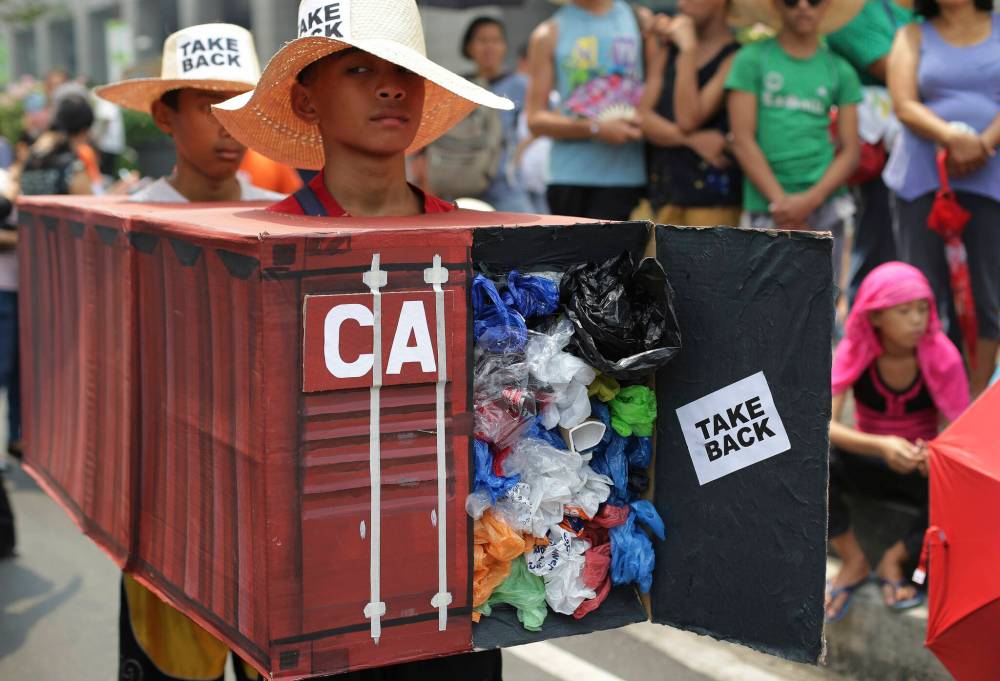
In this May 7 file photo, Filipino environmental activists wear a mock container vans filled with garbage to symbolize 50 containers of waste that were shipped from Canada to the Philippines as they hold a protest outside the Canadian embassy at the financial district of Makati, south of Manila, Philippines. Rich nations, including Canada, are shipping their garbage to countries with less stringent environmental regulations, Zack Gross writes. (The Associated Press)
Our mega-consumer society creates more waste of every type than we can easily deal with. At one time, the state of California, which has a population and economy bigger than our own, was shipping human waste by barge to Central America as there was nowhere to put it all “at home.” As well, Canada was implicated in an embarrassing situation just a few years ago when The Philippines flagged us for shipping unwanted industrial waste to them.
This has been labeled “Waste Colonialism,” the dumping of rich countries’ trash into the Global South. An article in Earth.org from August of last year details how millions of tons of plastic waste are exported from wealthy countries to poor ones, supposedly to be recycled. Much of it actually ends up in landfills or is burned, causing environmental and health degradation. The word “colonialism” is used as those least responsible for the excess of waste materials on our planet have become the nations and people who must deal with the burden of that unsustainable lifestyle.
As wealthy countries endeavour to reduce their carbon footprint, they want to avoid incinerating all the plastic waste they have accumulated. Thus, they send it to countries with a lower carbon footprint and less stringent environmental and labour regulations. The top waste exporters in the world, as reported by the Environmental Investigation Agency, last published in 2023, were all European nations, the U.S., Japan and Australia.
China was a top importer of plastic and other waste for a generation, which it recycled to use as raw materials in its own industries, but it ended this practice in 2018 amid increasing pollution problems and its own developing economy. Thus, wealthy countries turned to Asian and African nations to do their dumping, often mis-declaring what they were sending to get around national regulations. Ghana in West Africa, Mexico and Peru in Latin America, and Malaysia and Indonesia in Asia are now the destinations of choice for shipments of waste.
International agreements, such as the Basel Convention of 1989, have been created to limit the amount of transboundary movement of hazardous and other waste but these have not stemmed the tide. As well, national and state or provincial efforts to increase domestic recycling in developed nations have been stepped up but not always with satisfactory results. Part of the problem internationally is the deliberate mislabeling of what is recyclable and what is just truly garbage. A Global Plastic Treaty is being established at this time in the hope that countries and companies will be held accountable for the pollution they produce and will work co-operatively to face this longstanding problem.
We, as citizens, can join the global effort to improve our environment by recycling in our homes and workplaces. We must also show our support for national and international regulations, and consequences for bad actors, to make sure that those much larger recyclers do their duty as well.
» Zack Gross is board president of the Marquis Project, a Brandon-Westman based international development organization.