
Parliamentary math is not a scandal
Advertisement
Read this article for free:
or
Already have an account? Log in here »
We need your support!
Local journalism needs your support!
As we navigate through unprecedented times, our journalists are working harder than ever to bring you the latest local updates to keep you safe and informed.
Now, more than ever, we need your support.
Starting at $15.99 plus taxes every four weeks you can access your Brandon Sun online and full access to all content as it appears on our website.
Subscribe Nowor call circulation directly at (204) 727-0527.
Your pledge helps to ensure we provide the news that matters most to your community!
To continue reading, please subscribe:
Add Brandon Sun access to your Free Press subscription for only an additional
$1 for the first 4 weeks*
*Your next subscription payment will increase by $1.00 and you will be charged $20.00 plus GST for four weeks. After four weeks, your payment will increase to $24.00 plus GST every four weeks.
Read unlimited articles for free today:
or
Already have an account? Log in here »
Pierre Poilievre’s latest eruption over a Conservative MP crossing the floor says far more about his own political anxieties than it does about any supposed breach of democratic norms.
When Edmonton Riverbend MP Matt Jeneroux joined the Liberal caucus this week, Poilievre accused Prime Minister Mark Carney of trying to “seize a costly Liberal majority government” through “dirty backroom deals” and claimed Jeneroux had betrayed voters in his riding.
It was a familiar script for the Conservative leader: when events don’t break his way, he alleges impropriety, questions motives and implies that the system itself is being gamed.
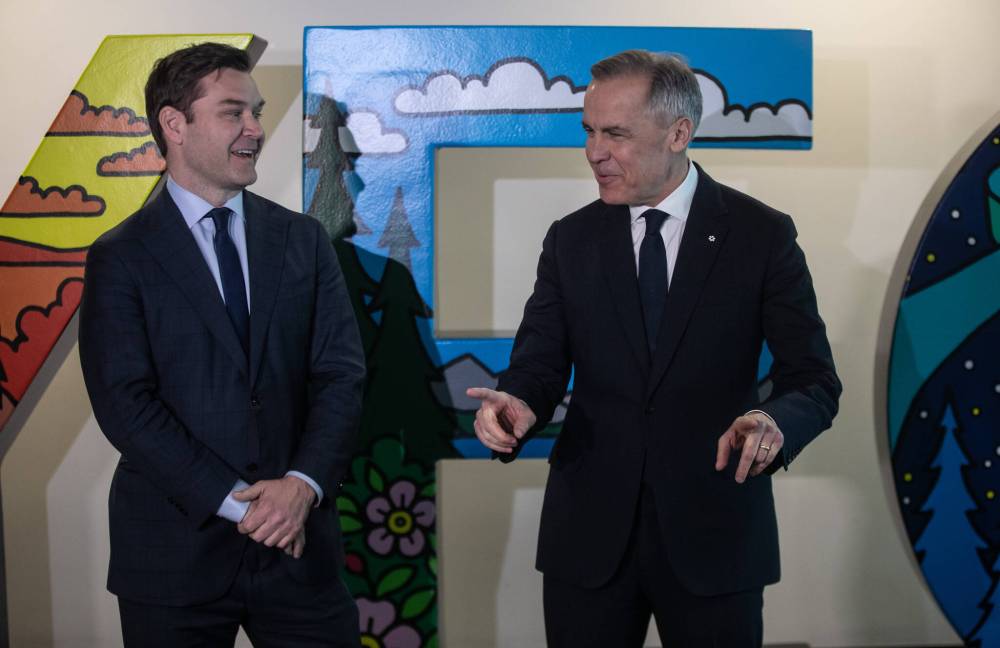
Prime Minister Mark Carney (right) and MP Matt Jeneroux meet in Edmonton after Jeneroux crossed the floor to the Liberals on Wednesday. (The Canadian Press)
The problem is that none of it stands up to even the most basic scrutiny.
There is nothing dirty, secretive or scandalous about MPs crossing the floor. It is not a loophole. It is not a trick. It is not a corruption of democracy. It is democracy — functioning exactly as it has in Canada since Confederation.
Members of Parliament are elected as individuals, not as indentured servants to party leaders. They are sent to Ottawa to exercise judgment on behalf of their constituents, not to suspend independent thought the moment a party logo is affixed beside their name on a ballot.
That judgment doesn’t end on election night. Nor does it evaporate when party leadership seems increasingly incapable of connecting with mainstream Canada.
Floor crossing is one of the mechanisms that allows Parliament to reflect political reality as it evolves between elections. And it has been used by MPs from every major party for more than 150 years.
Liberals have crossed to Conservatives. Conservatives have crossed to Liberals. Reform MPs crossed to the Progressive Conservatives. New Democrats have crossed to the Liberals.
Some did it over policy. Some over leadership. Some over principle. Some over ambition. All of it was legal, legitimate and part of our parliamentary tradition.
Jeneroux’s decision will avert a byelection in Edmonton Riverbend and add one seat to the Liberal total in a minority Parliament. That arithmetic seems to be the real source of Poilievre’s fury.
Prime Minister Mark Carney’s government is now three seats short of a majority, with three byelections looming. That makes every seat matter — but parliamentary math is not a scandal. It is the basic reality of minority governments.
Jeneroux has offered a detailed explanation for his decision. He says he initiated contact with the prime minister.
He points to Carney’s economic agenda, a high-profile speech in Davos calling on middle powers to unite against coercion by great powers, and growing concern over national unity — particularly the rise of separatist sentiment in Alberta and Quebec.
You can disagree with those reasons. You can argue he should have resigned and forced a byelection. You can say voters should judge him harshly at the next election.
All of that is fair game. What you cannot credibly say is that his decision is illegitimate or inherently corrupt.
The idea that a single party owns an MP’s conscience simply doesn’t align with how representative democracy works.
Canada-U.S. Trade Minister Dominic LeBlanc was right to call out the hypocrisy. Conservatives “stood and cheered” when a Liberal MP crossed the floor under Harper, he said. The double standard is glaring.
More importantly, Poilievre’s reaction avoids a far more uncomfortable question: why are MPs leaving his caucus at all?
This is now the third defection in recent months. The earlier departures sparked speculation about Poilievre’s leadership, even if he later passed a mandatory review with strong membership support.
But caucus cohesion and membership enthusiasm are not the same thing. Parties can win internal votes while losing the confidence of their own elected representatives.
There is a pattern here, and it has less to do with Liberal enticements than with Conservative direction. Under Poilievre, the party has embraced an aggressively divisive, Trump-style brand of politics that thrives on grievance, falsehoods and perpetual outrage.
Institutions are routinely attacked. Opponents are demonized. Compromise is treated as weakness.
That approach can be effective at mobilizing a base. It is far less effective at holding together a caucus made up of MPs with different regional realities, policy priorities and temperaments. Some MPs are simply not interested in spending their careers fuelling culture wars or mimicking American populist tactics.
Laura Stephenson, chair of political science at Western University, suggested the episode should prompt “soul searching” among Conservatives, about how they approach Parliament, how much they co-operate with the government and how they prevent further defections. That seems like sound advice.
Instead, Poilievre has chosen to reach for conspiracy-flavoured rhetoric about backroom deals and stolen majorities. It’s a strategy borrowed straight from the populist playbook: when outcomes are inconvenient, question the legitimacy of the process itself.
But floor crossing is not a democratic crisis. It is a safety valve. It allows Parliament to adapt, however imperfectly, to shifting political realities between elections.
Calling it dirty doesn’t make it so. It just makes it harder to ignore the real issue — that some Conservative MPs no longer see themselves reflected in the party Pierre Poilievre is leading.
» Tom Brodbeck is a Winnipeg Free Press columnist.