
Expressing freedoms to read, write and publish
» NEELIN VIEWS
Advertisement
Read this article for free:
or
Already have an account? Log in here »
We need your support!
Local journalism needs your support!
As we navigate through unprecedented times, our journalists are working harder than ever to bring you the latest local updates to keep you safe and informed.
Now, more than ever, we need your support.
Starting at $15.99 plus taxes every four weeks you can access your Brandon Sun online and full access to all content as it appears on our website.
Subscribe Nowor call circulation directly at (204) 727-0527.
Your pledge helps to ensure we provide the news that matters most to your community!
To continue reading, please subscribe:
Add Brandon Sun access to your Free Press subscription for only an additional
$1 for the first 4 weeks*
*Your next subscription payment will increase by $1.00 and you will be charged $20.00 plus GST for four weeks. After four weeks, your payment will increase to $24.00 plus GST every four weeks.
Read unlimited articles for free today:
or
Already have an account? Log in here »
Freedom to Read Week is an annual event that encourages Canadians to think about and reaffirm their commitment to intellectual freedom, a freedom guaranteed under the Charter of Rights and Freedoms.
Every year from Feb. 23 to March 1, Canadians celebrate Freedom to Read Week, a week dedicated to learning and reading and writing. Freedom to Read Week was founded in 1984 and is now mainly run by The Book and Periodical Council (BPC). The BPC is the umbrella organization for Canadian associations that are or whose members are primarily involved with the writing, editing, translating, publishing, producing, distributing, lending, marketing, reading and selling of written words.
A large part of Freedom to Read Week is discussing book challenges and book banning and how it affects you. It might seem like book challenges don’t affect us in Manitoba, but they do.
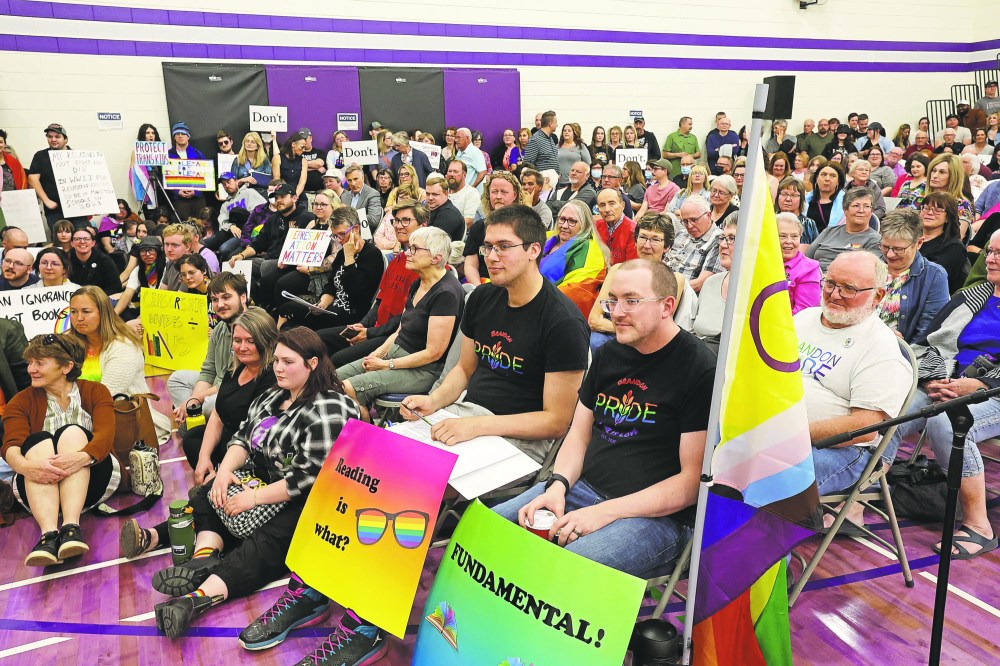
In 2023, trustees of the Brandon School Division voted 6-1 to reject a proposal to create a committee to review and ban books that focus on sexual minorities and sexual health. The Prairie Rose School Division also rejected the same proposal. That same year, southern Manitoba libraries faced defunding attempts over sex-ed content in children’s books.
Book challenges happen when someone formally requests that a book be removed, restricted, or reviewed because they believe the content to be inappropriate. Book challenging can happen for many reasons, and some examples include: sexual content or LGBTQ+ themes; explicit language; depictions of racism or violence; religious viewpoints; and/or political perspectives. When book challenges take place in school divisions or public libraries, usually the administrators, trusties, and librarians go through a review process and decide whether to keep the book as is, add age restrictions, add content warnings, or remove the book entirely.
Book banning comes from a government and can happen for any number of reasons.
Historically, book banning stemmed from governments wanting to control what the public consumed in terms of ideology (freedomtoread.ca). For example, after coming to power, the Nazi regime organized mass book burnings in 1933 across Germany (encyclopedia.ushmm.org). This was a government-directed censorship campaign tied to ideology and propaganda control.
In the present, book banning is happening because of alleged concern for literature that children consume (encyclopedia.ushmm.org). For example, as reported in the Winnipeg Free Press, in January Alberta’s two biggest school divisions said dozens of library books were taken off the shelves as that province’s ban on sexually explicit material took effect. Kim Smith, a spokesperson for the Edmonton Public School Board, says 34 titles were removed to comply with the government order (Winnipeg Free Press).
Freedom to Read Week is not only about reading; it is also about writing and publishing. That’s why The Writers’ Union of Canada (TWUC) presents the Freedom to Read Award in Celebration of Freedom to Read Week. The award recognizes work in support of freedom of expression and authors who stood up for their books.
Last year’s winner was poet and courageous presenter Bänoo Zan. Previous winners have included author Lawrence Hill for his response to the threat to burn his novel “The Book of Negroes,” Quebec writer Charles Montpetit for his tireless work to help preserve the freedom to read and write in this country, and Janine Fuller of Little Sisters Bookstore in Vancouver for her responses to ongoing book challenges in Canada.
As Freedom to Read Week is celebrated across Canada and here in Brandon, it offers an opportunity to appreciate the simple but powerful act of reading. Libraries and schools are places where people of all ages can explore new ideas, discover different perspectives, and find stories that reflect their own experiences. Freedom to Read Week encourages Canadians to value curiosity, open mindedness, and access to a wide range of books. Whether through reading, writing, or sharing stories, the week reminds us how important literature is in helping us learn, grow and better understand the world around us.
» Eleanore Wilts is a Grace 10 student at École secondaire Neelin High School.