
Expansive rearmament plans raise questions
Advertisement
Read this article for free:
or
Already have an account? Log in here »
We need your support!
Local journalism needs your support!
As we navigate through unprecedented times, our journalists are working harder than ever to bring you the latest local updates to keep you safe and informed.
Now, more than ever, we need your support.
Starting at $15.99 plus taxes every four weeks you can access your Brandon Sun online and full access to all content as it appears on our website.
Subscribe Nowor call circulation directly at (204) 727-0527.
Your pledge helps to ensure we provide the news that matters most to your community!
To continue reading, please subscribe:
Add Brandon Sun access to your Free Press subscription for only an additional
$1 for the first 4 weeks*
*Your next subscription payment will increase by $1.00 and you will be charged $20.00 plus GST for four weeks. After four weeks, your payment will increase to $24.00 plus GST every four weeks.
Read unlimited articles for free today:
or
Already have an account? Log in here »
Prime Minister Mark Carney’s recent Davos speech was widely lauded for calling out how today’s global order is reverting back to the law of the jungle. He also highlighted ways Canada is helping its middle-power allies adapt to this new reality by bolstering NATO’s hard power projection. For evidence, he touted Ottawa’s “unprecedented investments in over-the-horizon radar, in submarines, in aircraft and boots on the ground, boots on the ice.”
Expect to hear far more about Canada’s military modernization in the months and years ahead.
On Feb. 17, Carney released Ottawa’s long-awaited Defence Industrial Strategy. It’s a blueprint for how the bonus $81.8 billion over five years for the Canadian Armed Forces (CAF) contained in Budget 2025 will be spent. And all the enormous increases to the CAF budgets thereafter.
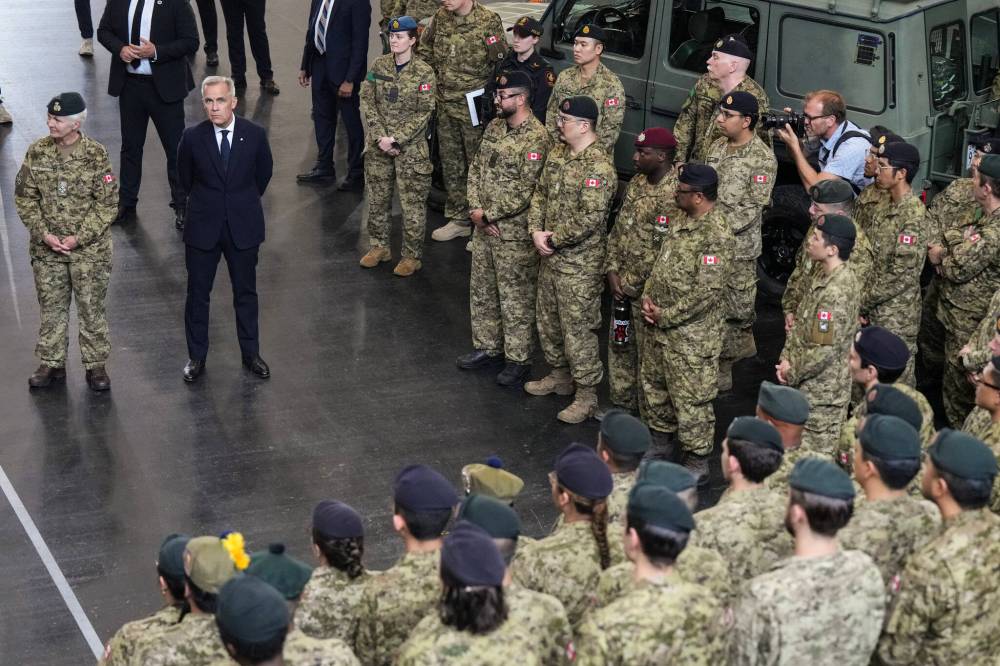
Prime Minister Mark Carney announced major defence spending last summer, but how and where that money will be spent is every bit as important as the dollars involved, Kyle Volpi Hiebert argues. (The Canadian Press files)
Carney last summer committed Canada to NATO’s elevated target of members spending five per cent of GDP on defence by 2035. If Ottawa honours that, the military’s annual budget will skyrocket to $160 billion in less than 10 years. That’s roughly five times more than the Department of National Defence’s budget estimates were in 2024-25.
But Ottawa is hoping this can also turbocharge Canada’s broader economy by steering investments into retooling the CAF for modern warfare toward domestic companies. Indeed, the Defence Industrial Strategy includes some eye-popping targets. The government claims it will create 125,000 high-paying career jobs, increase defence exports by half and spike defence-industry revenues by 240 per cent and more — all within a decade.
Much of the strategy hinges on helping Canadian companies become leaders in dual-use technologies with both commercial and military applications. Think data centres, drones, space-based capabilities and artificial intelligence. And there’s a good reason why.
Western governments must come to grips — fast — with how AI-powered autonomous weapons systems are changing the nature of contemporary combat. This is brutally apparent more than four years into the Ukraine war and in hot spots elsewhere. Yet the West’s ability to surge production of these systems “remains amateurish at best,” argues Eric Schmidt, the former Google CEO turned defence tech investor in a recent op-ed for the Financial Times.
This is a serious problem. “Mastery of autonomous systems and the ability to build those weapons in abundance will determine the outcome of future wars,” Schmidt writes. “The West must learn from what is happening on the front line in Ukraine, accelerate innovation and build the industrial base required to produce at the scale and speed the next conflict will demand.”
All told, Ottawa’s rearmament plan claims to cover investment of over half a trillion dollars into Canadian security, economic prosperity and sovereignty. Yet there are serious hurdles to convert this rhetoric into reality.
The most obvious are the mammoth but necessary funding commitments. Decades of neglect and underinvestment have hollowed out Canada’s military precisely as the world is becoming more dangerous. Although perhaps the larger problem is how far behind Canadian companies have fallen in the new globalized digital economy, which runs on intangible assets — data, patents, algorithms and intellectual property (IP).
“Instead of investing in Canadian firms to help them develop, own and sell Canadian intellectual property, governments have poured billions of dollars into foreign multinationals to set up domestic branches while most of the value those companies generate, particularly through the ownership of their IP, flows out of the country,” Benjamin Bergen, CEO of the Canadian Venture Capital and Private Equity Association, wrote in a recent essay for Maclean’s.
The result, Bergen says, is that Canada is funding its own economic decline. “We get the jobs. Someone else gets the wealth.”
The Carney government took considerable heat on this issue in November when federal Artificial Intelligence and Digital Innovation Minister Evan Solomon declared $72 million in government support for Finnish company Nokia to expand its corporate campus in Ottawa was a boon for Canada’s innovation industry. Industry Minister Mélanie Joly posted on X it signalled “Canada is leading the global tech race.”
Both officials failed to mention the bulk of the profits would be spirited outside of the country.
Canada’s AI champion Cohere is also deeply reliant on U.S. digital networks and hardware vendors — even when viable homegrown alternatives exist. Last year, for example, Cohere partnered with American company CoreWeave to open a new data centre facility in Cambridge, Ont., by using $240 million from Canada’s federal Sovereign AI Compute strategy.
The Defence Industrial Strategy will fail if these kinds of deals remain typical within Canada’s innovation ecosystem. For the sake of national security, that can’t be allowed to happen.
» Kyle Volpi Hiebert is a Montreal-based political risk analyst focused on globalization, conflict and emerging technologies. This column previously appeared in the Winnipeg Free Press.