
Trump plays games with Canada’s sovereignty
Advertisement
Read this article for free:
or
Already have an account? Log in here »
We need your support!
Local journalism needs your support!
As we navigate through unprecedented times, our journalists are working harder than ever to bring you the latest local updates to keep you safe and informed.
Now, more than ever, we need your support.
Starting at $15.99 plus taxes every four weeks you can access your Brandon Sun online and full access to all content as it appears on our website.
Subscribe Nowor call circulation directly at (204) 727-0527.
Your pledge helps to ensure we provide the news that matters most to your community!
To continue reading, please subscribe:
Add Brandon Sun access to your Free Press subscription for only an additional
$1 for the first 4 weeks*
*Your next subscription payment will increase by $1.00 and you will be charged $20.00 plus GST for four weeks. After four weeks, your payment will increase to $24.00 plus GST every four weeks.
Read unlimited articles for free today:
or
Already have an account? Log in here »
What in God’s name is U.S. Treasury Secretary Scott Bessent doing commenting publicly about sensitive national unity matters in Canada?
It is unprecedented, intrusive and highly provocative behaviour from a senior Trump administration official. There is no disputing the fact that Bessent has clearly gone well beyond the bilateral red lines and rules of the erstwhile Canada-U.S. “diplomatic culture.”
There has almost always been an unwritten understanding that neither country should openly interfere in the internal affairs of their neighbour. Politicians and officials on both sides of the border knew that nothing good would ever come from interjecting themselves into the cut and thrust of domestic political happenings.
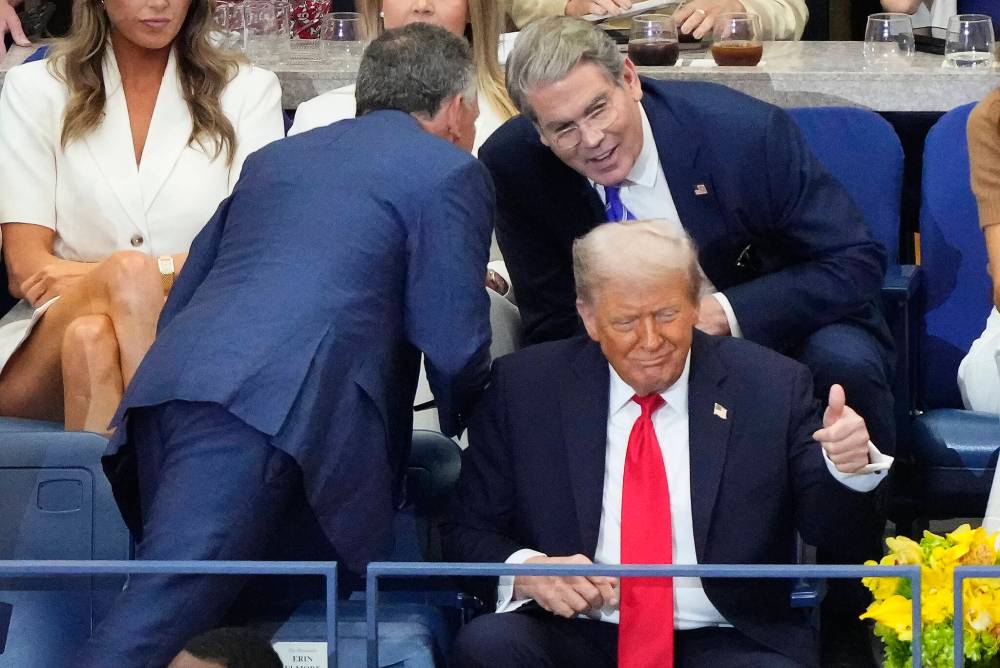
U.S. President Donald Trump and his Treasury secretary, Scott Bessent (rear), seem eager to tamper in Canada’s internal affairs — but to what end? (The Associated Press files)
Now and again, some low-ranking U.S. official, member of Congress, dim party staffer or newspaper columnist would pontificate about the likely dismemberment of Canada. It was a rarity, however, for any U.S. president (outside of Bill Clinton interjecting himself into the 1995 Quebec referendum) or senior cabinet secretary to opine about Canada’s national unity situation.
But with a look of spite and resentment, Bessent told a U.S. right-wing interviewer: “Alberta has a wealth of natural resources, but they won’t let them build a pipeline to the Pacific.” He then went to add mischievously: “I think we should let them come down into the U.S., and Alberta is a natural partner for the U.S. They have great resources. The Albertans are very independent people.”
Would not the same type of thinking apply to Quebec? We may find out.
When the Parti Québécois, and party leader René Lévesque, won the 1976 Quebec provincial election, everyone knew that a sovereignty referendum would eventually be held. In an effort to calm the financial waters and to put forth the face of a reasonable and respectful separatist government, Lévesque went to Wall Street in early 1977 to steady and court anxious U.S. investors and skeptical business leaders. In the end, Lévesque’s speech had the opposite effect, and he left New York in damage-control mode.
Jimmy Carter, who was U.S. president at that time, made sure that Lévesque and the separatists were given the diplomatic cold shoulder. It was then and there that Carter enunciated what became official U.S. policy on Canada’s potential breakup: (1) the U.S. government does not interfere in Canadian domestic affairs; (2) the decision on whether to break up the country rests entirely with the Canadian people; and (3) the United States has always benefited from a strong and united Canada.
Evidently, the respectful Carter strategy has now been replaced by U.S. President Donald Trump’s disruptive approach. He has effectively cast to one side any pledge that the U.S. would stay out of the business of Canada’s “neverendums.” Indeed, he looks and sounds like he may actually want to put his finger on the national unity scale.
One can never be too sure why exactly Trump does what he does — especially when it comes to relations with Canada. But venturing into questions about the breakup of Canada (by having Bessent unleash on Alberta secession) so soon after Prime Minister Mark Carney’s prickly Davos speech points to the petty vindictiveness of Trump after being upstaged by a plain-spoken Canadian.
In addition, Trump wants Carney to know that he can stir the pot and turn up the heat at any time over separation in Alberta — or even on a potential Quebec sovereignty referendum in 2027. His message is clear: Carney needs to be careful about what he says and does (particularly in a minority government) because I’m the guy who can make your political life a living hell.
Just think about it for just one moment: what if Trump decides to openly endorse the “Yes” side in the Alberta referendum campaign? What if he instructs U.S. government officials or MAGA supporters to engage in a well-organized and financed disinformation and misinformation operation? And, in the wake of a referendum “No” verdict, could Trump not come out and claim the whole process was rigged, nothing more than a sham referendum and clearly stolen from the “Yes” side?
Of course, part of Trump’s likely urging Bessent to speak out is about sending an obvious signal to others who might be contemplating doing a “full Carney.” They have obviously been put on notice: Tariff Man will not be amused.
I’m also thinking that there might be some connection between the Alberta referendum outburst and the pending Canada-United States-Mexico Agreement renegotiations. Trump is attempting to hold the sovereignty knife to the throat of the Carney government so as to extract significant trade concessions from the Canadian side. Maybe Trump thinks that the Alberta referendum could be his ace-up-the-sleeve to come away victorious on dismantling Canada’s supply-management system, its stringent banking regulations or the pact’s dispute settlement mechanism.
I wish that I had a crystal ball to tell me where Trump is going with all this reckless referendum talk. The only thing that I do know for sure is that there is definitely a strategy and endgame for him doing so. And if past is prologue, it won’t be good for Canada.
» Peter McKenna is professor of political science at the University of Prince Edward Island in Charlottetown. This column previously appeared in the Winnipeg Free Press.