
A party at odds with Canadian values
Advertisement
Read this article for free:
or
Already have an account? Log in here »
We need your support!
Local journalism needs your support!
As we navigate through unprecedented times, our journalists are working harder than ever to bring you the latest local updates to keep you safe and informed.
Now, more than ever, we need your support.
Starting at $15.99 plus taxes every four weeks you can access your Brandon Sun online and full access to all content as it appears on our website.
Subscribe Nowor call circulation directly at (204) 727-0527.
Your pledge helps to ensure we provide the news that matters most to your community!
To continue reading, please subscribe:
Add Brandon Sun access to your Free Press subscription for only an additional
$1 for the first 4 weeks*
- Enjoy unlimited reading on brandonsun.com
- Read the Brandon Sun E-Edition, our digital replica newspaper
*Your next Free Press subscription payment will increase by $1.00 and you will be charged $20.95 plus GST for four weeks. After four weeks, your payment will increase to $24.95 plus GST every four weeks.
Read unlimited articles for free today:
or
Already have an account? Log in here »
Hey there, time traveller!
This article was published 27/02/2026 (199 days ago), so information in it may no longer be current.
As support for the Conservative Party of Canada continues to fall in public opinion polls, and Tory Leader Pierre Poilievre’s hopes of ever becoming prime minister continue to fade, the obvious question to ask is why this is happening, just weeks after Poilievre received a resounding vote of confidence at the party’s national convention.
Some may suggest the latest polling numbers, which have the Liberals soaring in support across the country and the Tories sliding, merely reflect the normal “ups and downs” of polls between elections. Others may argue the results are distorted by the toxic actions of the Trump administration, with the Tories paying a political price.
Still others will say, and many will agree, that the decline in support for the Tories is the logical consequence of anxious Canadians coming together at a precarious time in the nation’s history, with Mark Carney’s Liberals being the beneficiaries of that reality.
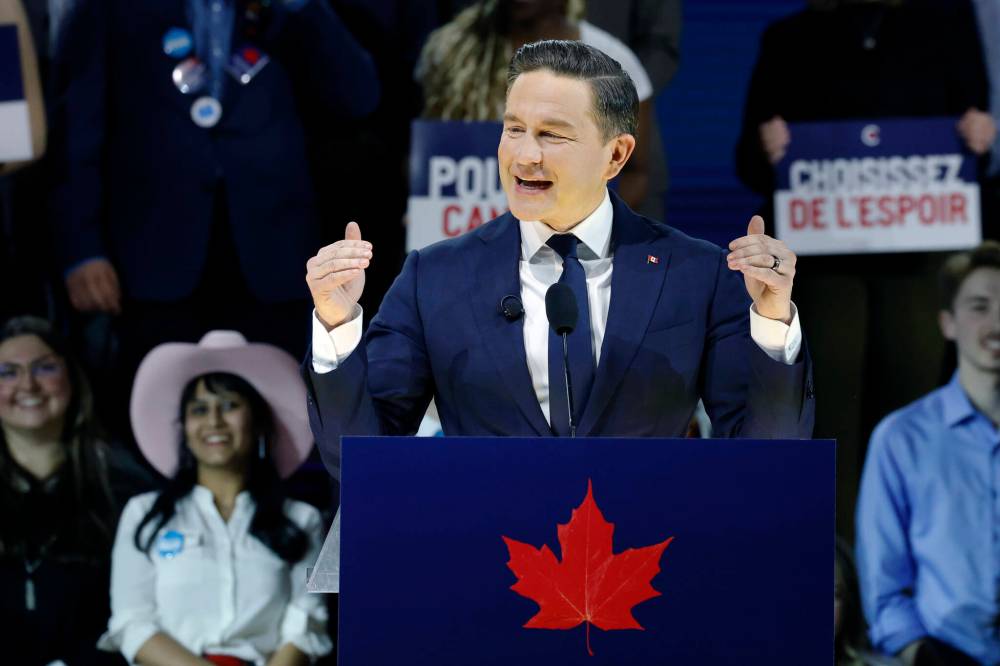
Conservative Leader Pierre Poilievre delivers his keynote address at the party’s national convention in Calgary in January. Deveryn Ross writes that while Poilievre is often blamed for the Conservative party’s problems, “the reality runs much deeper than that.” (The Canadian Press files)
Those are plausible explanations, and each may reflect the view of a segment of Canadians, but there is another factor that undoubtedly impacts the fortunes of the Conservative Party. That is the nature of the party itself and how it is perceived by voters.
In January, just days before the Tories’ convention in Calgary, Abacus Data conducted a large, nationwide poll aimed at quantifying and understanding Canadians views on Poilievre and his party. The results were likely a surprise to many.
The survey found that the Conservative “base” — the group that would only consider voting for a Conservative candidate — is made up of just 23 per cent of Canadians. That’s slightly more than one in five voters, and slightly more than half the percentage the Tories need in order to win a federal election.
At a deeper level, the poll also found that the Tory base “is demographically and ideologically distinct from the broader Canadian electorate. On questions of institutional trust, cultural change, climate policy and the role of government, Conservative base voters hold views that often diverge sharply from the rest of the country. These differences are not marginal. They represent fundamentally different perspectives on the direction Canada should take.”
In other words, they share a perspective on a range of issues that is at odds with the majority of Canadians, and favour policies that most Canadians disagree with.
For example, the poll found that only 26 per cent of the Conservative base believes that “Canada’s institutions (courts, Elections Canada, the public service) generally do their job fairly,” while 60 per cent of the rest of Canadians feel that way.
Just 23 per cent of the Conservative base believes “the mainstream media in Canada usually tries to report the facts fairly,” while 62 per cent of the rest of the population agrees with that statement.
A staggering 78 per cent of the Tory base believes “Canada has gone too far in accommodating different values and cultures,” while 49 per cent of “everybody else” shares that sentiment.
On reconciliation with Indigenous Canadians, just 28 per cent of the Conservative base agrees that reconciliation is essential to Canada’s future, even if it requires major changes. Among the rest of Canadians, however, 56 per cent agree with that statement.
Six out of 10 members of the Conservative base told Abacus that protecting individual freedom is more important than promoting equality, while only 36 per cent of everyone else shares that opinion. That may explain why the Conservative Party is perceived by many as the political home for libertarians and anti-vaxxers.
On the environment, just 34 per cent of the Tory base believes that climate change is an urgent issue that requires immediate action. Among the rest of Canadians, however, more than double that percentage — 69 per cent — regard climate change as something that must be immediately acted upon.
The poll also found that 45 per cent of the Tory base believes their party should become even more conservative in its policies, while just seven per cent feels it should be less conservative. Forty-five per cent of that group also feels their party should use strong language such as “Canada is broken” when discussing what they feel is not working in Canada.
Notably, an eye-popping 59 per cent of the Conservative base believes their party “should stand firm on conservative principles, even if makes it harder to win.”
Beyond specific issues, Abacus also found that 57 per cent of the current members of the Conservative base are male and that, overall, the base is younger and less-educated than the most Canadians. In particular, 41 per cent of those who comprise the base have a high school education or less, compared to just 27 per cent of everybody else.
All of that data explains in large part why the Conservative Party is stuck on the opposition benches and likely to remain there for the foreseeable future. They aren’t as educated as the rest of Canadians and they hold views — extreme opinions, in some cases — that the majority of voters do not share.
To make matters worse, a large part of the Conservative base is stubbornly unwilling to soften their party’s policies in order attract the voters they need to win an election.
Pierre Poilievre is repeatedly blamed for the Tories’ problems, but the reality runs much deeper than that. Successful election campaigns strive to build a consensus that reflects the values and priorities shared by as many voters as possible. The Conservatives aren’t trying to do that — in fact, they refuse to do so — and that’s why they keep losing elections.