
NDP’s unforeseen budget expenses legitimate, but so is bloated deficit
Advertisement
Read this article for free:
or
Already have an account? Log in here »
We need your support!
Local journalism needs your support!
As we navigate through unprecedented times, our journalists are working harder than ever to bring you the latest local updates to keep you safe and informed.
Now, more than ever, we need your support.
Starting at $15.99 plus taxes every four weeks you can access your Brandon Sun online and full access to all content as it appears on our website.
Subscribe Nowor call circulation directly at (204) 727-0527.
Your pledge helps to ensure we provide the news that matters most to your community!
To continue reading, please subscribe:
Add Brandon Sun access to your Free Press subscription for only an additional
$1 for the first 4 weeks*
- Enjoy unlimited reading on brandonsun.com
- Read the Brandon Sun E-Edition, our digital replica newspaper
*Your next Free Press subscription payment will increase by $1.00 and you will be charged $20.95 plus GST for four weeks. After four weeks, your payment will increase to $24.95 plus GST every four weeks.
Read unlimited articles for free today:
or
Already have an account? Log in here »
Hey there, time traveller!
This article was published 05/03/2026 (234 days ago), so information in it may no longer be current.
By the time government budget season is over this spring, the country will be awash in fiscal red ink.
From coast to coast, federal and provincial governments are reporting astronomical budget deficits, almost all of them larger than forecasted in last spring’s budgets. Almost all of them will offer the hope of a dramatic turnaround within a couple of years.
Three at the most. OK, maybe four or five years.
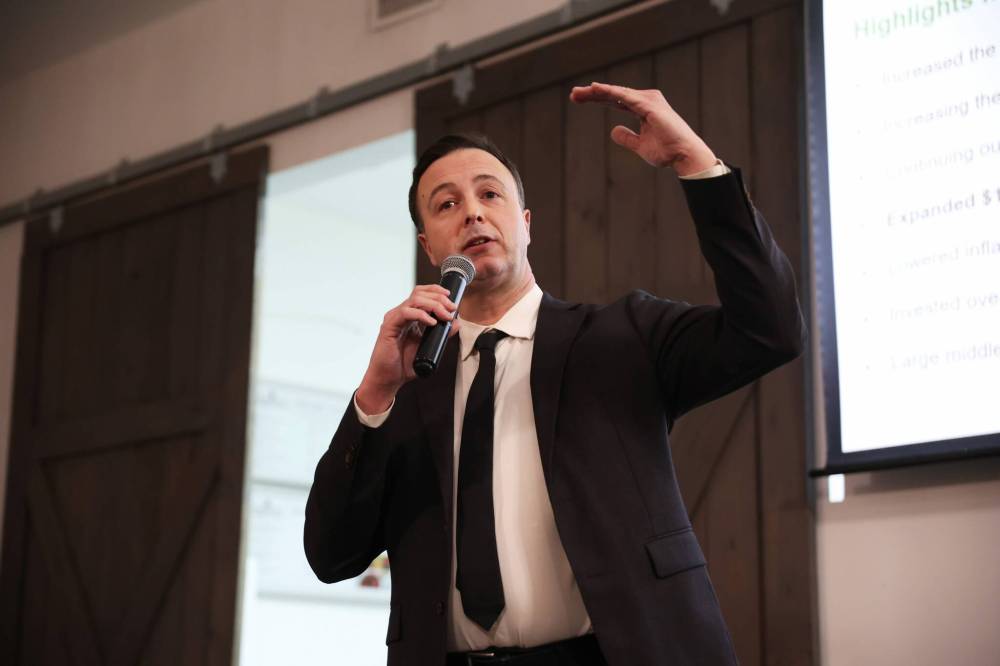
Manitoba Finance Minister Adrien Sala speaks during a pre-budget consultation at The Backyard on Aberdeen in Brandon in February. (Photos by Tim Smith/The Brandon Sun files)
Some of the numbers being posted are eye-popping, with four provinces posting 11-figure budget shortfalls: Quebec ($13.6 billion); Ontario ($13.5 billion); British Columbia ($11.2 billion) and Alberta ($10 billion).
Three others, including Manitoba, will see 10-figure deficits: Manitoba ($1.6 billion); New Brunswick ($1.3 billion); and Nova Scotia ($1.3 billion). Newfoundland and Labrador has an outside chance to join the club after posting an updated deficit of $948 million.
The sole outlier is Saskatchewan, which started the year forecasting a very small surplus but has since backed into a $427-million deficit that looks favourable only when compared to other provinces.
How should we assess the fiscal performance of any government in an era of slow economic growth, climate disasters, persistent inflation and global volatility fuelled by tariffs and lust for geo-political conflict that drives U.S. President Donald Trump?
In the end, there is really no one else to blame other than the governments of the day.
Even though each province has a somewhat valid argument to explain how it got into the mess it finds itself in now.
Alberta Premier Danielle Smith blamed her government’s skyrocketing deficit on immigration costs and much lower revenues expected from oil and gas. Although blaming immigration is an empirically weak and morally offensive strategy, Smith does have a point about resource revenues.
Last year, the Trump administration bullied U.S. oil companies into a record year of production which, in turn, drove down the price of crude oil and gasoline.
Although she is culpable for her xenophobic rants, Smith cannot be held responsible for a failure to predict how hard and fast Trump would attack oil prices.
And what of Manitoba? Do Premier Wab Kinew and Finance Minister Adrien Sala have plausible deniability for a budget deficit that has doubled from the $794 million forecast one year ago? There are viable excuses.
Manitoba suffered a $232-million unfunded expense to combat summer wildfires. If that weren’t bad enough, the drought that sparked those wildfires also contributed to an enormous $700-million loss at Manitoba Hydro.
The province also suffered from $270 million less in income tax, a phenomenon that struck just about every province last year, as 2024 personal income assessments underwent a huge reboot. Add in some unexpected costs related to renegotiated transfer payments for child care (-$137 million) and a drop in federal infrastructure funding (-$100 million), and you’ve got a massive and seemingly insurmountable deficit.
Does all that add up to plausible deniability in a charge of fiscal incompetence?
Budget forecasts from last year were not nearly precise enough, even though there are reasonable explanations for the variance, particularly when you look at the fact that every province missed its budget targets.
Rather than debating whether governments should have been able to anticipate the mayhem of 2025, we should look to the future and whether Manitoba is trying to do something — anything — to slow spending.
Using the last available fiscal update, budget documents from last spring and public accounts for last year, Manitoba is on track to increase its overall spending this fiscal year by 2.62 per cent.
This would be a major slowing of expenditures over 2024-25, when spending went up by more than seven per cent and hundreds of millions of dollars were devoted to needless tax cuts.
Kinew and Sala will point out, with some justification, that most of the increased spending over their first two years in power was focused on restoring viability to health care, which was seriously undermined during eight years of Progressive Conservative premiers Brian Pallister and Heather Stefanson.
But the need to heal health care is not necessarily immune to political blowback.
If the NDP had made more progress in reducing surgical and diagnostic wait lists, for example, then the premier and finance minister would have a powerful argument to justify current deficits.
Unfortunately, while progress has most definitely been made, particularly in the recruitment of doctors and nurses, it hasn’t really fixed the system; far too many Manitobans are waiting far too long for basic services.
Regardless of what the next budget forecasts, it will be enormously difficult to stop the deficit from getting worse over the next fiscal year.
The NDP is deeply devoted to the idea that cutting core government services is not a just way to fight deficits. But even if that’s correct, in the short term, there are limits to that strategy.
At some point in the future, even with plausible excuses for the current situation, the NDP in Manitoba and other provincial governments will run out of time and money waiting for the economy to rebound. And when they reach the end of that runway, hopes of healing health care will be dashed, sacrificed on the altar of fiscal reality.
» Dan Lett is a Winnipeg Free Press columnist.