
Trump caught in Iran trap
Advertisement
Read this article for free:
or
Already have an account? Log in here »
We need your support!
Local journalism needs your support!
As we navigate through unprecedented times, our journalists are working harder than ever to bring you the latest local updates to keep you safe and informed.
Now, more than ever, we need your support.
Starting at $15.99 plus taxes every four weeks you can access your Brandon Sun online and full access to all content as it appears on our website.
Subscribe Nowor call circulation directly at (204) 727-0527.
Your pledge helps to ensure we provide the news that matters most to your community!
To continue reading, please subscribe:
Add Brandon Sun access to your Free Press subscription for only an additional
$1 for the first 4 weeks*
*Your next subscription payment will increase by $1.00 and you will be charged $20.00 plus GST for four weeks. After four weeks, your payment will increase to $24.00 plus GST every four weeks.
Read unlimited articles for free today:
or
Already have an account? Log in here »
Donald Trump is caught in the trap that he helped to build, and he is starting to flail against his fate. His “war of choice,” “Operation Epic Fury,” was supposed to end in “unconditional surrender” by Tehran in just a few weeks, but if Trump ever had a plan beyond “use massive force,” it isn’t working.
Trump managed to “decapitate” much of the Iranian regime in the first hour of the American-Israeli sneak attack. (For the second time in a year, the United States attacked while still in peace talks with Iran.) However, this massacre of the old leadership class only ensured that a younger, smarter generation of true believers would lead Iran’s resistance struggle.
Knowing a bit about the cult of martyrdom in Shia Islam, I am even tempted to speculate that Ayatollah Ali Khamenei knew that the U.S. might strike that meeting and held it anyway. At any rate, it gave regime supporters more martyrs (killed by infidels) to celebrate, including the new Supreme Leader Mojtaba Khamenei’s father, mother, wife and son.
Mojtaba was a hardliner anyway, having fought as a 17-year-old volunteer in the Iran-Iraq War. (Saddam Hussein’s Iraq invaded Iran with U.S. encouragement and support in 1980-88.) There is almost zero probability that Iran’s new leadership will seek a peace deal with the U.S. and Israel — and no good reason that it needs to.
The American staff officers who planned Operation Foolish Fantasy counted up all of Iran’s worn-out fighters, decrepit warships and creaking logistics, and concluded that they couldn’t hold their own in a fight with America and Israel for even two weeks. Nobody asked if that was the fight they had to win.
The Iranian planners, well aware that they couldn’t win a stand-up fight with Israeli high-tech weapons, considered where they did have leverage and decided that fossil fuels and Western economies were their enemies’ vulnerable flank. Stop the flow of oil and gas, Western economies will tank, and they’ll have to make a deal with the ayatollahs.
(I am assuming here that after the murder of several tens of thousands of civilian protesters in the streets of Iranian cities in January, nobody is going to try another uprising until the regime is clearly, irrevocably losing. It’s a long way from that now.)
So: oil again. Fifty years after the first oil embargo brought the West to its knees, you’d think that the powers-that-be might have switched to a less vulnerable energy source, but, you know — “the money’s good and I just want to make my pile, and then we can all switch to a safer, cleaner, closer source of energy …” Repeat for 50 years.
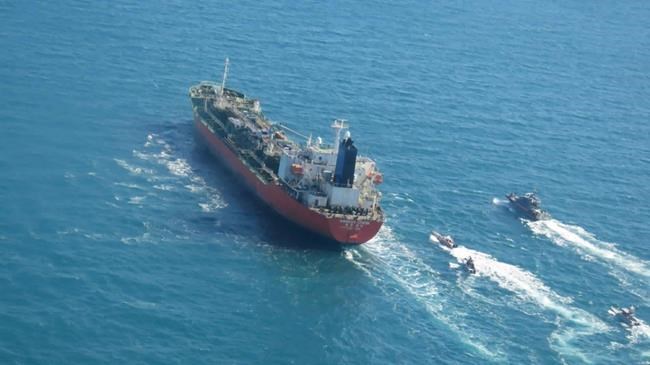
Can the United States and its allies break Iran’s closure of the narrow Strait of Hormuz, which is currently stopping 20 per cent of the world’s oil and liquefied natural gas traffic from entering or leaving the Persian Gulf? Technically, yes. Indeed, French President Emmanuel Macron has suggested a multinational naval operation to do exactly that.
But Operation Blind Rage may not be the best answer either. The price of oil has almost doubled and the world economy is sliding into a major recession. Fighting might sink ships in the narrow channel and block it that way. And in the middle of it all is Donald Trump, unable to stop what he started and beginning to realize that he has been had by Benjamin Netanyahu.
We will never know whether Netanyahu genuinely believes there is a nuclear problem with Iran, but we can be certain that the Israeli intelligence services (and the American ones and everybody else’s, too) have assured him that Iran is at least five years away from deliverable nuclear weapons.
Netanyahu first warned that Iran would have nukes “in three to five years” in 1992. He has repeated the warning at frequent intervals, saying it was one, two, three or at most five years away. But it was just a useful fiction, as nobody takes 34 years to make nuclear weapons if they are serious about it. Consider Pakistan. Consider North Korea. Consider Israel itself.
The lie was useful because it enabled Netanyahu to portray Iran as a threat, not just to Israel (which it was), but also to rich and powerful Western countries. His goal has always been to draw those countries into a direct conflict with Iran, and with Trump he has finally succeeded.
To escape again, Trump would have to accept that he has been wrong, so probably not. The likeliest alternative, unfortunately, is for Trump to decide that the solution is more force. Perhaps including boots on the ground because it will be hard to make the Strait of Hormuz safe without controlling the Iranian islands on the north side of the Strait.
» Gwynne Dyer’s new book is “Intervention Earth: Life-Saving Ideas from the World’s Climate Engineers.” His previous book, “The Shortest History of War,” is also still available.