
Tough budget situation makes for difficult choices
Advertisement
Read this article for free:
or
Already have an account? Log in here »
We need your support!
Local journalism needs your support!
As we navigate through unprecedented times, our journalists are working harder than ever to bring you the latest local updates to keep you safe and informed.
Now, more than ever, we need your support.
Starting at $15.99 plus taxes every four weeks you can access your Brandon Sun online and full access to all content as it appears on our website.
Subscribe Nowor call circulation directly at (204) 727-0527.
Your pledge helps to ensure we provide the news that matters most to your community!
To continue reading, please subscribe:
Add Brandon Sun access to your Free Press subscription for only an additional
$1 for the first 4 weeks*
- Enjoy unlimited reading on brandonsun.com
- Read the Brandon Sun E-Edition, our digital replica newspaper
*Your next Free Press subscription payment will increase by $1.00 and you will be charged $20.95 plus GST for four weeks. After four weeks, your payment will increase to $24.95 plus GST every four weeks.
Read unlimited articles for free today:
or
Already have an account? Log in here »
As Manitoba approaches its 2026 budget, we need to recognize the profound political and economic changes that have occurred since the NDP were elected in 2023, primarily tied to the Trump administration in the U.S.
In this new environment, the NDP effectively cannot simultaneously meet key commitments to: rebuild public services, especially health care, after years of austerity; balance the budget in the first term; and, not increase taxes.
One of these three needs to give.
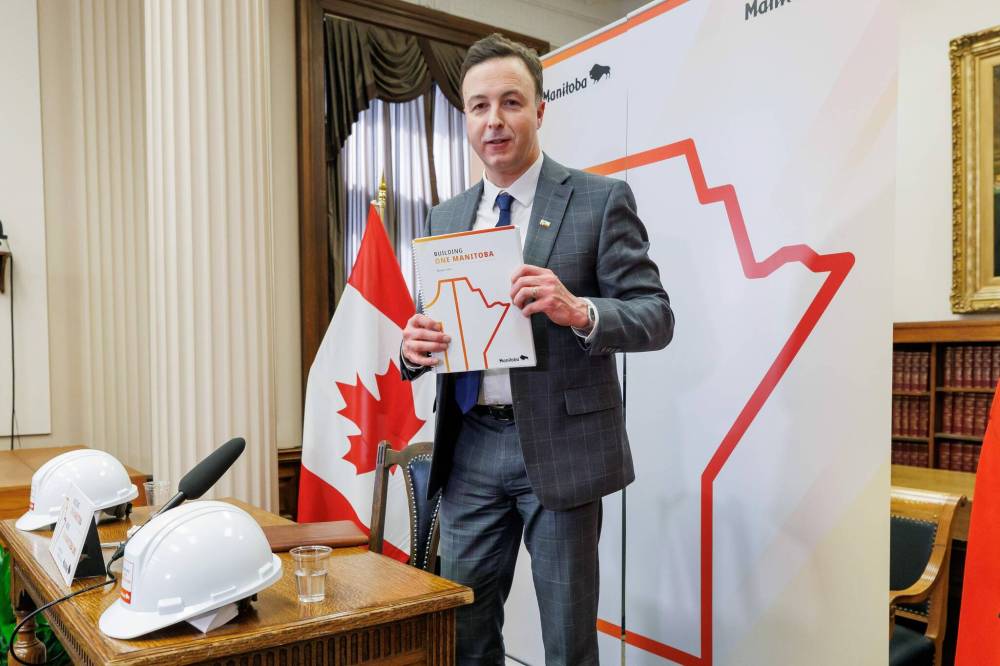
Manitoba Finance Minister, Adrien Sala, talks to the media prior to tabling the 2025 Manitoba Budget last year. This year, the province faces especially tough choices due to world events, and something has got to give, writes Jesse Hajer. (Mike Deal/The Winnipeg Free Press files)
Premier Wab Kinew made these commitments based on a misleading, overly optimistic fiscal forecast released by the governing PCs in the lead-up to the 2023 election, but has yet to revisit the fiscally conservative promises despite significant fiscal pressures. The debt-to-GDP ratio is projected to reach 38.2 per cent, one of the higher ratios among provinces and the second highest in modern Manitoba history.
It is tempting to frame the issue as a simple need for spending restraint, but the province is still facing a large deficit despite low projected spending growth this year of 2.3 per cent, about equal to inflation.
Only looking at spending ignores how we got here. Between 2016 and 2023, the PC government’s tax cuts reduced provincial revenues by about $1.6 billion (coincidentally and notably equivalent to this year’s projected deficit). Those tax cuts benefited high-income earners and wealthy property owners the most, while providing very little for low-income Manitobans.
The NDP government has floated ideas for further tax cuts, for example, by removing the PST from nonessential items sold at grocery stores — a move that would impact all consumers, the wealthy included.
That would be a mistake — Manitoba cannot afford to further undermine the provincial treasury by cutting the shopping bills of millionaires.
Any affordability support should be income-tested to ensure scarce public dollars go to those who need it, for example, through a PST credit for lower-income earners.
We need to prioritize revenues to rebuild our public services.
From 2016 to 2023, the PCs pursued austerity measures that shrank the public service, froze wages, and left our health-care system and public services more generally in disarray.
Approximately 2,000 workers were cut from the civil service, and vacancy rates reached 22 per cent during this period.
Chronic understaffing contributed to burnout, attrition, and declining service quality.
Things are improving, but many of these challenges remain.
The tax cuts undertaken by the previous Manitoba government and mostly maintained by the current one are unsustainable and have generated a massive hole in the provincial budget, slowing progress on rebuilding health care and other public services.
The NDP government has taken some modest steps to increase revenues, including changes to education property tax credits and a clawback of some tax credits for very high-income earners, but these measures only recover roughly 14 per cent of the PC cuts. If we are going to stabilize Manitoba’s finances, increased revenue measures will be required.
That said, the province needs to ensure that the burden of any tax increase is equitable. High inflation hit the bottom 40 per cent of households hardest, reducing their purchasing power and creating significant cost-of-living challenges.
Higher income households, however, have not faced the same burden, with gains in investment income more than compensating for higher costs.
The province should be looking at ways to ensure that those who are better off are the ones required to pay more. There are many options that have been implemented in other provinces, including adding a higher income tax bracket, further clawing back tax credits for high-income earners, and implementing higher property taxes on high-end homes (a “mansions tax”).
While reducing deficits should be part of the medium-term plan, the budget cannot realistically be balanced before the next election without deep cuts to public services, especially given the challenging economic circumstances we currently face.
In periods of economic uncertainty, strong public institutions help households weather downturns, support businesses through infrastructure and skilling-up workers, and stimulate the economy.
Manitoba needs revenues to continue investing in public assets that produce long-term economic returns: quality childcare and education, social housing, energy infrastructure, climate resilience, and efficient public services. These investments not only improve quality of life and reduce inequality; they also support labour force participation, productivity, and economic growth.
Budget 2026 should consider responsible revenue measures to fund these investments and promote the benefits Manitobans receive from public services, with a focus on equity and fairness.
Budgets are, at their core, statements of values.
This year’s budget will provide an important opportunity, in an increasingly unstable and precarious global political and economic environment, to signal what values our government prioritizes.
» Jesse Hajer is an associate professor in economics and labour studies at the University of Manitoba and a research associate with the Canadian Centre for Policy Alternatives – Manitoba.