
Is America the safe harbour?
Advertisement
Read this article for free:
or
Already have an account? Log in here »
We need your support!
Local journalism needs your support!
As we navigate through unprecedented times, our journalists are working harder than ever to bring you the latest local updates to keep you safe and informed.
Now, more than ever, we need your support.
Starting at $15.99 plus taxes every four weeks you can access your Brandon Sun online and full access to all content as it appears on our website.
Subscribe Nowor call circulation directly at (204) 727-0527.
Your pledge helps to ensure we provide the news that matters most to your community!
To continue reading, please subscribe:
Add Brandon Sun access to your Free Press subscription for only an additional
$1 for the first 4 weeks*
*Your next subscription payment will increase by $1.00 and you will be charged $20.00 plus GST for four weeks. After four weeks, your payment will increase to $24.00 plus GST every four weeks.
Read unlimited articles for free today:
or
Already have an account? Log in here »
During the past year, there have been oceans of ink and pixels spilled about how much, and how quickly, Canadians’ views of and relationship with the U.S. has changed. With Donald Trump’s 51st state talk, many Canadians are turning away from America as much as they can — not travelling there, not buying stuff they make, etc.
My team at Probe Research and I have been pulling hard at these threads for the past 12 months, trying to understand how these views are evolving and what it means politically, culturally and economically. We’ve been asking questions that I never imagined asking — like our latest, which finds that more than one in five Manitobans think there is at least some possibility of our southern neighbour invading our home and native land in the next two years.
This would have seemed far-fetched at one point — Bud Boomer and his beer-drinking, brawling buddies becoming the tip of a propaganda spear was the stuff of farce, seemingly far from reality.
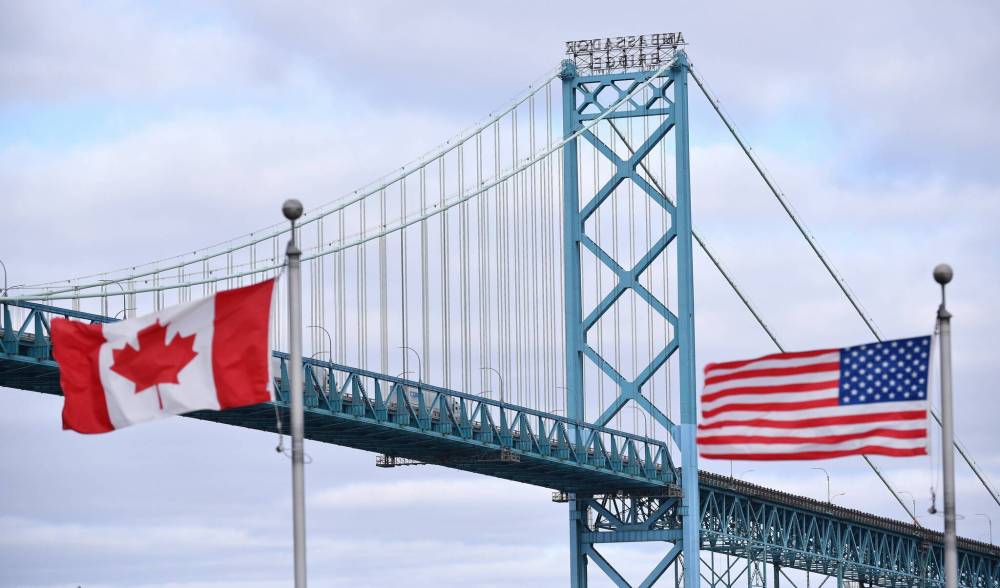
Canadian and American flags fly near the Ambassador Bridge at the Canada-USA border crossing in Windsor, Ont. in March 2020. Probe Research Inc. partner Curtis Brown examines the loyalty to the U.S. held by a portion of Canadians. (The Canadian Press)
But it’s not such a joke in 2026. Look at Denmark’s plans to repel a U.S. invasion of Greenland, and it’s not so hard to imagine what might unfold if planes, drones and even troops suddenly sweep in over the 49th parallel to make Canada American.
With this — and with all the focus on trade issues — we see most Manitobans and Canadians supportive of the approach being taken by Prime Minister Mark Carney and the federal Liberal government. Don’t cave on whatever Trump’s latest threats are. Try to sell more stuff to Europe, China and India. Seek out coalitions with other countries who share our values and place in the world.
But one thing strikes me again and again when I look at the data. For a small yet sizeable chunk of the population, the present version of America is not viewed as a threat — in fact, it might even be the safer port in a stormy world. And even if its democratic character convulses and changes with all the things the Trump administration is doing, a mixture of either grim realism or frustrated naiveté has these folks clinging hard to the U.S. no matter what.
So who are these people?
Based on our extensive polling over the past year, they tend to be younger men who do not have a university degree and who work in blue collar or service jobs. They’re more likely to be found in rural parts of Manitoba than in Winnipeg.
And the one connective thread is that they’re much, much more likely to support the federal Conservatives.
To be clear — they aren’t the majority of Conservative supporters, many of whom are as vocally elbows up as everyone else.
But the results of one of our recent questions showed this very starkly. We asked: How willing are you, if at all, do accept some economic pain (higher prices, job losses, etc.) if Canada deliberately reduces its trading relationship with the United States?
Overall, 55 per cent of Manitobans either strongly or somewhat agreed with this. This shoots up to 71 per cent among women over 55. But among men aged 18-34? It’s half that (34 per cent).
And most tellingly — only 29 per cent of federal Conservative voters would accept this level of economic turmoil. Among Liberals and NDP voters, it’s way higher — 75 per cent and 71 per cent, respectively.
Only 46 per cent of federal Conservative voters agree Canada should make alliances with other countries to potentially protect itself against the U.S. (it’s 71 per cent overall, and around 90 per cent among Liberal and NDP voters).
More than one-quarter — 27 per cent — of Conservative voters support Canada becoming part of the U.S. It’s 13 per cent overall, and practically nil among Liberals and NDP supporters.
Conservative supporters are also more likely to still see the U.S. as Canada’s ally. And they’re more likely to want Canada to negotiate any trade deal — even if it’s not great — than walk away from free trade negotiations.
So, why?
You might guess this is a case of picking up some Maple MAGA bros in our polling who generally like Trump and his overall approach. But this doesn’t explain why the difference is so stark for some things, particularly the resistance to experiencing economic pain.
My broader theory is that this is deeply rooted in prolonged economic anxiety. For younger folks who are less economically secure, talk of enduring higher prices and job losses on top of what we’ve already experienced in the past few years may be deeply unappealing.
If you’re barely scraping by and feel you can’t get ahead — if you can’t save up for a down payment, struggle to cover rising costs and feel your job is hanging by a thread or two — the idea of voluntarily signing up for economic hardship would be a bridge too far.
If you’re older, retired and more economically secure, on the other hand, perhaps you feel that you can deal with the downsides of a major shock to our economic system.
To the folks living in this more precarious place, clinging to the U.S. may be a potentially safer bet. It’s the big economy next door, and there’s been free trade for (in many cases) their entire lifetimes. Even if the days of unfettered, tariff-free trade are over, you may see it as more pragmatic to make any kind of deal with the Trump administration and hope for the best.
For some, even joining the U.S. may be viewed as a better proposition. If the promise of the Canadian economy hasn’t been working for you, it might be appealing to potentially get paid in American dollars and be able to move somewhere like Florida or Texas with plenty of sunshine and zero state income tax.
For some, the downside of a 159-year-old sovereign country being swallowed whole by its neighbour could be a small price to pay if it potentially means the personal financial stability and economic opportunities that have been eluding them in Canada most of their adult lives.
Maybe Pierre Poilievre explaining to large American audiences why tariffs are a bad idea will alleviate the situation. With energy prices rising and pressure on the Trump administration rising, perhaps the message will get through that messing with this largely harmonious economic and political relationship was never a good idea.
But there may be more happening under the surface. And I’m keen to dig deeper into it in as these interesting times unfold.
» Curtis Brown is a partner at Probe Research Inc., and a former editorial page editor with The Brandon Sun