
Boosting vaccine access only part of the solution
Advertisement
Read this article for free:
or
Already have an account? Log in here »
We need your support!
Local journalism needs your support!
As we navigate through unprecedented times, our journalists are working harder than ever to bring you the latest local updates to keep you safe and informed.
Now, more than ever, we need your support.
Starting at $15.99 plus taxes every four weeks you can access your Brandon Sun online and full access to all content as it appears on our website.
Subscribe Nowor call circulation directly at (204) 727-0527.
Your pledge helps to ensure we provide the news that matters most to your community!
To continue reading, please subscribe:
Add Brandon Sun access to your Free Press subscription for only an additional
$1 for the first 4 weeks*
*Your next subscription payment will increase by $1.00 and you will be charged $20.00 plus GST for four weeks. After four weeks, your payment will increase to $24.00 plus GST every four weeks.
Read unlimited articles for free today:
or
Already have an account? Log in here »
Manitoba’s measles outbreak didn’t happen overnight, and it won’t be solved with a single policy change. But the province’s decision Monday to allow pharmacists to administer measles vaccines is a practical, sensible decision.
With 352 confirmed cases so far in 2026 — more than every other province combined — Manitoba now leads the country in something no jurisdiction wants to lead: the resurgence of a highly contagious, entirely preventable disease.
The numbers are stark. The implications are worse. And the underlying cause is unmistakable.
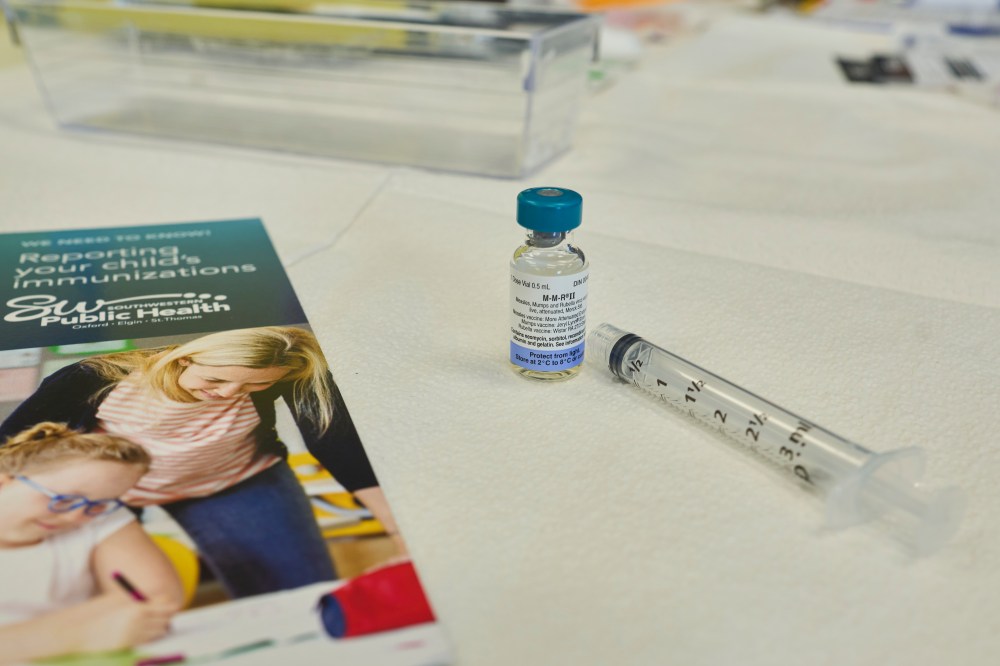
About 90 per cent of those infected this year were not immunized.
Pharmacists Manitoba on Monday called for an “all-hands-on-deck” response to the outbreak, including allowing pharmacists to administer the measles vaccine.
Within hours, Health Minister Uzoma Asagwara agreed with that request, announcing the change will occur immediately. The minster deserves credit for the speedy and correct response.
There are more than 1,700 pharmacists working in nearly 500 pharmacies across 90 communities in Manitoba. They are among the most accessible health-care providers in the province, particularly in rural and under-served areas where access to doctors and clinics can be limited.
Pharmacists have established relationships with patients. They are trained, regulated and already deeply involved in vaccine delivery for influenza and COVID-19.
Other provinces have already recognized this reality. British Columbia, Quebec and several Atlantic provinces allow pharmacists to administer the measles vaccine.
The infrastructure is largely in place. Most pharmacists already have access to Manitoba’s Public Health Information Management System, allowing them to check immunization records and update them in real time.
They can communicate with physicians and integrate seamlessly into the broader health system. This isn’t a leap into the unknown. It’s an incremental, logical expansion of an existing role.
And it will make a difference, at least at the margins.
Convenience matters. Access matters. When people can get vaccinated at a local pharmacy in the evening or on a weekend, rather than navigating limited clinic hours or long wait times, some will take that option. Not all, but some. And in the middle of an outbreak, every additional vaccination helps slow the spread.
But let’s be clear about what this is and what it isn’t.
Allowing pharmacists to administer the measles vaccine is a necessary step. But it’s not enough to combat this outbreak.
That’s because Manitoba’s vaccination problem is not primarily about access. It’s about misinformation around vaccines generally, a growing phenomenon in some parts of the province that has caused immunization rates among children to fall.
The measles vaccine is safe. It’s effective. It has been used for decades and has prevented countless illnesses and deaths. None of that is in scientific dispute.
Yet a growing number of Manitoba families have chosen to opt out, leaving themselves, their children and their communities vulnerable.
Why?
Because misinformation works.
During the COVID-19 pandemic, anti-vaccine rhetoric found fertile ground, particularly in parts of rural, southern Manitoba. What was once fringe thinking became mainstream in some circles, amplified by social media algorithms that reward outrage and conspiracy over evidence and expertise.
False claims about vaccine safety, government overreach and fabricated risks spread faster than any virus. And unlike measles, there’s no simple injection to stop it.
The result is what we’re seeing now: declining vaccination rates, rising case counts and a health-care system once again forced to deal with a problem that should have been left in the past.
If the province is serious about turning this around, it needs to confront the misinformation crisis with far greater urgency.
That means an aggressive, co-ordinated, multi-faceted public information campaign — one that goes far beyond passive messaging and generic reassurances.
The medical community must lead, but it cannot act alone. Schools need to play a central role in educating students — and by extension, their families — about the science and importance of vaccines.
Government must invest in clear, consistent messaging that is tailored to different communities, including those where skepticism runs highest. Community leaders, including those in rural areas, and faith-based organizations, need to be part of the conversation, not bystanders to it.
And perhaps most important, misinformation needs to be challenged directly.
For too long, there has been a reluctance to engage head-on the claims pushed by the anti-vaccine movement, as if ignoring them might make them go away. It hasn’t. Their reckless falsehoods have filled a vacuum, shaping perceptions and decisions in ways that are now having real-world consequences.
Combating that requires more than facts on a website. It requires active outreach, targeted communication and a willingness to repeat the truth — clearly, consistently and persistently — until it breaks through.
None of this will produce instant results. Changing minds rarely does. But without that stepped-up effort, Manitoba will remain stuck in a cycle of preventable outbreaks and reactive measures.
Letting pharmacists administer the measles vaccine is a smart, practical move. The province is right to act on it immediately.
But if that’s where the response begins and ends, it won’t be enough.
» Tom Brodbeck is a Winnipeg Free Press columnist.