
Canada can play a role in what’s next for climate
Advertisement
Read this article for free:
or
Already have an account? Log in here »
We need your support!
Local journalism needs your support!
As we navigate through unprecedented times, our journalists are working harder than ever to bring you the latest local updates to keep you safe and informed.
Now, more than ever, we need your support.
Starting at $15.99 plus taxes every four weeks you can access your Brandon Sun online and full access to all content as it appears on our website.
Subscribe Nowor call circulation directly at (204) 727-0527.
Your pledge helps to ensure we provide the news that matters most to your community!
To continue reading, please subscribe:
Add Brandon Sun access to your Free Press subscription for only an additional
$1 for the first 4 weeks*
- Enjoy unlimited reading on brandonsun.com
- Read the Brandon Sun E-Edition, our digital replica newspaper
*Your next Free Press subscription payment will increase by $1.00 and you will be charged $20.95 plus GST for four weeks. After four weeks, your payment will increase to $24.95 plus GST every four weeks.
Read unlimited articles for free today:
or
Already have an account? Log in here »
Global warming is getting a cold shoulder these days; it’s a hoax, according to the official policy of the United States of America, now the world leader in oil and gas production.
If the scientific community is alarmed, they aren’t shouting very loud. The World Meteorological Organization has released a report — you can read about it in your favourite news feed by scrolling past sports and celebrity items — that documents the alarming warming of the oceans and its likely effects. Coverage on major news networks merited a minute, maybe; you will probably have to wait a while before getting much more climate change coverage.
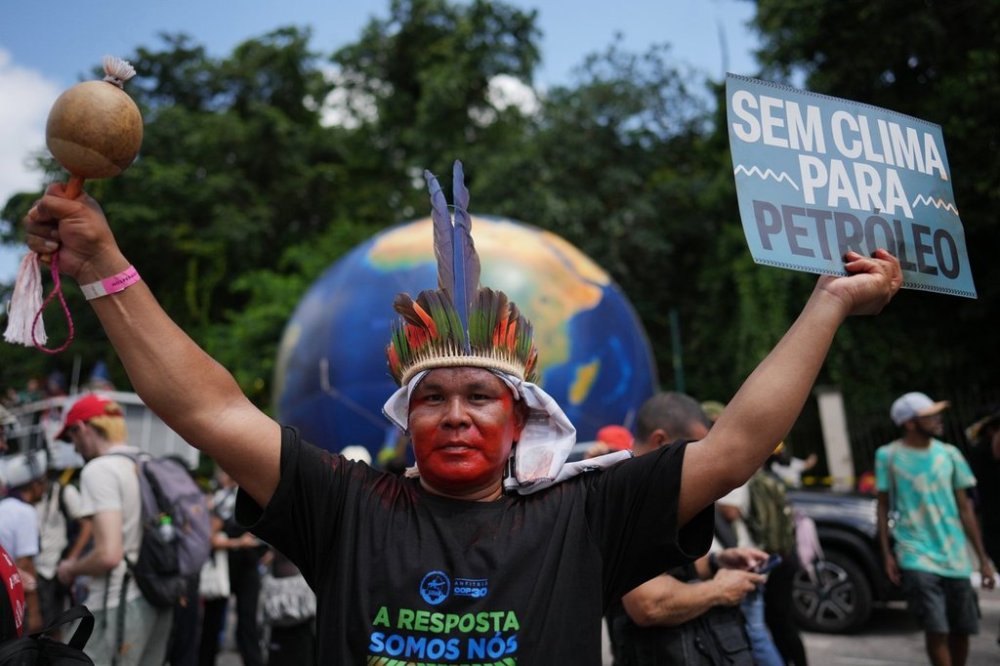
The secretary-general of the United Nations reacted with: “every key climate indicator is flashing red.” No kidding. The UN’s annual Conference of the Parties brings together its 198 member states to attempt to reach consensus on actions to combat climate change. Consensus on anything meaningful in a group that includes failed states, criminal states, autocracies, absolute monarchies, theocracies and several whose economies rely heavily on oil and gas revenues is not difficult — it’s impossible. The 30th instalment — COP 30 held last November in Brazil, which was attended by tens of thousands of delegates — received coverage commensurate with its results; almost nothing. Perhaps the corpse will materialize again next November — after all, it has become a mini-industry — but the process lacks any credibility and is dead.
If the U.S. has any rational strategy at all, it is to become the world’s energy superpower, opening up markets in India, Europe and Africa, while controlling competing sources like Venezuela and Iraq and destabilizing others like Iran. This, of course, depends upon extending the fossil energy era indefinitely; the U.S. won’t be exporting windmills or solar panels.
Business has fallen into line. Few companies bother to “greenwash” anymore. Major financial institutions that had previously committed to policies promoting green investment have quietly dropped any such aspirations. Major vehicle manufacturers have written down billions in losses as they scramble to get out of the electric vehicle business.
The assault on Iran has revealed just how little progress we’ve made over the last 30 years in reducing our dependence on fossil energy. We are in a genuine energy crisis. The price of gas is covered every day in every newscast.
The International Energy Agency has stepped in to ease the crisis by releasing 400 million barrels of oil into the market. That will cover about four days of global oil consumption.
The true state of affairs can be discerned by following a few key indicators — the level of atmospheric CO2, daily global oil consumption, global greenhouse gas emissions, ocean temperatures and average annual global temperature. There are others, but these provide a clear picture. All are pointed in the same direction — up. Having reverted to an almost business-as-usual case, the actions required to contain global temperature increase below three degrees centigrade are, barring a global catastrophe, out of reach.
There are positive indicators like the substantial increase in global renewable energy supply. Unfortunately, this is largely, at least in the large economies, meeting the rapid increase in the demand for electricity by uses like data centres, veritable energy black holes. There are not a lot of coal, oil and gas-fired generating stations being retired, while more new ones are being built. Our own Manitoba Hydro Integrated Resource Plan includes increased reliance on natural gas.
What’s the point of all this whinging? Well, if we continue to shrug our shoulders as America seeks to increase our dependence on fossil energy, we will wake up three years from now to key climate change indicators and the accelerating effects that are much, much worse.
Canada can play a key role to ensure that the world is not just marking time. Prime Minister Mark Carney can begin by putting into action the fine words of his Davos speech.
First, he can fill the vacuum created by the failed UN COP process by providing climate leadership for the “middle powers.” The message: ‘Let’s collectively get ready for the inevitable climate shock as a result of the next several years of increased carbon emissions.” Consensus among 20 or so countries is feasible.
Second, he can build on our long-delayed rapprochement with China to bring China into this new climate coalition. China is the global leader in emissions. They are world leaders in new renewable and nuclear energy production. They continue to build new fossil fuel electrical capacity. They will be severely impacted by climate change. Sure, we have to be cautious about our relationship with China, but it must be brought into the tent.
Finally, the prime minister can initiate a massive program of adaptation that can prepare our food supply, infrastructure and freshwater resources for the climate shock to come. And of course, since the Iran war has demonstrated just how dangerous our reliance on fossil energy is, we should be pouring resources into a national energy grid and renewables.
We are, as Carney articulated in Davos, in a new era, uncertain and dangerous times in which we are going to have to live with ambiguity. We will preach common action on climate while prolonging the life of some less-than-climate-friendly industries. We will have measured diplomatic and economic relations with nations we recently considered “enemies.” We will part company internationally with our heretofore strongest ally, while still maintaining many of the strong north-south linkages between Canada and the U.S.
We need certainty in direction even while outcomes remain uncertain. May you live in interesting times.
» Norman Brandson is the former deputy minister of the Manitoba departments of environment, conservation and water stewardship. This column previously ran in the Winnipeg Free Press.