
Watching war from a distance creates sense of ‘split belonging’
Advertisement
Read this article for free:
or
Already have an account? Log in here »
We need your support!
Local journalism needs your support!
As we navigate through unprecedented times, our journalists are working harder than ever to bring you the latest local updates to keep you safe and informed.
Now, more than ever, we need your support.
Starting at $15.99 plus taxes every four weeks you can access your Brandon Sun online and full access to all content as it appears on our website.
Subscribe Nowor call circulation directly at (204) 727-0527.
Your pledge helps to ensure we provide the news that matters most to your community!
To continue reading, please subscribe:
Add Brandon Sun access to your Free Press subscription for only an additional
$1 for the first 4 weeks*
*Your next subscription payment will increase by $1.00 and you will be charged $20.00 plus GST for four weeks. After four weeks, your payment will increase to $24.00 plus GST every four weeks.
Read unlimited articles for free today:
or
Already have an account? Log in here »
I live and work in Toronto, but as a Lebanese‑Ukrainian immigrant in Canada, my attention has been elsewhere since the United States and Israel launched their war with Iran. I refresh my phone constantly, checking in with family in Lebanon, scanning group chats, watching the news, hoping the next alert is not the one I fear most.
For many in diaspora communities, this has become a daily condition. As conflict in the Middle East intensifies, its effects are not contained by borders. They are lived transnationally, folding distant violence into the routines of everyday life.
What emerges is a condition I — a displacement, migration and identity scholar — call “split belonging,” an experience of being physically located in one place while remaining emotionally, cognitively and relationally anchored in another that is under threat.
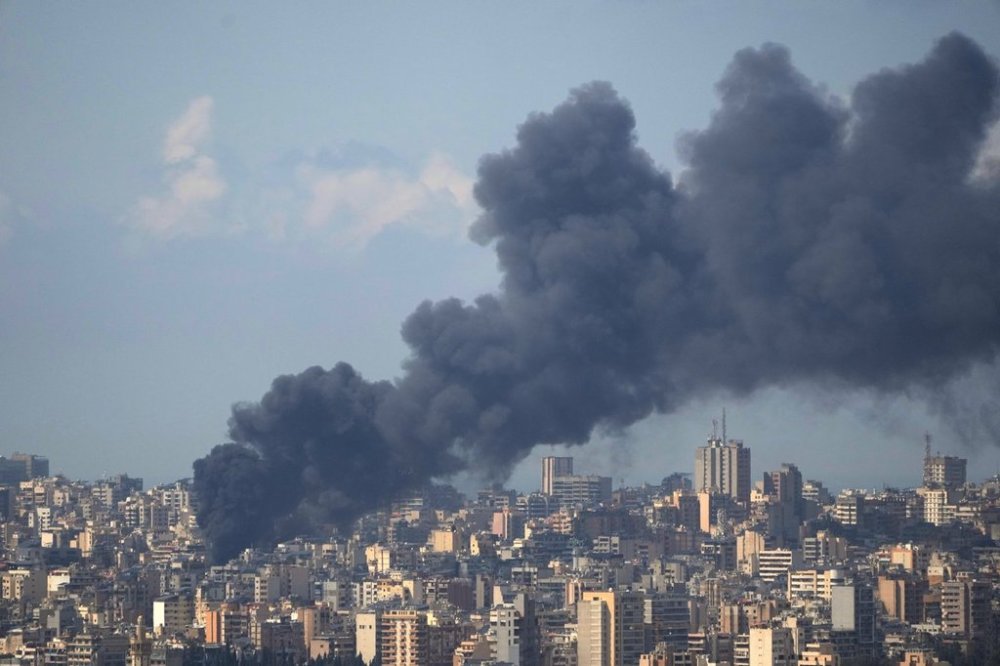
Unlike more familiar accounts of diaspora and hybrid identities — which often emphasize continuity or the preservation of an unbroken cultural lineage and the formation of new identities through cultural mixing — “split belonging” is about being pulled by two places at once.
It captures the demand to function in conditions of stability while remaining persistently oriented toward instability elsewhere, especially where loved ones still reside there
This distinction shifts the focus from identity to capacity, asking how people live, work and participate while managing ongoing exposure to crisis.
LIVING IN BETWEEN STABILITY, INSTABILITY
My own experience reflects this.
I’ve lived at a distance from conflict in both my home countries: the October 2019 Lebanese uprising; the Beirut explosion in August 2020; the Russian invasion of Ukraine beginning in February 2022; the Israeli war in Lebanon in 2024; and the current bombardments displacing more than a million people.
Experiencing these events remotely reorganizes daily life. It shows up in the rituals that become instinctive: calling for proof of life, calculating the distance between a bombing site and a relative’s home, then returning, almost automatically, to meetings and deadlines.
This is the emotional architecture of split belonging. It is not a single crisis, but a constant oscillation between urgency and routine.
It is hearing your niece say: “They hit the house next to my school, but we’re OK, we’re used to this,” and realizing she has already learned to normalize fear. And then, because life here keeps moving, it’s also returning to your work inbox as if nothing has happened.
This rhythm is sustained by technological proximity and social expectation. The same tools that enable connection, such as WhatsApp and live news, also ensure that distance no longer protects against exposure.
THE HIDDEN STRAIN OF TRANSNATIONAL STRESS
Cultural psychology research helps explain why this condition is so consuming. The distress often appears in indirect forms, including fatigue, distraction, irritability or emotional numbing — states that are easily misread in workplaces and classrooms.
This is compounded by what researchers describe as remote conflict stress, the strain experienced by individuals who are physically safe but emotionally embedded in zones of violence. This form of stress disrupts concentration, sleep and decision-making, shaping how people engage with their environments even when those environments are stable.
The concept of split belonging extends this insight by situating remote stress within broader social and relational dynamics.
Migrants are often expected to provide emotional support, financial assistance and real-time co-ordination for family members in crisis. These obligations intensify during periods of conflict, increasing pressure and dependency across borders.
Scholars of migration and diaspora have long argued that belonging is not a fixed state but a negotiation between place, memory and the stories we inherit. Sara Ahmed, a post-colonialism and critical race scholar, writes that emotions “stick” to bodies and histories, shaping how individuals move through the world. This helps explain how attachments to places in conflict are not easily set aside through migration.
Feminist and gender studies academic Judith Butler similarly argues that grief reveals the attachments that constitute who we are. This clarifies why distant violence is experienced as immediate. Under conditions of split belonging, threats to loved ones abroad are not abstract concerns, but disruptions to the very relationships that anchor a person’s sense of self.
Together, these frameworks show how global conflict becomes embedded in the everyday lives of diasporic individuals, even though they remain geographically distant.
WHY THIS ISN’T JUST PERSONAL
Digital media plays a central role in this process. It acts as both infrastructure and amplifier.
Continuous immersion in graphic content and live updates extends the reach of violence and makes disengagement difficult. Following it online can trigger anxiety, depression and symptoms resembling PTSD even when people are physically safe. Digital exposures intensify the psychological burden of watching violence unfold from afar.
These dynamics have concrete consequences that remain largely unacknowledged in public discourse. In workplaces, cognitive overload can affect performance, productivity and career progression, contributing to underemployment. In educational settings, disruptions to attention and memory shape participation and outcomes.
Ongoing crises abroad can also deepen social isolation for migrants, which is one of the strongest predictors of poor mental health among newcomers.
Canada’s multiculturalism model recognizes that belonging can extend across local and global contexts, but it often treats these connections as stable rather than crisis-driven. Split belonging highlights this limitation.
Recognizing the feeling of split belonging has important implications for policy and institutional practice. It points to the need for more flexible and responsive systems.
Workplaces need to account for transnational stress. Educational institutions need trauma-informed approaches that recognize ongoing crises. Settlement services need to address not only past trauma but also continuous exposure to instability abroad.
As global conflicts persist, immigrants will continue to meet their obligations to employers, schools and families while navigating forms of strain that remain private. But to meaningfully support diasporic inclusion, Canadian institutions need to understand this reality.
» Lara El Mekaui is a research fellow with FUTUREMIG — Futures of Migration and Mobility project at Toronto Metropolitan University.
» This column was originally published at The Conversation Canada: theconversation.com/ca