
The evolution of car safety
» NEELIN VIEWS
Advertisement
Read this article for free:
or
Already have an account? Log in here »
We need your support!
Local journalism needs your support!
As we navigate through unprecedented times, our journalists are working harder than ever to bring you the latest local updates to keep you safe and informed.
Now, more than ever, we need your support.
Starting at $15.99 plus taxes every four weeks you can access your Brandon Sun online and full access to all content as it appears on our website.
Subscribe Nowor call circulation directly at (204) 727-0527.
Your pledge helps to ensure we provide the news that matters most to your community!
To continue reading, please subscribe:
Add Brandon Sun access to your Free Press subscription for only an additional
$1 for the first 4 weeks*
- Enjoy unlimited reading on brandonsun.com
- Read the Brandon Sun E-Edition, our digital replica newspaper
*Your next Free Press subscription payment will increase by $1.00 and you will be charged $20.95 plus GST for four weeks. After four weeks, your payment will increase to $24.95 plus GST every four weeks.
Read unlimited articles for free today:
or
Already have an account? Log in here »
When the first gasoline-powered automobile sputtered to life in 1885, it sparked a transformation that would reshape the world. The birth of what we now know as the Mercedes-Benz opened people’s eyes to the possibilities of the future.
Throughout the 20th and early 21st centuries, cars have undergone major advancements in technology, purpose, size and safety. Early vehicles were smaller than today’s sedans, fuel economy rose and fell over time, new innovations appeared every decade, and safety has steadily improved since the earliest days of the automobile.
In the early 20th century, gas cars were short, small, and as hard as a rock. They began with no roof and no doors, and different brands had different top speeds, achieving a top speed of 75 kilometers an hour. The fuel economy in the early-to-mid 20th century was around the same as what it is today, which makes sense considering vehicles like the Mercedes 35 and the Ford Model A are smaller than the Toyota Corolla we know today. Back then, vehicles were seen as transportation instead of luxury, but not a necessity for everyday things. Most people still travelled on foot or by horse and carriage. Early 20th century vehicles did not have key ignition or automatic transmission; rather they had hand cranks to start the engine and manual transmission.
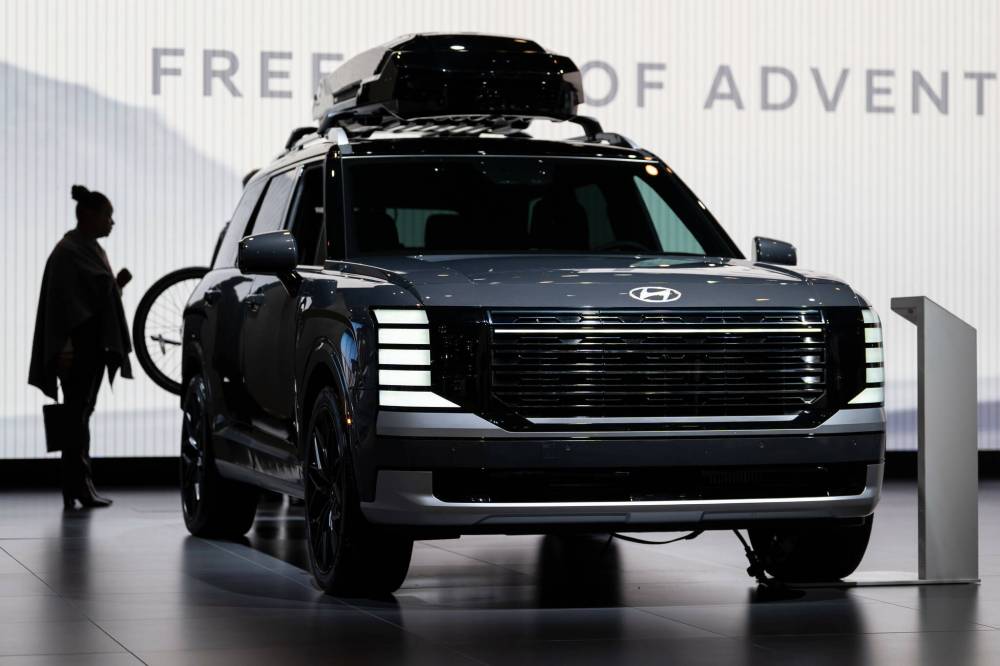
The 2026 Hyundai Palisade Hybrid is displayed at the New York International Auto Show on April 2 in New York. Kitt Hughes describes how cars have evolved in favour of safety. (The Associated Press)
During the Second World War, the automotive industry saw great advancements in technology. Gas cars began to be seen as a symbol of status. During the war, cars gained roofs and doors, though some kept the roofless aesthetic. In the early 40s, cars began to take up more space on the road in the 1941 Packard and the 1942 Hudson, but the technology hadn’t quite made it to mass-producing SUVs yet. Once the U.S. joined the war, domestic manufacturers were required to make vehicles like tanks, jeeps, and planes for the war effort.
After the war, production of commercial vehicles resumed. Post-war cars tended to lean towards artistry, hosting tailfins, grilles, chrome, headlight casings, and many more extravagant details. In 1948, Chrysler created the key ignition as a replacement for the hand crank the vehicles of the early 20th century had. That same year, Buick created the first recorded automatic transmission vehicle, which rendered cars safer and easier to drive. But with the creation of automatic transmission and larger vehicles came the decline of fuel economy worldwide. The fuel economy declined, and the average car just got larger. Vehicles functioning as SUVs started to spike in popularity in the early ‘50s as well, as people began needing (or rather wanting) larger vehicles that could be used for transporting their families and hauling medium tows.
Before 1959, manufacturers believed that the more durable the car, the safer the passenger. But the rise in deaths due to collisions worldwide proved to be a prominent issue. An engineer at Mercedes came up with the idea of “crumple zones” – zones of the car that would crumple on impact and absorb most of the force to help the people inside the vehicle walk away with minimal injuries.With airbags not being mandated until 1988, it made the cars of the ‘60s just a pinch safer. Along with the creation of crumple zones, seatbelts were also beginning to be offered in the ‘50s as the first line of defence for the people inside the cars. Cars today are required to have airbags and seatbelts, but crumple zones depend on the make and model. However, most makes and models today have crumple zones that allow the people inside the vehicle to walk away untouched. Fuel economy at the time was still deteriorating but would look brighter once the 1980s arrived.
By the 1970s, the auto industry began to shift from style to reliability. The 1973 oil crisis, influenced by the policies of the Organization of the Petroleum Exporting Countries (OPEC), forced manufacturers to rethink fuel economy and pushed smaller, more efficient vehicles into the spotlight. Overseas brands such as Toyota and Honda rose to global prominence, building cars that were affordable, dependable, and economical to run. Meanwhile, safety research flourished due to customer advocates highlighting the dangers of poorly designed vehicles. By the late 1980s and into the 1990s, airbags became mandatory, anti-lock braking systems became common, and manufacturers started using computers to control engines and improve fuel efficiency. The most fuel-efficient car of the 1980s was the Honda CRX at roughly 4.8 litres per 100 kilometres, which showed that lightweight, small cars were the best for the environment and for people.
Since the 1990s, cars have seen great leaps and bounds in electronic advancements. In the mid-to-late-90s, adaptive cruise control was invented and introduced in almost every vehicle. Airbags have become safer than ever, with them slowly being introduced in the doors and roof of the cabin of the car. Cars became even more fuel efficient than in the 80s, with the first mass-produced hybrid vehicle being the Toyota Prius, which was released worldwide in 2000. That paved the way for hybrids to improve and modernize throughout the years. In 2010, Nissan launched the Leaf, a fully-electric SUV. Apple Carplay was invented in 2014, followed by Android Auto in 2015, and they were both implemented in almost every new vehicle by 2016. In the last quarter of 2025, nearly 20 per cent of all new registered vehicles in Canada were hybrid.
New technology brings new struggles. Carplay requires a compatible screen to be in the car, and a large handful of new cars after Carplay and Android Auto were introduced took that overboard. With the new large screen inside each car, these technologies contribute to driver distraction. According to the U.S. Department of Transportation, in 2013, before Carplay and Android Auto were created, 16 per cent of all police-reported accidents in the U.S. were caused by distracted driving, yet by 2018, that had spiked to nearly 30 per cent.
Today’s vehicles are safer and more advanced than ever before, but the evolution of the automobile is far from over. As electric vehicles, hybrid technology, and driver-assistance systems continue to develop, the future of transportation is shifting toward sustainability and automation. At the same time, new challenges such as distracted driving remind us that innovation can bring unintended consequences. Though all of this seems overly negative, relative to the beginning of cars in 1885, the commercial vehicle has improved in the interest of the safety of the driver and the passengers.
» Kitt Hughes is a grade 12 student at École secondaire Neelin High School.