
The need for regulation in a digital age
Advertisement
Read this article for free:
or
Already have an account? Log in here »
We need your support!
Local journalism needs your support!
As we navigate through unprecedented times, our journalists are working harder than ever to bring you the latest local updates to keep you safe and informed.
Now, more than ever, we need your support.
Starting at $15.99 plus taxes every four weeks you can access your Brandon Sun online and full access to all content as it appears on our website.
Subscribe Nowor call circulation directly at (204) 727-0527.
Your pledge helps to ensure we provide the news that matters most to your community!
To continue reading, please subscribe:
Add Brandon Sun access to your Free Press subscription for only an additional
$1 for the first 4 weeks*
- Enjoy unlimited reading on brandonsun.com
- Read the Brandon Sun E-Edition, our digital replica newspaper
*Your next Free Press subscription payment will increase by $1.00 and you will be charged $20.95 plus GST for four weeks. After four weeks, your payment will increase to $24.95 plus GST every four weeks.
Read unlimited articles for free today:
or
Already have an account? Log in here »
Mark Zuckerberg, CEO of Meta and co-founder of Facebook, has been under increased scrutiny in past months after being forced to testify in a Los Angeles courtroom over allegations that Meta-owned Instagram is designed to be addictive, especially when it comes to kids.
The social media deity-cum-Trump-sycophant vigorously defended his operations against the mountain of evidence amassed over the past two decades that convincingly shows the harms caused by social media and screentime in general.
Yet Zuckerberg’s court appearance sort of misses the point. We know social media is harmful to kids. We know they are addicted, to adopt that broad-based framework.
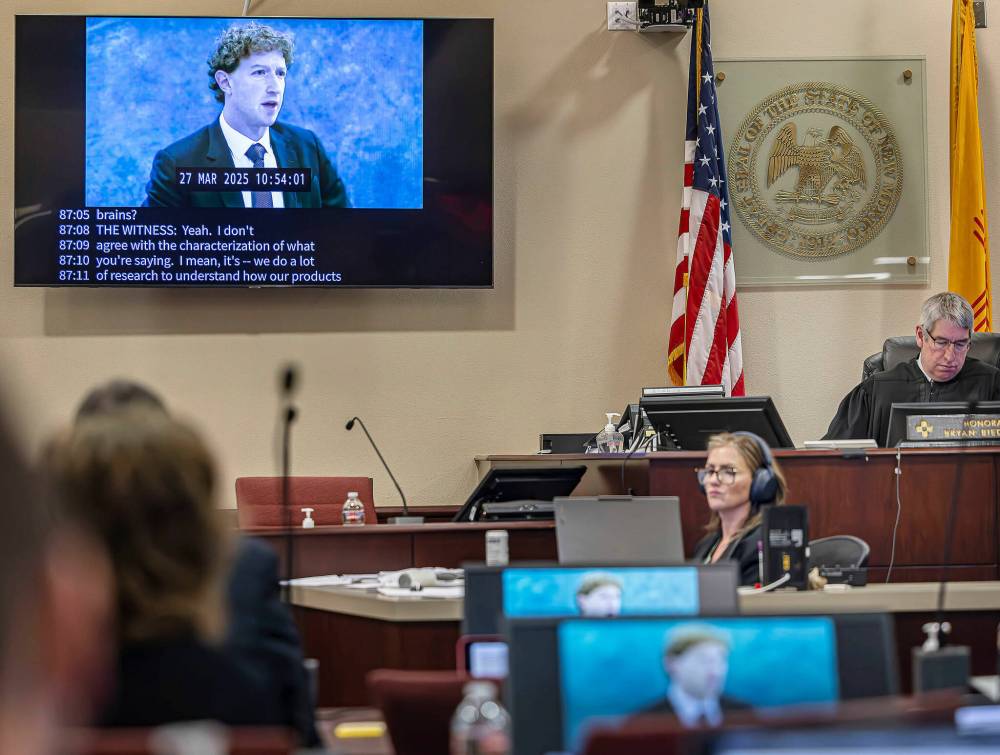
A recording of Meta Founder and CEO Mark Zuckerberg’s deposition is played for the jurors on March 4 in Santa Fe, N.M. The jury ruled against Meta at a trial that centred on child safety. Andrew Lodge argues that the harmful effects of our screens need to be regulated. (Santa Fe New Mexican files)
It also begs the question why we give Zuckerberg and his ilk the pretense of legitimacy, especially when it comes to our well-being and the health of our kids?
The second point is easy enough to dismiss. As if Zuckerberg gives a damn about you or your kids.
For the seller, a product with addictive properties is ideal. Just ask the executives of Big Tobacco. Or the meth dealer down on your corner.
That’s the point of the thing.
The first issue, around safety and well-being is more difficult, if only because in a relatively short period of time, screens have become ubiquitous. Dislodging their place in our society becomes increasingly unimaginable.
Meanwhile, the idea of the internet space freeing your mind has become about as absurd as us bombing Iran into some feminist paradise.
Screens — the veritable window into the digital age — have been transformative. As people the world over stopped looking at — and talking to — each other, and stare zombie-like at a little rectangular box, we need to ask some hard questions.
Why is everyone anxious? More broadly, why is there a precipitous rise in mental health diagnoses?
Without being overly reductionist, one clear change has been screentime and its impact on other social interactions.
Why do virtually all kids exhibit behaviours around devices that are strikingly similar to those in the throes of substance addiction?
The evidence is overwhelming. We just don’t seem to know what to do with it.
Maybe — just maybe — because the adults are in the same boat.
It’s hard to maintain any semblance of parental authority when you are doing the exact same thing you are trying to prevent your kid from doing. Tell little Johnny not to sleep with the screen on. Two hours later, daddy falls asleep with his own screen flickering across his face.
We are all watching this in real time. And, like so many things in our hypersonic world, we seem paralyzed while the maelstrom rages on.
Humans think of themselves as adaptable.
But can we change fast enough for something as intrusive and pervasive as screens have become?
At what point does this dominance fundamentally alter both individual psychology and the
collective consciousness?
Foundational biological theory rests on the notion of adaptability, but the evolution process requires countless generations to unfold. Neurological plasticity — an ability to adapt to new conditions — is remarkable but certainly not without limits. A singular blow can irreversibly alter brain function, and similarly over time, repeated insults can distort how we think, how we act, how we feel.
Hours of screentime a day fits the bill.
The addiction parallel, while not perfect, is instructive.
Behaviour around screens is strikingly similar to characteristics seen in addictions of other sorts. Just ask any parent who removes a tablet or phone from their kids’ hands.
The difference in this analogy is that we regulate substance use. There is near universal consensus on the need to protect people — youth in particular, but also adults — from harmful, maladaptive behaviours. Public health programs exist to mitigate/reduce harms and provide treatment when needed.
Similar safeguards with respect to screens are in woefully short supply. Schools — increasingly on the frontline of child development as other informal collective structures fade — struggle to get a hold on a problem that lands on their doorstep every morning.
But without broader regulation, schools are set up to fail.
Likewise, parents seem helpless to combat this storm that just won’t quit — with headwinds only gaining momentum.
The neoliberal economic mantra that leaves regulation to market forces has always been disastrous when public health is concerned.
When profit is paramount, the most vulnerable are always most susceptible to negative consequences along the way. A child’s heightened anxiety is considered an externality in economic parlance, an unintended byproduct that should, nevertheless, not impede the shareholder imperative to profit.
The kids are woefully exposed. We all are, to a great degree, but the formative years are a particularly fertile time — and one that is all too easily disrupted.
Make no mistake. Digital technology has become a massive disrupter.
Do we really want the Zuckerbergs of the world — entirely driven by profit — to hold sway over the one of the most dominant forces in our societal mindscape?
Put more simply, do you want him and his friends to be the arbiters of your kid’s mental health?
We desperately need regulation to curb the impact screens are having on every aspect of our lives. Government needs to move to support those on the frontlines of child development. Regulation does not mean draconian measures.
But it does require identifying potential harms and legislating measures to prevent these from taking hold — more than they already have.
It would benefit us all.
» Andrew Lodge is an assistant professor at the University of Manitoba and medical director of Klinic Community Health.