
A speech short on specifics
Advertisement
Read this article for free:
or
Already have an account? Log in here »
We need your support!
Local journalism needs your support!
As we navigate through unprecedented times, our journalists are working harder than ever to bring you the latest local updates to keep you safe and informed.
Now, more than ever, we need your support.
Starting at $15.99 plus taxes every four weeks you can access your Brandon Sun online and full access to all content as it appears on our website.
Subscribe Nowor call circulation directly at (204) 727-0527.
Your pledge helps to ensure we provide the news that matters most to your community!
To continue reading, please subscribe:
Add Brandon Sun access to your Free Press subscription for only an additional
$1 for the first 4 weeks*
*Your next subscription payment will increase by $1.00 and you will be charged $20.00 plus GST for four weeks. After four weeks, your payment will increase to $24.00 plus GST every four weeks.
Read unlimited articles for free today:
or
Already have an account? Log in here »
During the years I worked for the Manitoba government, I had a hand in writing several of the premier’s “state of the province” speeches. There would be a speech each December for a Winnipeg audience, followed by a different speech to be delivered in Brandon each spring.
In almost every case, the content and themes of the speeches would be different, in that they focused somewhat on issues relevant to the communities where the speech was being delivered. An additional factor that impacted the content of those speeches was the reality that the Winnipeg speech was delivered when the provincial budget process was just beginning, while the Brandon speech was usually given after the new provincial budget had been tabled.
Despite the uniqueness of each “SOTP speech,” they would each contain two key components: a summary of where the province currently stood on a range of important issues (the provincial economy in particular), along with a glimpse of the government’s plans for the future. In simple terms, the objective was to give each audience a clear sense of where we are and a positive, perhaps even hopeful, vision of where we are going.
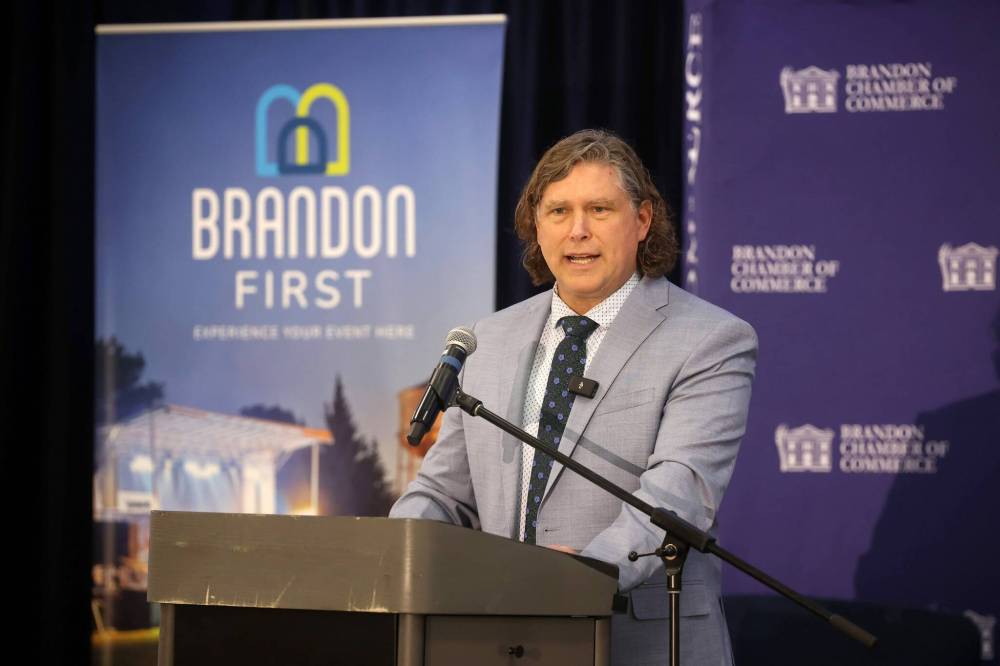
Brandon Mayor Jeff Fawcett delivers a keynote address during the Brandon Chamber of Commerce’s State of the City luncheon at the Keystone Centre’s UCT Pavilion on Thursday. (Tim Smith/The Brandon Sun)
Those two components can be seen in the “state of the city” speech delivered this week by Brandon Mayor Jeff Fawcett to a Brandon Chamber of Commerce audience. During his presentation, he claimed that Brandon has added more than 400 new housing units and recorded approximately $150 million in construction activity this year, including $80 million in residential development. He emphasized that the city’s housing efforts require a mix of solutions, but added that the strong demand for entry-level and workforce housing means that “We can’t go fast enough.”
Fawcett also told the audience that the city has been actively pursuing funding from both the federal and provincial governments and said that “In the last four years, we secured over $106 million for the City of Brandon … This does not happen by accident. It’s a calculated effort to be constantly talking about Brandon at every table in every room.”
In what should be regarded as election-year rhetoric, he claimed that “Brandon is much better off than it was four years ago … We have momentum, and we need to keep building on it.” Part of that momentum presumably includes the goal of increasing the city’s population to 80,000 by 2040. He explained that the target “is part of building economic sovereignty. This is part of getting the critical population we need to have the services and identity Brandonites want.” I’m not sure what that actually means, but it sounds good.
This year’s speech was more focused than the mayor’s previous efforts, and it contained the “here’s where we are, here’s where we’re going” components, but did it hit the target? Was it the speech Fawcett needed to give, and Brandonites needed to hear, at this time?
With many national polls showing that Canadians’ and Manitobans’ top concerns are inflation and affordability, the speech could have done more to convince, if not reassure, the audience that the city understands the concern so many are feeling and is working hard to ensure that taxpayers are getting their money’s worth.
In particular, Brandonites are paying much higher water bills and are about to receive significantly higher property tax bills. They need to hear a credible explanation why those increases are necessary, how they benefit from those higher bills and when the pain of large increases will end. With a growing number of citizens struggling to make ends meet, they need to know that the mayor and council understand their worries and are doing what they can to minimize that anxiety.
Beyond that, it would have been helpful for the speech to be clearer on future economic development and downtown revitalization plans. Fawcett may want to increase the population to 80,000 within the next 14 years, but that means adding thousands of new jobs. Who will be creating those jobs and how much will they pay? Where will all those new workers come from and what skills will they need? What role will Brandon University and Assiniboine College play in ensuring those new workers have the necessary skills?
Those are just some of the details that should normally be in any state of the city speech because they would give a clearer sense of the mayor’s vision for the city’s future. Beyond that, they would also help the audience assess whether the goals are realistic, or merely expressions of hope for future mayors and councils to deliver on.
Having said all of that, Fawcett’s speech was better than his previous efforts, and must be viewed in the context of the fact the next municipal election is just six months away. Whether there was enough in the speech to convince voters to give him another four years to capitalize on the momentum he claims exists is up to them to decide.