
Patchwork of half-measures not real interprovincial trade reform
Advertisement
Read this article for free:
or
Already have an account? Log in here »
We need your support!
Local journalism needs your support!
As we navigate through unprecedented times, our journalists are working harder than ever to bring you the latest local updates to keep you safe and informed.
Now, more than ever, we need your support.
Starting at $15.99 plus taxes every four weeks you can access your Brandon Sun online and full access to all content as it appears on our website.
Subscribe Nowor call circulation directly at (204) 727-0527.
Your pledge helps to ensure we provide the news that matters most to your community!
To continue reading, please subscribe:
Add Brandon Sun access to your Free Press subscription for only an additional
$1 for the first 4 weeks*
*Your next subscription payment will increase by $1.00 and you will be charged $20.00 plus GST for four weeks. After four weeks, your payment will increase to $24.00 plus GST every four weeks.
Read unlimited articles for free today:
or
Already have an account? Log in here »
It’s hard to find a more stark example of shooting oneself in the foot than Canada’s interprovincial trade barriers.
For decades, we’ve made it easier to buy a bottle of wine from California than from British Columbia, easier to ship bourbon from Kentucky than a craft whisky from Alberta. And now, even with governments finally agreeing in principle to fix the problem, Canadians are still being told to wait.
Again.
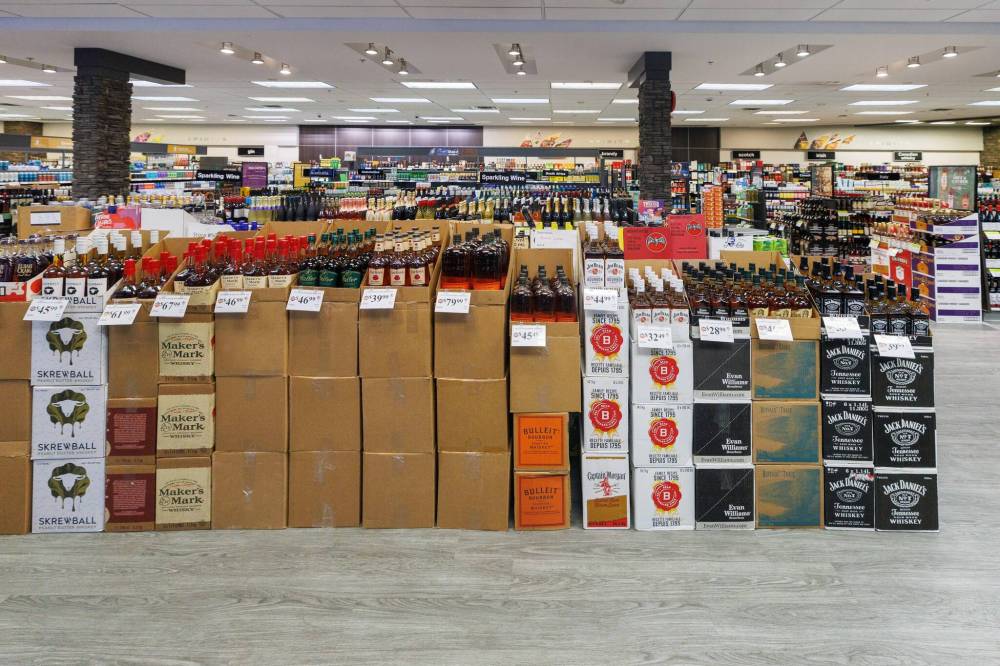
It has long been easier to get bourbon from Kentucky than a craft whisky from Alberta. (Mike Deal/Winnipeg Free Press files)
The latest promise is that by May 2026, Canadians in 10 provinces and Yukon will be able to order beer, wine and spirits directly from producers in other parts of the country. That’s the goal, anyway.
“We’re almost there,” Prince Edward Island Premier Rob Lantz said recently.
“Almost there” has become the unofficial slogan of interprovincial trade reform in Canada.
According to Pierre-Alain Bujold, a spokesperson for the Privy Council Office, provinces and territories are “continuing to work toward” the deadline, with each jurisdiction deciding how to implement the policy on its own terms.
And there’s the problem, in a nutshell.
Canada doesn’t have a free domestic market. It has 13 different ones, each with its own rules, its own gatekeepers and, in the case of alcohol, its own powerful liquor monopolies that have spent decades controlling what Canadians can buy and from whom.
So even when governments agree to open things up, they do it in the most Canadian way possible — cautiously, incrementally and with enough loopholes to keep the status quo largely intact.
This is not a minor irritant. It’s an economic weakness at a time when Canada can least afford it.
We’re living in an era of global uncertainty. The United States, our largest trading partner, continues to advance protectionist policies, slapping tariffs on key industries whenever it suits its political mood.
Meanwhile, geopolitical instability — including the ongoing war involving Iran — is rattling global markets and supply chains.
If there was ever a time to make it easier for Canadians to buy Canadian, this is it.
And yet, here we are, still bogged down in bureaucratic molasses over whether someone in one province can legally buy alcohol in another, or whether producers can easily sell their products anywhere in Canada without jumping through hoops.
It shouldn’t be this hard.
The irony is that governments know this. They’ve known it for years. The Supreme Court of Canada’s 2018 decision in the Comeau case — the one involving a New Brunswick man fined for bringing beer across the Quebec border — effectively upheld provincial authority over alcohol distribution, but it also sparked a renewed push to reduce internal trade barriers.
Since then, there have been announcements, agreements and plenty of political back-patting. Last year’s deal, signed by all 10 provinces and Yukon, was supposed to be a breakthrough, allowing consumers to order alcohol directly from producers for personal consumption.
And to be fair, there has been some progress. Ontario and Nova Scotia signed a bilateral agreement in March allowing residents to buy directly from producers in either province. That’s a step in the right direction.
But why is this still being done piecemeal?
Why does a Canadian winery or brewery still have to navigate a patchwork of provincial rules to sell its product within its own country?
And why, in 2026, are we still treating direct-to-consumer alcohol sales like a radical idea instead of a basic feature of a modern economy?
The answer, as usual, comes down to money and control.
Provincial liquor boards generate billions of dollars in revenue. They control distribution, markups and, in many cases, retail sales. Opening the door to direct shipments from out-of-province producers threatens that model, even if only at the margins.
So governments drag their feet. They sign agreements, set deadlines and then quietly leave it up to each province to figure out the details — knowing full well that some will move faster than others, and some will do the bare minimum required.
The result is a system that looks like progress on paper but feels like business as usual on the ground.
For consumers, it means fewer choices and higher prices.
For producers, especially small and medium-sized ones, it means limited access to markets that should be wide open.
And for the broader economy, it means leaving growth on the table at a time when we should be doing everything possible to strengthen domestic trade.
This isn’t just about alcohol. It’s about the bigger picture of how Canada functions as an economic union — or, more accurately, how it often doesn’t.
Interprovincial trade barriers cost the Canadian economy billions of dollars every year. They restrict the flow of goods, limit competition and make it harder for businesses to scale up nationally.
Politicians love to talk about “Team Canada” when dealing with external threats. But that unity tends to evaporate when it comes to tearing down barriers within our own borders.
If Ottawa and the provinces are serious about fixing this, they need to stop congratulating themselves for incremental progress and start acting with some urgency. That means clear, enforceable rules that actually allow direct-to-consumer sales across the country — not a patchwork of half-measures.
Because at some point, Canadians are going to notice that “almost there” looks a lot like nowhere at all.
» Tom Brodbeck is a Winnipeg Free Press columnist.