
Less partisanship, more consensus building
Advertisement
Read this article for free:
or
Already have an account? Log in here »
We need your support!
Local journalism needs your support!
As we navigate through unprecedented times, our journalists are working harder than ever to bring you the latest local updates to keep you safe and informed.
Now, more than ever, we need your support.
Starting at $15.99 plus taxes every four weeks you can access your Brandon Sun online and full access to all content as it appears on our website.
Subscribe Nowor call circulation directly at (204) 727-0527.
Your pledge helps to ensure we provide the news that matters most to your community!
To continue reading, please subscribe:
Add Brandon Sun access to your Free Press subscription for only an additional
$1 for the first 4 weeks*
- Enjoy unlimited reading on brandonsun.com
- Read the Brandon Sun E-Edition, our digital replica newspaper
*Your next Free Press subscription payment will increase by $1.00 and you will be charged $20.95 plus GST for four weeks. After four weeks, your payment will increase to $24.95 plus GST every four weeks.
Read unlimited articles for free today:
or
Already have an account? Log in here »
In a flyer that arrived in my mailbox earlier this week, Brandon-Souris Conservative MP Grant Jackson takes aim at the Carney government’s Bill C-9, the Combating Hate Act. The Carney government’s legislation aims to amend the Criminal Code to strengthen hate crime laws, criminalize the display of hate symbols in public and prohibit the obstruction of access to religious or community spaces. It was recently passed in the House of Commons and is now being considered by the Senate.
Jackson argues in his flyer that while hate speech, threats and crimes against places of worship are already illegal, the new law would lower important safeguards that have up to now prevented the misuse of the law. He also claims that the amendments remove “long-standing ‘good faith’ protections for religious expression, which he says have allowed Canadians to communicate their sincerely held beliefs without fear of criminal prosecution.”
Without those safeguards, he warns “there is a real risk that lawful religious or personal expression could be drawn into the scope of criminal law.” Based on all those concerns, he asks that readers sign a petition calling on the Senate to demand changes that restore the safeguards and “protect your freedoms.”
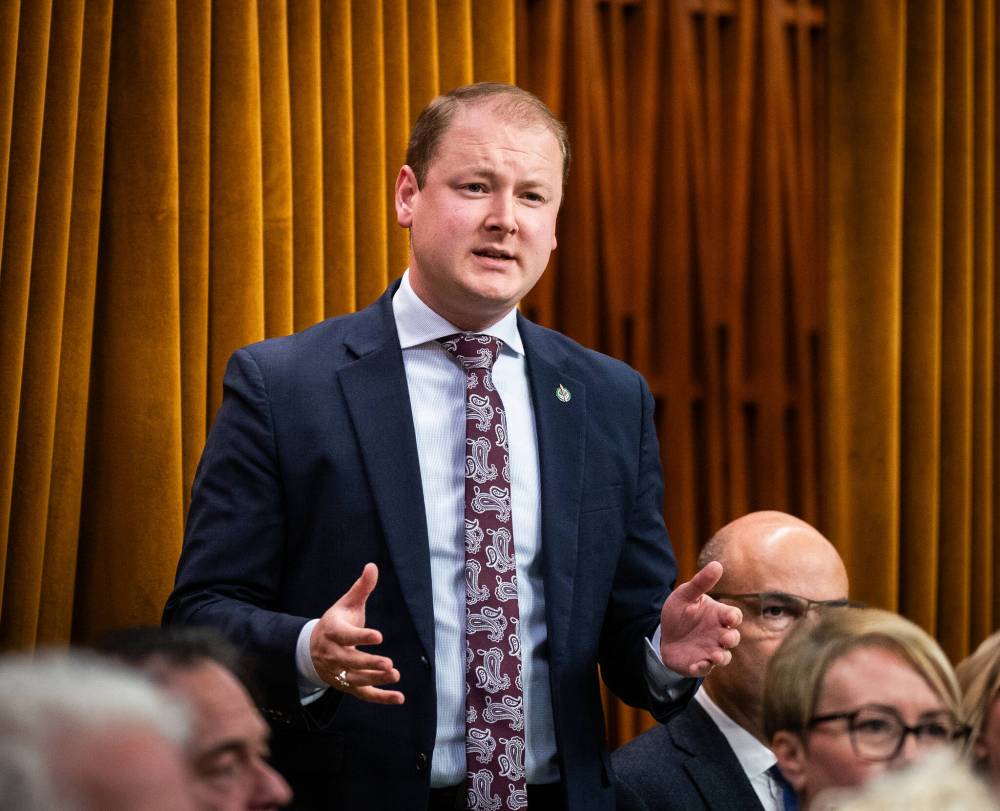
Brandon-Souris Conservative MP Grant Jackson, shown speaking in the House of Commons, recently sent out a flyer criticizing the Carney government’s Bill C-9, the Combating Hate Act. (Supplied)
This appears to be another example in Canadian politics of “the right cause, but the wrong message,” in which displays of partisanship overshadow and distract from what should be a thoughtful discussion of a serious issue.
When I first read Jackson’s flyer, it appeared to simply be a case of our MP’s staff mailing out a Conservative Party-designed document that uses “over-torqued” language and graphics to energize the religious right and freedom extremists within that political party. Given the strong influence the group has in that party, combined with the vast amounts of money they collectively contribute to the party each year, communications that focus on their priorities and anxieties are standard fare from the Tories.
Viewed from that perspective, it would have been easy to dismiss and ignore Jackson’s flyer as sensationalist propaganda aimed at “firing up” the party base and harvesting donations. The fact is, however, that our MP’s concerns about C-9 are valid. The problem is the way in which he has framed those concerns in his flyer.
Instead of using language and design elements that appear aimed at riling up his party’s base, Jackson could (and should) have pointed out that dozens of groups across the country, representing virtually every segment of our society’s political and religious spectrum, have expressed their reservations regarding aspects of the legislation.
He could have buttressed that argument by pointing out that the Canadian Civil Liberties Association has issued a letter that argues that C-9 “creates new criminal laws that risk serious and unjustified infringements on Charter-protected fundamental freedoms, including the criminalization of peaceful protest.” The letter claims that the bill risks criminalizing peaceful protests near tens of thousands of locations in Canada, and would disproportionately harm the very communities it purports to protect.
The letter has more than 40 signatories, including the Arab Canadian Lawyers Association, the Jewish Faculty Network, Toronto Palestinian Families and Jews Say No to Genocide. He could have said that the fact that those groups, which disagree on so many issues, are unified in their concerns about C-9 is a red flag.
Similarly, Jackson could have pointed out that the Canadian Labour Congress also opposes C-9. They allege that the legislation “threatens labour rights, fundamental freedoms, the right to protest, and public accountability.” Of even greater concern, they say the bill “will undermine core democratic rights and expand state powers in ways that put workers and marginalized communities at risk.”
Our MP could have also mentioned that Egale Canada, a national organization that works to improve the lives of 2SLGBTQI people, takes a similar position. It claims that “Bill C-9 appears less as a tool for protecting marginalized groups and more as a broad expansion of police power with a high risk of misuse.” It warns that the legislation, as currently worded, provides “limited protection against the forms of hate 2SLGBTQI communities most frequently experience.”
If that still isn’t enough to cause concern, Jackson could have also discussed the fact that Cardinal Frank Leo of the Metropolitan Archdiocese of Toronto recently told senators that “Faith communities stand firmly against hatred and discrimination in all its forms. At the same time,” he added, “it is vital that legislation aimed at confronting hatred does not inadvertently limit the lawful expression of religious beliefs or the ability of communities to live out their faith.”
By framing his arguments as a partisan attack against the Liberals, as opposed to a good-faith summary of the concerns that such a diverse collection of groups across Canada have expressed, Jackson undermined the importance and impact of his argument. Even worse, he missed the opportunity to begin building a reputation as a common-sense, consensus-building Conservative — something that is rare these days.
Given the depth of opposition to C-9, it is puzzling that the Liberals are so determined to see it passed in its current, flawed form. That is the point Jackson should be making, combined with thoughtful amendments that would enable the legislation to protect Canadians from hate.
Some MP needs to play that constructive role. With a little more thought and a little less partisan zeal, Jackson could be that MP.