
The obstacles in the way of middle-power co-operation
Advertisement
Read this article for free:
or
Already have an account? Log in here »
We need your support!
Local journalism needs your support!
As we navigate through unprecedented times, our journalists are working harder than ever to bring you the latest local updates to keep you safe and informed.
Now, more than ever, we need your support.
Starting at $15.99 plus taxes every four weeks you can access your Brandon Sun online and full access to all content as it appears on our website.
Subscribe Nowor call circulation directly at (204) 727-0527.
Your pledge helps to ensure we provide the news that matters most to your community!
To continue reading, please subscribe:
Add Brandon Sun access to your Free Press subscription for only an additional
$1 for the first 4 weeks*
- Enjoy unlimited reading on brandonsun.com
- Read the Brandon Sun E-Edition, our digital replica newspaper
*Your next Free Press subscription payment will increase by $1.00 and you will be charged $20.95 plus GST for four weeks. After four weeks, your payment will increase to $24.95 plus GST every four weeks.
Read unlimited articles for free today:
or
Already have an account? Log in here »
Can middle powers actually coalesce?
Let’s set to one side the lack of definitional clarity and precision about the concept of so-called “middle powers.” I have previously raised some concerns about how the term “power” is calculated and measured, which countries should belong to this club and whether their membership is more a function of the roles that they perform on the international stage.
I’ll assume that this classification of states does exist for purposes of this discussion. But are these middle powers capable of joining forces and serving as a counterpoise to the “great powers” of China, the U.S. and, arguably, Russia? Can they also come together to constrain the actions of the major powers, to articulate new avenues to confront serious global difficulties and to bring sanity to the community of states?
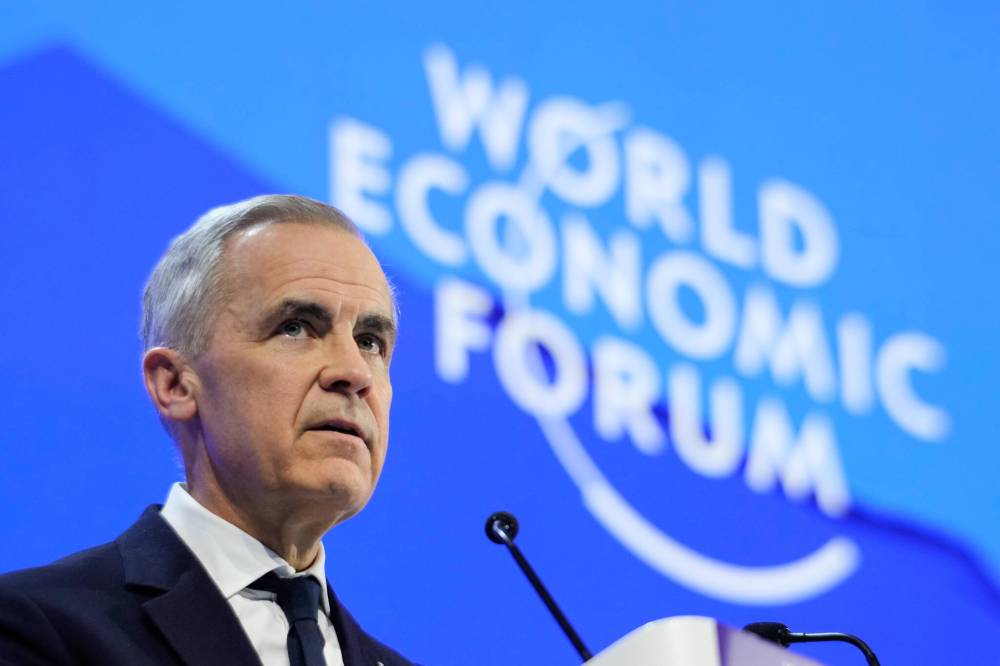
Prime Minister Mark Carney speaks during the annual meeting of the World Economic Forum in Davos, Switzerland, in January. “Middle powers must act together because if we’re not at the table, we’re on the menu,” Carney said during his speech. (The Associated Press files)
In January, Prime Minister Mark Carney spoke a lot about the emergent middle powers as central to the institutional machinery and international norms that make global politics manageable. His speech in Davos highlighted the seminal challenge of the moment: “The multilateral institutions on which the middle powers have relied — the World Trade Organization, the United Nations, the Conference of the Parties — the architecture, the very architecture of collective problem solving — are under threat.”
In another section of his speech, he identified the nature of the quandary facing middling countries: “The question for middle powers, like Canada, is not whether to adapt to this new reality. We must. The question is whether we adapt by simply building higher walls — or whether we can do something more ambitious.”
More importantly, Carney didn’t mince his words: “Middle powers must act together because if we’re not at the table, we’re on the menu.”
“In a world of great power rivalry,” he went on to explain, “the countries in between have a choice: to compete with each other for favour or to combine to create a third path with impact.” (We now have a sense of the vulnerability that the Global South has been contending with over these many decades.)
Peer countries working together is what Carney believes is necessary to establish “something better, stronger, more just.” As the clock continues to tick, he said plainly: “This is the task of the middle powers, the countries that have the most to lose from a world of fortresses and the most to gain from genuine co-operation.”
I’m not suggesting for a second that middle powers or like-minded countries working together to construct a fairer and more responsive rules-based order is a bad idea. But it is important to understand that such a proposition comes with a multitude of serious impediments and challenges.
To begin with, how exactly do you get these countries to all work together, let alone to agree on a concerted plan?
The tyranny of geography does not leave Canada and Mexico with a whole lot of room to manoeuvre. They may talk a good game about middle power collaboration, but the reality is that they are inextricably linked to the fate of the U.S. Put differently, working in concert with other peer countries will not advance their core interests.
Personalities and petty issues between and among political leaders can also make impactful co-operation exceedingly difficult. Added to these roadblocks would be domestic political considerations, soft public opinion backing and growing nationalistic sentiments at home.
Seeking a coalition with middling countries in the Global South will also be problematic. The hoarding of COVID-19 vaccines by leading industrialized countries, an unwillingness to embrace climate reparations, and their limp support for reforming multilateral organizations are still fresh on the minds of leaders from the developing world.
All of this does not mean that a middle power coalition is a definite non-starter. But it does strongly suggest the forces driving countries apart are more in vogue today than any pressures bringing them tightly together.
One would wonder how such a coalition could sustain itself in a post-Trump world. It may not be business as usual in such an international setting, but the glue that would bind middle powers in alignment would certainly be dissolved.
» Peter McKenna is professor of political science at the University of Prince Edward Island in Charlottetown. This column previously appeared in the Winnipeg Free Press.