
How to end the hostile heckling
Advertisement
Read this article for free:
or
Already have an account? Log in here »
We need your support!
Local journalism needs your support!
As we navigate through unprecedented times, our journalists are working harder than ever to bring you the latest local updates to keep you safe and informed.
Now, more than ever, we need your support.
Starting at $15.99 plus taxes every four weeks you can access your Brandon Sun online and full access to all content as it appears on our website.
Subscribe Nowor call circulation directly at (204) 727-0527.
Your pledge helps to ensure we provide the news that matters most to your community!
To continue reading, please subscribe:
Add Brandon Sun access to your Free Press subscription for only an additional
$1 for the first 4 weeks*
- Enjoy unlimited reading on brandonsun.com
- Read the Brandon Sun E-Edition, our digital replica newspaper
*Your next Free Press subscription payment will increase by $1.00 and you will be charged $20.95 plus GST for four weeks. After four weeks, your payment will increase to $24.95 plus GST every four weeks.
Read unlimited articles for free today:
or
Already have an account? Log in here »
Earlier this week, Manitoba Legislative Assembly Speaker Tom Lindsey prohibited MLAs from calling other MLAs a number of bad words. His order reflects the fact that the conduct of members has reached its lowest level in years.
How did they get to this point? How did it become necessary for the Speaker to warn his fellow MLAs — every one of them elected by their respective communities — that they must refrain from saying things and behaving in a manner that would get them fired from any other workplace in the province? Since when is the standard of behaviour for MLAs lower than the standard for kids attending schools in this province?
For years, readers have complained to me about the offensive conduct of MLAs in the Manitoba legislative assembly, as well as the way in which MPs handle themselves in the House of Commons. The complaints about Manitoba MLAs have dramatically increased over the past year, however. I receive texts and emails from Manitobans almost each week when the assembly is in session, expressing shock and disappointment over the things MLAs are doing and saying in the legislative chamber.
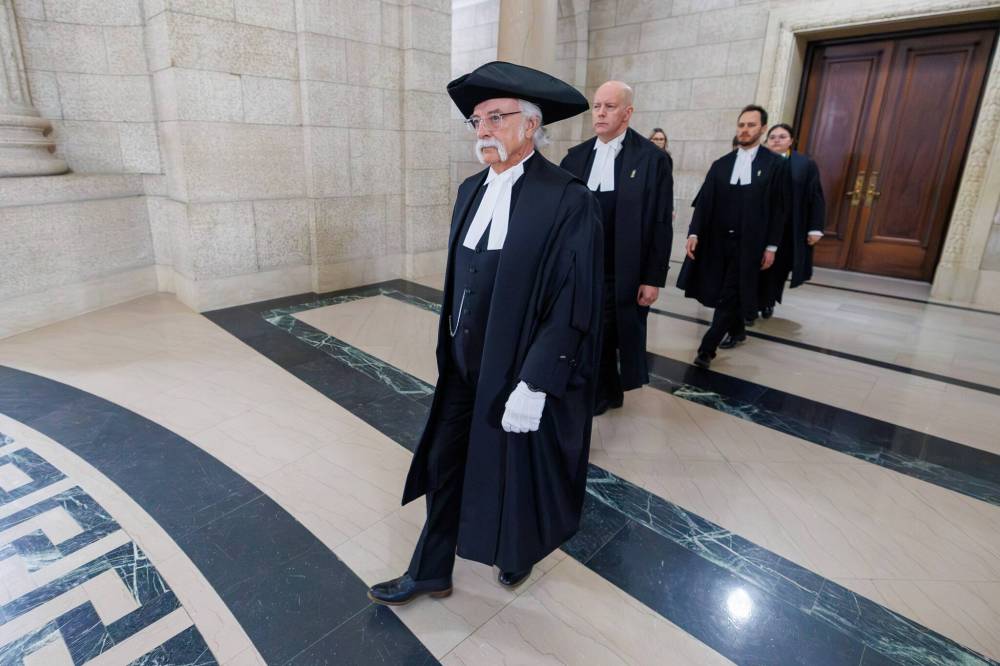
Speaker Tom Lindsey heads toward the Manitoba Legislative Assembly chamber for question period on Wednesday. Earlier this week, Lindsey banned MLAs from calling one another a “bigot,” “homophobe,” “racist,” “misogynist” or “transphobe” in the chamber. (Mike Deal/Winnipeg Free Press)
I realize there is a centuries-old tradition of heckling in legislative chambers, but I have never been able to figure out what the point of the angry, overheated behaviour is. I don’t understand how elected officials think it improves their standing in the assembly, or in the larger community. Do they honestly assume the public isn’t paying attention? Do they seriously believe that hurling insults and acting like a foam-mouthed pack of hyenas increases the public’s respect for them?
This is the time of year when school-age children often participate in field trips to the Legislative Building and often observe question period from the gallery. Instead of seeing principled leadership in action, and elected community leaders acting as role models, they see our MLAs yelling at each other and acting in an intimidating manner. The experience must be confusing for most of those kids, and terrifying for some.
When I ask MLAs why they behave that way, instead of simply sitting in their chairs and quietly listening to the questions and answers, they often respond that heckling is part of the job and a longstanding tradition. They argue it’s a way to let off steam. Some even say there is a “pack mentality” that permeates question period, in which each side’s members feel compelled to defend their colleagues against the words and actions of the rival group. What a bunch of thin-skinned baby-talk.
There’s no heckling at school board meetings, nor do city councillors yell at the mayor and their fellow councillors during city council meetings. If school trustees and city councillors can behave like the leaders the public expects them to be, so can our MLAs and MPs.
How do we solve this problem? First, nobody forces MLAs and MPs to act this way, and nobody is stopping them from keeping their yaps shut. If one side of the assembly (government or opposition) would collectively decide to set a higher level of conduct and not engage in the shouting, insults and threats that occur each day, the other side would look really silly to the public — and that would eventually cost votes.
Second, make it easier for the public to see what is happening. The public is largely unaware of the daily mayhem occurring in the Legislative Assembly and House of Commons because there aren’t enough cameras, and the “house rules” effectively prevent the misbehaviour from being recorded and broadcast. Even worse, most of the offensive dialogue never makes it into the daily transcript (known as Hansard), so there is a printed record of what was said.
That should change. If representatives, reporters and members of the public had the right to record proceedings in the assembly and to post those recordings online, showing our MLAs and MPs acting like jerks, that would have an immediate impact back home. It would change behaviour.
Finally, and perhaps most importantly, party leaders must set the correct tone for other members to follow, and enforce that standard of conduct. If Premier Wab Kinew and Opposition Leader Obby Khan order their respective caucuses to cease the heckling or face consequences, the yelling and insults will stop. That hasn’t happened, however, because they each appear to enjoy the question period mayhem far too much.
That has to change. It’s time for our MLAs and MPs to grow up and be the leaders that voters and children expect them to be, and that is especially the case for Kinew and Khan. Before taking a shot at the MLA across the aisle, they should look up at the kids in the gallery. They should ask themselves what those kids are thinking, and what they say to adults — voters — when they get home.