
Bridging the chasm of hatred
Advertisement
Read this article for free:
or
Already have an account? Log in here »
We need your support!
Local journalism needs your support!
As we navigate through unprecedented times, our journalists are working harder than ever to bring you the latest local updates to keep you safe and informed.
Now, more than ever, we need your support.
Starting at $15.99 plus taxes every four weeks you can access your Brandon Sun online and full access to all content as it appears on our website.
Subscribe Nowor call circulation directly at (204) 727-0527.
Your pledge helps to ensure we provide the news that matters most to your community!
To continue reading, please subscribe:
Add Brandon Sun access to your Free Press subscription for only an additional
$1 for the first 4 weeks*
- Enjoy unlimited reading on brandonsun.com
- Read the Brandon Sun E-Edition, our digital replica newspaper
*Your next Free Press subscription payment will increase by $1.00 and you will be charged $20.95 plus GST for four weeks. After four weeks, your payment will increase to $24.95 plus GST every four weeks.
Read unlimited articles for free today:
or
Already have an account? Log in here »
News of increasing antisemitism, Islamophobia and transphobia is taking me back to another time when Canada was steeped in fear, hate and violence. Families and faith communities were divided.
Employees were being fired and the government was secretly surveilling and interrogating members of the Canadian Armed Forces. Landlords were kicking tenants out of their homes. Fear kindled misinformation, fanned by hate, spread by rumour and accusation.
A dear ally received death threats if she continued her support. Another dear friend was brutally murdered when travelling in Europe with his teenage son, leaving his terrified son stranded.
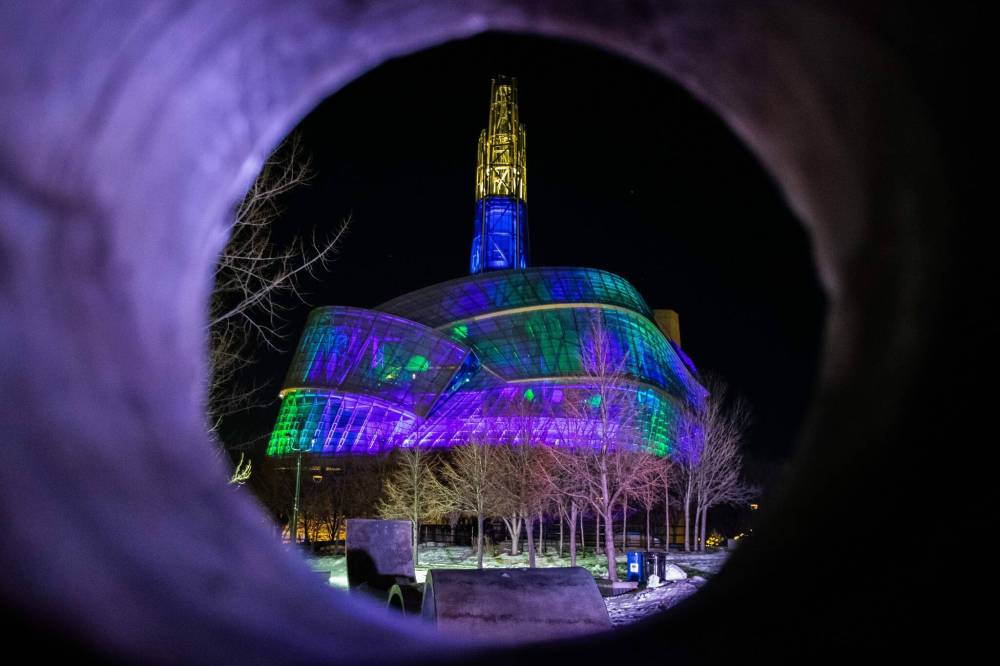
The Canadian Museum for Human Rights, lit with a multicoloured light show, inspired by the northern lights. (Daniel Crump/Winnipeg Free Press files)
This was the 1980s when people suspected of being lesbian or gay were being targeted in Canada and around the world.
I was a minister in rural United Church congregations in Saskatchewan when our church was debating whether or not we could be accepted as ministers. Most of us were closeted, including my partner who was an elementary school teacher, fearing that we could lose our jobs if our communities knew about our sexual orientation.
Moral indignation was justifying vigilante actions. We were on high alert. If either of us came home to graffiti sprayed on our houses, we were prepared to flee.
There were a few courageous individuals who publicly declared their sexual orientation so as to invite conversation.
One of them was Ken DeLisle, another United Church minister, who continues to inspire me.
He approached members of a group organized to ban “homosexuals” from ministry and, in some cases, from the church. Ken did not go with a placard or megaphone. Instead, he bravely went with an open hand and open heart, inviting them to listen to his story, as he would listen to their fears. One by one, relationship by relationship, Ken enabled enemies to cross the chasm of fear.
I was converted.
Although I was still too afraid to come out at that time, I listened to parishioners’ fears and anger as I offered pastoral care. One man told me from his hospital bed that he wanted to round up all the homosexuals, put them on a raft in the middle of the ocean and sink it. I paused, praying for wisdom, and responded with a smile, “Well—that’s a fine Christian attitude!”
We both laughed as my heart pounded. Over the next few weeks of visits before his death, his anger dissipated and his heart softened.
I have learned over the decades that personal relationships are the key to bridging polarized divisions of hate, with their underlying fears.
As a social activist, I have been part of many protests and rallies. There is power in collectively saying no to hate and abuse. I also realize that they can contribute to a deepening of the divide and a dehumanizing of the other.
There is another way that I, personally, have found to be much more effective.
Women Wage Peace in Israel is a group of Jews, Muslims, and Christians who are trying to bridge the divide of hate and violence in Israel and Palestine. Eschewing military aggression, they prioritize political negotiations, that include women, to bring justice and peace.
Their close partner is Women of the Sun, a Palestinian women’s organization. They have worked miracles through personal friendships that have crossed the forbidden divide. When I heard about the formation of a Winnipeg chapter of this group, I was in.
Recently, Women Wage Peace Winnipeg worked in partnership with the Canadian Museum for Human Rights to offer workshops on storytelling and practical tools for difficult conversations.
The evening featured keynote speaker Dr. Amal Elsana Alh’jooj, a Bedouin, feminist Palestinian who co-founded Solidarity Dialogues. Her inspiring talk included stories of the horror of Oct. 7 when her dear friend Vivian Silver was brutally murdered, the decimation of Gaza in which she lost 52 family members, and increasing settler violence in the West Bank.
She then held a conversation with Rabbi Donna Kirshbaum, co-founder of Women Wage Peace in Israel. Donna told the story of light filling a house.
I was reminded of the Jewish principle of mending the world, which suggests that the house is that of the whole world. Amal stressed that the goal of peace and security alone was the goal of oppressors, while the goal of justice and liberation was the goal of the oppressed. This confirmed the need for both peace and justice for all. It also demonstrated the need for difficult conversations that are able to hold multiple truths with compassion.
This conference was sold out a week in advance. Many Jewish and Palestinian leaders, along with their allies, were present. Delicate conversations were held throughout the afternoon and evening, some tentatively and others passionately. New, collaborative partnerships are being considered.
These difficult conversations and personal relationships with those of opposing views are desperately needed in our own increasingly polarized community.
Only open hearts and minds can conceive of a third, creative force arising from two oppositional forces.
This third way is not a mushy middle of compromise, but a creative alternative that offers us a difficult but necessary path of truth and reconciliation. Our Indigenous relatives have taught us the way.
» Loraine MacKenzie Shepherd is a retired United Church of Canada minister. This column was originally published in the Winnipeg Free Press.