
Putting the economy over the environment
Advertisement
Read this article for free:
or
Already have an account? Log in here »
We need your support!
Local journalism needs your support!
As we navigate through unprecedented times, our journalists are working harder than ever to bring you the latest local updates to keep you safe and informed.
Now, more than ever, we need your support.
Starting at $15.99 plus taxes every four weeks you can access your Brandon Sun online and full access to all content as it appears on our website.
Subscribe Nowor call circulation directly at (204) 727-0527.
Your pledge helps to ensure we provide the news that matters most to your community!
To continue reading, please subscribe:
Add Brandon Sun access to your Free Press subscription for only an additional
$1 for the first 4 weeks*
- Enjoy unlimited reading on brandonsun.com
- Read the Brandon Sun E-Edition, our digital replica newspaper
*Your next Free Press subscription payment will increase by $1.00 and you will be charged $20.95 plus GST for four weeks. After four weeks, your payment will increase to $24.95 plus GST every four weeks.
Read unlimited articles for free today:
or
Already have an account? Log in here »
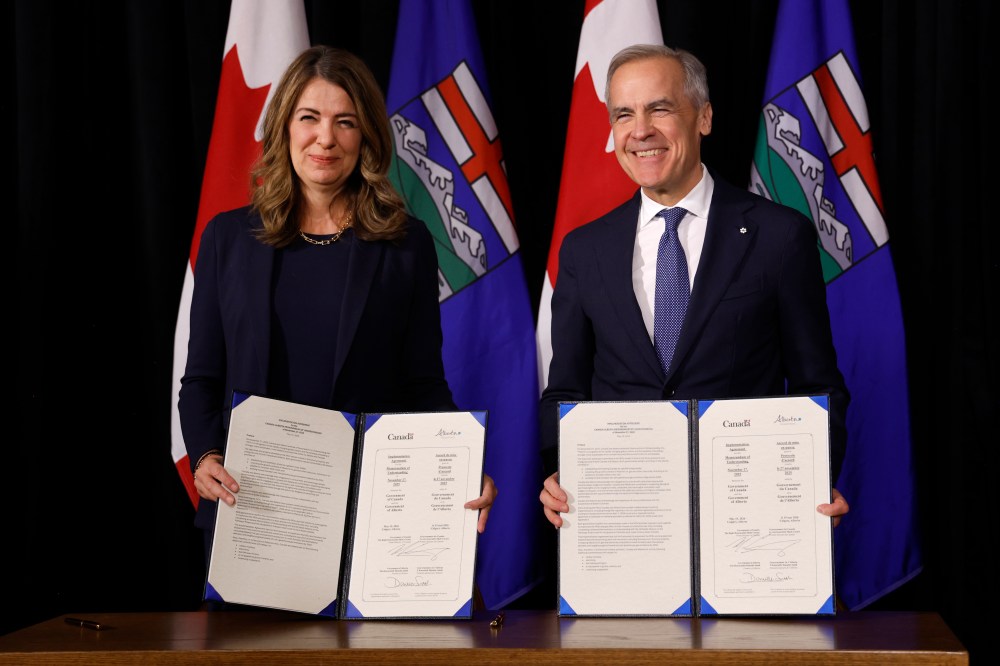
Yesterday’s announcement that the governments of Canada and Alberta have reached an agreement that could lead to the construction of a new pipeline capable of transporting one million barrels of oil daily to the Pacific coast is good news for both Canada’s economy and national unity.
The path the two governments have chosen to achieve that objective, however, raises serious questions about the equality of provinces within Canada’s federalist system, and the whether the nation’s commitment to environment issues is subordinate to the interests of the oil and gas industry.
The new agreement is the sequel to the “memorandum of understanding” signed by the two governments last fall. That deal set out numerous conditions for construction of a new oil pipeline to the West Coast, including the requirement that the pipeline would include Indigenous ownership, as well as Alberta’s commitment to increases in its industrial carbon price.
In exchange, the federal government agreed to suspend its clean-electricity regulations for Alberta, not implement its oil and gas emissions cap and, if the pipeline is eventually constructed, to make the current oil tanker ban less restrictive.
Friday’s agreement also contains changes on carbon pricing and carbon emission reductions. Alberta’s “effective industrial carbon emission price” will rise to $130 per tonne by 2040, while its “headline price” will increase from the current $95 per tonne to $140 per tonne also by 2040. The “effective price” refers to the price carbon credits are sold for on the open market, while the “headline price” is the price companies pay in order to comply with emission limits.
A headline carbon emission price for Alberta of $140 per tonne by 2040 means that the federal government in Ottawa is adopting a much lower pricing scheme for the province, compared to the current federal backstop price, which is scheduled to reach $170 per tonne six years from now.
That may be a great deal for Alberta, but what about the other nine provinces? A lower industrial carbon tax in Alberta gives that province a significant advantage in the competition among provinces to attract and retain large-scale industrial investment and activity. That impacts jobs in those provinces, as well as those provinces’ ability to provide services at a level on par with Alberta.
For that reason — and given the fact the Supreme Court of Canada ruled in 2021 that all provinces must be treated equally on carbon pricing — it is very likely that yesterday’s agreement will force the federal government to lower industrial carbon taxes charged in all other provinces to match the new Alberta rates. That, in turn, could make it all but impossible for Canada to meet its target for greenhouse gas emission reductions within the time frame agreed to in the Paris Accord.
In response to that possibility, the federal government says the new pipeline is conditional on the construction of Pathways, a massive “carbon capture and storage” project near Alberta’s oil sands. It would use a 400-kilometre pipeline to transport carbon trapped at oil sands facilities to an underground storage facility near Cold Lake.
That sounds good, but carbon capture continues to be regarded by many scientists as an unproven technology. Even worse, yesterday’s agreement significantly lowers the volume of carbon emissions that would have to be removed via the CCS project, from 22 megatonnes annually to just six megatonnes. Companies will be required to also reduce emissions by an additional 10 megatonnes via “a range of technologies” by 2045, but few believe the obligation would ever be enforced.
This points to the reality that the new agreement is just the first chapter in what will almost certainly be a nationwide “economy versus the environment” contest over the coming years, as the federal and provincial governments strive to increase international trade via large-scale “national projects” that put the environment at greater risk.
Earlier this week, the Angus Reid Institute revealed that 61 per cent of Canadians believe that economic growth should take precedence over environmental protection as the top priority shaping federal energy policy. Whether they continue to feel that way, after seeing the environmental damage inevitably caused by one or more of these large projects, remains to be seen.