
Moose Hide Campaign helps start national conversations
Advertisement
Read this article for free:
or
Already have an account? Log in here »
We need your support!
Local journalism needs your support!
As we navigate through unprecedented times, our journalists are working harder than ever to bring you the latest local updates to keep you safe and informed.
Now, more than ever, we need your support.
Starting at $15.99 plus taxes every four weeks you can access your Brandon Sun online and full access to all content as it appears on our website.
Subscribe Nowor call circulation directly at (204) 727-0527.
Your pledge helps to ensure we provide the news that matters most to your community!
To continue reading, please subscribe:
Add Brandon Sun access to your Free Press subscription for only an additional
$1 for the first 4 weeks*
- Enjoy unlimited reading on brandonsun.com
- Read the Brandon Sun E-Edition, our digital replica newspaper
*Your next Free Press subscription payment will increase by $1.00 and you will be charged $20.95 plus GST for four weeks. After four weeks, your payment will increase to $24.95 plus GST every four weeks.
Read unlimited articles for free today:
or
Already have an account? Log in here »
This past week marked the 15th annual Indigenous-led Moose Hide Campaign aimed at stopping gender-based violence.
While the campaign is recognized by official observances in British Columbia, Manitoba and Saskatchewan, this was the first time the movement went national, including a launch in front of a large crowd in Toronto and an online audience of 150,000.
Full disclosure: I was one of the speakers.
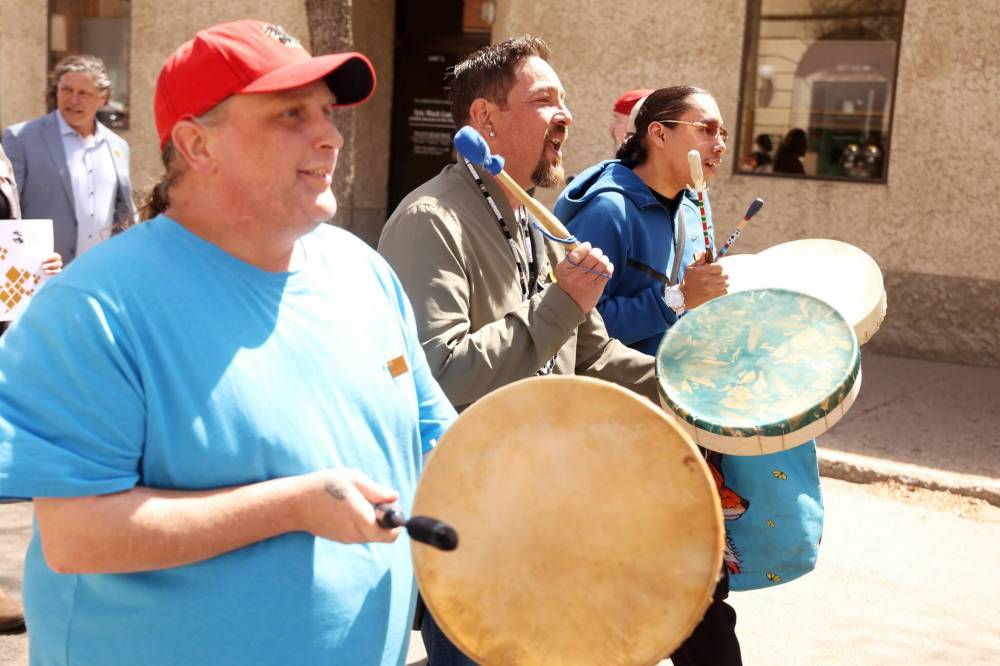
Jason Gobeil (middle) with the Good Hearted Warriors men's group and other drummers lead the Moose Hide Campaign Community Walk in Brandon on Thursday. (Tim Smith/The Brandon Sun)
Regardless of my participation, the campaign has become one of the most important Indigenous-led movements in Canada — as well known as Orange Shirt Day.
It has also become, alongside the Red Dress Campaign, which commemorates murdered and missing Indigenous women, girls and LGBTTQ+ people, one of this country’s most important movements against domestic violence.
The Moose Hide movement takes commemoration a step further.
In 2011, Paul Lacerte and his daughter Raven were hunting moose along Highway 16 in northern British Columbia — the stretch of road known as the “Highway of Tears” due to the tragic, decades-long string of slayings and disappearances of dozens of predominantly Indigenous women and girls.
As they were harvesting a moose, they began talking about the land they were on and the many women who had lost their lives.
They talked about how nearly every Indigenous man they knew had experienced trauma and, in turn, had turned that pain inward — resulting in suicide and addiction — and often onto others and, in particular, the women and children in their lives.
They began talking about how thankful they were for the moose, an animal that, despite its huge size, travels deftly through the forest, creates paths for others and parents its young with love and commitment.
Suddenly, the Moose Hide Campaign was born.
When the pair arrived home, they tanned the moose hide and cut it into one-inch squares. They distributed the pieces, with a safety pin attached, to friends, family and community members and asked them to wear them.
They said if anyone asked them what they were wearing, it would start a conversation about domestic violence — and specifically the violence experienced by Indigenous women, children and LGBTTQ+ people in Canada.
By 2018, more than one million people were wearing the moose hide squares. That same year, researchers with the campaign unveiled that studies showed each square inspired an average of five conversations about domestic violence.
On Thursday morning, campaign organizers announced that eight million squares had been distributed to Canadians — alongside 40 million conversations.
Conversation may be the most important step to stop what has become an epidemic of violence against Indigenous women, girls and LGBTTQ+ community members.
A female is killed in Canada every two days, according to research by the Canadian Femicide Observatory for Justice and Accountability at the University of Guelph.
In more than 90 per cent of the cases in 2025, the perpetrator was a male and usually a spouse, family member or a man known to the victim.
When you add in the discrimination and racism experienced by Indigenous women, girls and LGBTTQ+ people, these numbers turn much worse — with that community more than 12 times more likely to be murdered or go missing.
This is a hard thing to talk about in Indigenous communities.
To put it simply: nearly every single Indigenous woman, girl or LGBTTQ+ person I know has experienced some sort of violence.
In nearly every case, I have shared space with, know or am related to the individual who perpetrated the harm.
Not all violence involves a crime, of course, and in nearly every situation the perpetrator had a long history of being hurt before hurting others — but this is no excuse.
This is why talking might be the most important step of all in stopping violence.
Conversations involve multiple speakers and listeners.
This is not how “justice” in Canada works. The legal system, in fact, is where conversations end — with nearly every engagement with everything from the police to the courts to the media being one person competing with another to dominate the story.
At best, Canadian “justice” involves people never talking, sharing a community or seeing each other ever again.
Conversations are proactive. They require people to sit together and find some way to understand the many perspectives why situations come to be.
In some cases, of course, conversations are too emotional, increase the harm and are impossible.
In far more cases, though, silence is the reason conflicts turn into violence.
A few years ago, this province took a big step in talking about — and even taking some action to stop — violence against Indigenous women.
This has been a difficult and imperfect process — as it has also been in two other epicentres of similar violence: B.C. and Saskatchewan.
For the first time this week, this conversation went national; a good step toward a real conversation this country needs to have.
» Niigaan Sinclair is Anishinaabe and is a columnist at the Winnipeg Free Press.