
To the GenAI class of 2026
Advertisement
Read this article for free:
or
Already have an account? Log in here »
We need your support!
Local journalism needs your support!
As we navigate through unprecedented times, our journalists are working harder than ever to bring you the latest local updates to keep you safe and informed.
Now, more than ever, we need your support.
Starting at $15.99 plus taxes every four weeks you can access your Brandon Sun online and full access to all content as it appears on our website.
Subscribe Nowor call circulation directly at (204) 727-0527.
Your pledge helps to ensure we provide the news that matters most to your community!
To continue reading, please subscribe:
Add Brandon Sun access to your Free Press subscription for only an additional
$1 for the first 4 weeks*
- Enjoy unlimited reading on brandonsun.com
- Read the Brandon Sun E-Edition, our digital replica newspaper
*Your next Free Press subscription payment will increase by $1.00 and you will be charged $20.95 plus GST for four weeks. After four weeks, your payment will increase to $24.95 plus GST every four weeks.
Read unlimited articles for free today:
or
Already have an account? Log in here »
Since the release of ChatGPT in the fall of 2022, attention to generative artificial intelligence (GenAI) has dominated the cultural and educational landscape.
With minimal input, GenAI like ChatGPT can near immediately produce an array of content providing students with answers to test questions or completed drafts of course work papers. Outsourcing thinking in this way is not a good use of GenAI because it is antithetical to learning.
Beyond the university, there are wider practical and ethical discussions regarding the use of GenAI and its potential uses as the technology continues to quickly develop. Imagined apocalyptic doomsday scenarios such as artificial intelligence (AI) replacing humans for everything imaginable are also part and parcel of discussions about the technology.
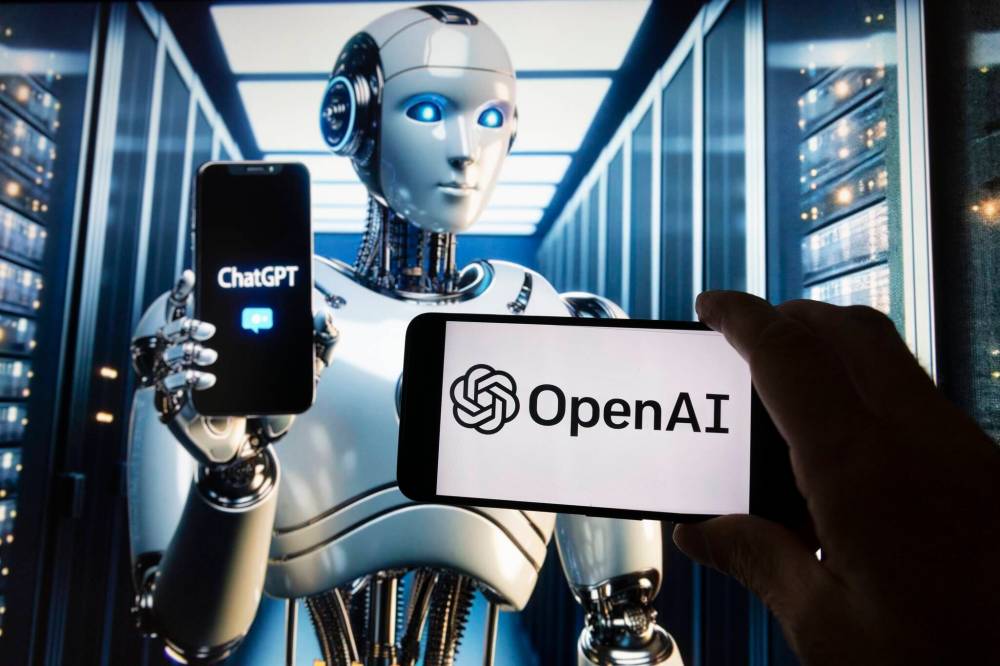
The OpenAI logo is seen displayed on a cellphone with an image on a computer screen generated by ChatGPT’s Dall-E text-to-image model in Boston in 2023. Brandon University sociology professor Christopher J. Schneider writes that with generative artificial intelligence (GenAI) taking root in society, university graduates “should be especially cautious not to relinquish their precious and hard-earned thinking skills by relying too much on GenAI moving forward.” (The Associated Press files)
Universities across Canada are about to graduate the first class of students who began their studies just as GenAI was unleashed into the world. The class of 2026 was GenAI’s first test subjects as universities learned and adapted to the technology alongside students.
Some faculty members have fully embraced the technology while others have eschewed it. If professor A requires GenAI use for course assignments and professor B prohibits its use entirely, individual student perceptions of what constitutes cheating and when might differ.
University policies, when they were created, sometimes provided limited or no real helpful direction, especially since policies quickly shifted from knee-jerk reactions like blanket bans to more sensible approaches concerning the use of GenAI.
Nevertheless, the continued lack of a consensus across universities and even among faculty at the same institution about the appropriate use of GenAI has no doubt caused ongoing confusion.
There is a lot that continues to remain uncertain. So, what do we know?
First, the good news. The class of 2026 was able to navigate an otherwise tumultuous time at university attributed to GenAI interruptions having successfully completed their degree programs. The class of 2026 might perhaps be understood as a story of human ingenuity in the ways students adapted to unforeseen distractions to their learning.
For example, the appropriate use of AI when prescribed for coursework to facilitate engagement and learning and of course avoiding the temptation to use AI when assignments were challenging.
Human ingenuity undergirded by problem solving and critical thinking cannot be replaced by AI because AI itself cannot think, interpret or reason. In this way, artificial intelligence is a misnomer as it is not itself intelligent nor does AI have any value system that guides its content generation. AI has invented nothing and has offered no cures for any disease.
Consider that while AI has led to advancements in cancer detection, AI has not cured the disease. It will be human ingenuity that will eventually cure cancer and other diseases.
It is also human ingenuity and not AI that will guide university graduates as they navigate the world whether it be the evolving job market, solving complex life problems, building communities, raising families, and so on.
Second, the bad news. GenAI has made it so much easier to cheat. Unfortunately, some students will always cheat, GenAI or not. However, beyond the matter of cheating there are serious known concerns about AI’s environmental footprint, including that its data centres require vast amounts of energy and generate electronic waste such as lead and mercury, toxic substances that cause, among other things, cognitive difficulties. There is evidence that AI also weakens critical thinking and assessment skills.
Last year, an MIT study found that repeated reliance on ChatGPT resulted in the “accumulation of a cognitive debt.” The long-term consequences of cognitive debt attributed to ChatGPT, the study concluded, led to diminished critical inquiry — a key driver of human ingenuity.
The basic takeaway of the study according to the authors is to “support an educational model that delays AI integration until learners have engaged in sufficient self-driven cognitive effort.”
We might reasonably surmise that the ensuing confusion about AI use in classroom spaces over the past four years has included the delayed integration of GenAI into aspects of university curriculum. A result of this delay may have inadvertently preserved aspects of critical inquiry in the graduating class of 2026.
Brandon University is historically and primarily an institution focused on the liberal arts. One of the primary objectives of attaining a liberal arts education is the cultivation of analytical thinking skills. Graduates should be especially cautious not to relinquish their precious and hard-earned thinking skills by relying too much on GenAI moving forward.
Remember to think for yourself! The adage “If you don’t use it, you lose it” has never been more prescient than it is today.
For the class of 2026, the story of human ingenuity is only just beginning as our university graduates move onto the next chapter of their lives.
Congratulations, class of 2026!
» Christopher J. Schneider is professor of sociology at Brandon University. He is the 2026 recipient of the Excellence in Teaching Award presented by BU’s Alumni Association.