
Putin’s imperial dream is crumbling
Advertisement
Read this article for free:
or
Already have an account? Log in here »
We need your support!
Local journalism needs your support!
As we navigate through unprecedented times, our journalists are working harder than ever to bring you the latest local updates to keep you safe and informed.
Now, more than ever, we need your support.
Starting at $15.99 plus taxes every four weeks you can access your Brandon Sun online and full access to all content as it appears on our website.
Subscribe Nowor call circulation directly at (204) 727-0527.
Your pledge helps to ensure we provide the news that matters most to your community!
To continue reading, please subscribe:
Add Brandon Sun access to your Free Press subscription for only an additional
$1 for the first 4 weeks*
- Enjoy unlimited reading on brandonsun.com
- Read the Brandon Sun E-Edition, our digital replica newspaper
*Your next Free Press subscription payment will increase by $1.00 and you will be charged $20.95 plus GST for four weeks. After four weeks, your payment will increase to $24.95 plus GST every four weeks.
Read unlimited articles for free today:
or
Already have an account? Log in here »
Every May 9, Russia commemorates the defeat of Nazi Germany with a Victory Day parade in Moscow’s Red Square. But the 2026 edition wasn’t so grand. Fears of Ukrainian drone strikes caused sparse attendance. No military hardware was showcased.
The lack of pageantry points to a larger truth. Four years on, what President Vladimir Putin envisioned as a swift conquest of Ukraine has devolved into an epic quagmire.
Kyiv’s deft use of unmanned systems has brought Russia’s invasion to a standstill. Legions of military drones, in the skies and on land, form an impassable kill zone 10 to 20 kilometres deep along the front lines.
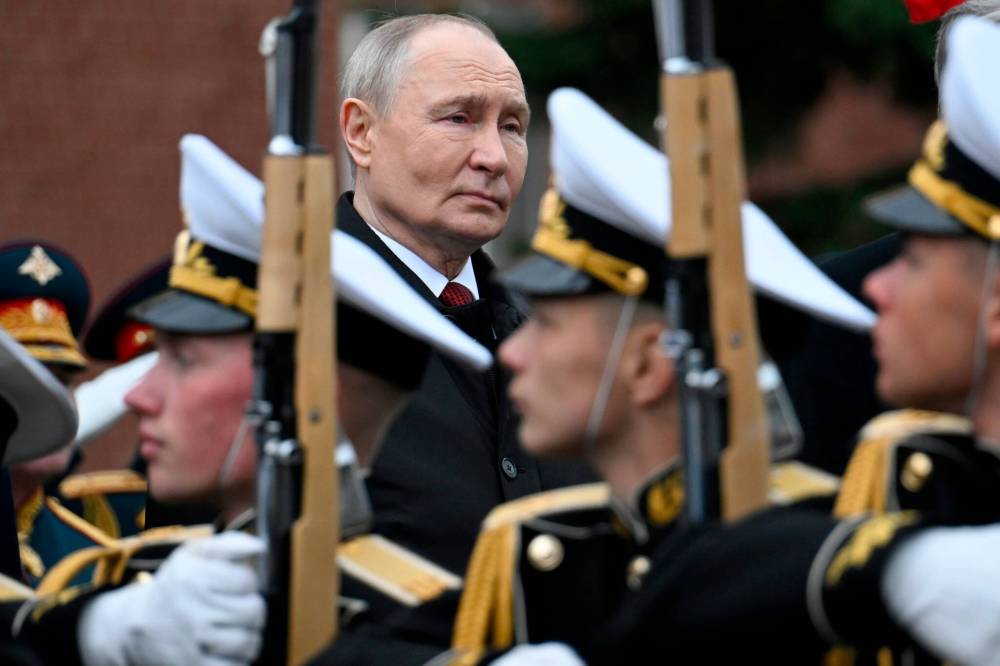
Russian President Vladimir Putin (rear, centre) attends a ceremony to lay flowers at the Tomb of the Unknown Soldier by the Kremlin wall in Moscow on May 9 during celebrations of the 81st anniversary of the Soviet Union’s victory over Nazi Germany during the Second World War. (The Associated Press files)
Such innovation is helping erase Ukraine’s manpower deficit. Meanwhile, Russia’s monthly casualties still number around 35,000. And that’s on top of the possibly 1.2 million killed and wounded since February 2022.
“The Russian army is not currently struggling to recruit new contract soldiers,” Dmitry Kuznets, the editor of exiled Russian independent media outlet Meduza, wrote recently. Yet the quality of new enlistees is diminishing just as “the nature of warfare increasingly requires trained specialists rather than mass infantry.”
American defence analyst Brynn Tannehill is more blunt. New recruits, she says, are often completely unfit for service — “alcoholics, drug addicts, amputees, felons and people with severe health problems who literally have to be carried around by their comrades.”
Military experts estimate that, at its current pace, a Russian campaign to seize all of Ukraine would drag on for two centuries. Wresting control over the eastern Donbas region alone may require three more years of grinding efforts with no guarantee of success, reports The New York Times.
All the while, Putin’s war machine is torpedoing Russia’s economy.
The government’s budget deficit this year has ballooned to a record 2.5 per cent of GDP. Increasingly devastating long-range Ukrainian drone attacks on Russian oil and gas infrastructure also means that the Kremlin can’t truly cash in on spiking energy prices caused by turmoil in the Middle East. Higher taxes, runaway inflation and scarce labour are propelling one-third of small businesses toward closure.
Popular discontent is rising too. Domestic intelligence agencies have launched an internet crackdown in response. WhatsApp and Telegram — Russia’s two most popular digital platforms, used daily by nearly 100 million citizens — have been blocked. The government is pushing an unencrypted super-app, dubbed Max, as a substitute.
The Financial Times reports that Putin is isolating himself, as well. In particular, by spending much more time in underground bunkers and beefing up his personal security to protect against being assassinated.
Still, even as Putin’s expansionist goals evaporate, Russia remains fully capable of menacing its Western adversaries. European officials already warn that Russia may escalate its hybrid war against NATO countries to compensate for stalled progress in Ukraine.
Putin also possesses the world’s largest stockpile of nuclear weapons. Earlier this month, his Defence Ministry abruptly ordered three days of joint nuclear exercises with neighbouring Belarus, involving 64,000 soldiers alongside hundreds of missile launchers, aircraft, warships and submarines.
Russia retains an unrivalled Arctic military presence. Its intelligence sharing and technology transfers are bolstering the capabilities of rogue regimes in Iran and North Korea. And Putin has the ironclad backing of China’s President Xi Jinping — although Russia is now the junior member of their “no limits” strategic partnership.
Plus, despite being outclassed by Ukraine in drone warfare, Russia is among the few nations learning first-hand how modern combat works. Especially around emerging autonomous weapons systems powered by artificial intelligence.
“They have already undertaken sweeping changes in their operational concepts, force structure, training and development of leaders and feedback loops that drive continuous adaptation,” David Petraeus, retired U.S. general and former CIA director, wrote (with a co-author) last month. “Russia is adapting under combat conditions, and China is studying intently and learning from Russia’s experience.”
After this year’s downbeat Victory Day ceremony, Russian President Vladimir Putin said his war of choice was likely “coming to an end.” Russian forces then unleashed 1,500 drones against Ukrainian cities over a three-day span.
“These are definitely not the actions of those who believe the war is coming to an end,” Ukraine President Volodymyr Zelenskyy said afterward.
Putin clearly fancies himself as one of history’s great strongmen. Russia’s leader is thus unlikely to abort his war in Ukraine just yet — even amid obvious strategic failure. His ego won’t let him.
During his 25 years in power, Putin has always put himself ahead of the well-being of his country and its people. That isn’t about to change.
» Kyle Volpi Hiebert is a Montreal-based political risk analyst focused on globalization, conflict and emerging technologies. This column was originally published in the Winnipeg Free Press.