
How U.S. crackdowns are tarnishing the World Cup
Advertisement
Read this article for free:
or
Already have an account? Log in here »
We need your support!
Local journalism needs your support!
As we navigate through unprecedented times, our journalists are working harder than ever to bring you the latest local updates to keep you safe and informed.
Now, more than ever, we need your support.
Starting at $15.99 plus taxes every four weeks you can access your Brandon Sun online and full access to all content as it appears on our website.
Subscribe Nowor call circulation directly at (204) 727-0527.
Your pledge helps to ensure we provide the news that matters most to your community!
To continue reading, please subscribe:
Add Brandon Sun access to your Free Press subscription for only an additional
$1 for the first 4 weeks*
- Enjoy unlimited reading on brandonsun.com
- Read the Brandon Sun E-Edition, our digital replica newspaper
*Your next Free Press subscription payment will increase by $1.00 and you will be charged $20.95 plus GST for four weeks. After four weeks, your payment will increase to $24.95 plus GST every four weeks.
Read unlimited articles for free today:
or
Already have an account? Log in here »
This was supposed to be the most spectacular FIFA men’s World Cup in history.
There are more national teams (48), more host countries (three) and more matches (104) than ever before.
For 39 glorious days, billions of people around the world will be glued to their screens watching.
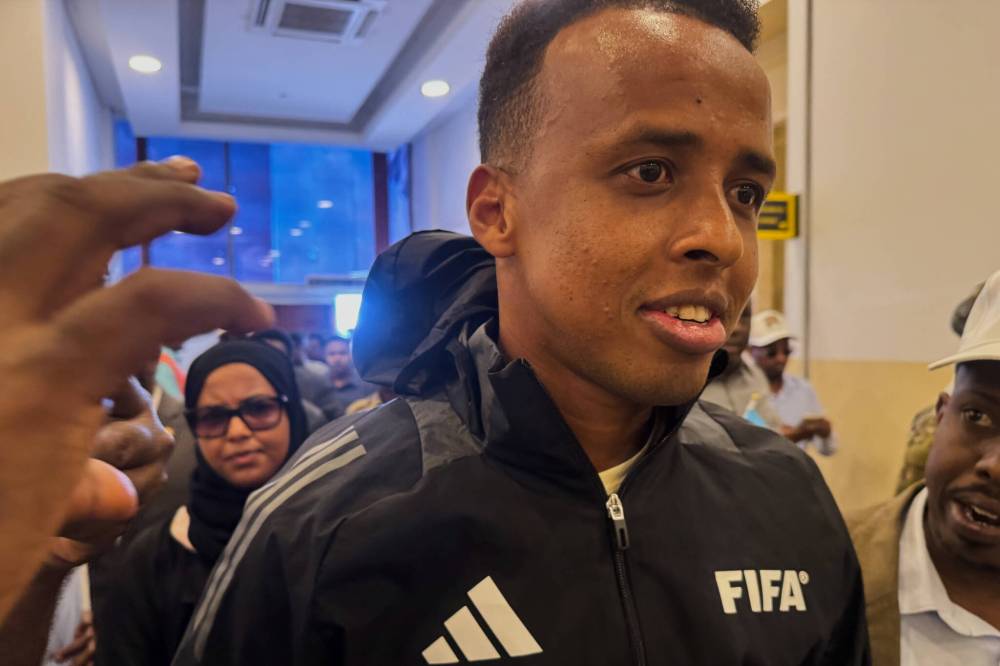
FIFA referee Omar Artan, who was denied entry to the United States to officiate several upcoming World Cup matches, arrives in Mogadishu, Somalia, on Wednesday. (The Associated Press)
FIFA has estimated it could result in as much as US$30.5 billion in tourist revenue for the United States, Canada and Mexico — the three host countries.
Yet much of the pre-tournament gloss has been eroded by events that have taken place far from the playing fields.
FIFA, THE U.S. AND HUMAN RIGHTS
This is the first World Cup where FIFA embedded human rights requirements into the bidding and hosting process.
The problem is, 78 of the tournament’s 104 matches are due to be played in the U.S., where — according to many critics, including Amnesty International — xenophobia and performative cruelty have been guiding immigration policy since Donald Trump returned to the White House.
Human Rights Watch reported that from January 2025 to March 2026, Immigration and Customs Enforcement (ICE) arrested 167,000 people around the 11 U.S. cities that will be hosting matches.
Two months ago, Amnesty International and more than 100 local human rights organizations issued an explicit travel warning for fans, players and officials planning to visit the U.S. for the World Cup.
Visitors were warned about “racial profiling” at the border, intrusive searches and other violations of “the United States’ human rights obligations under domestic and international law.”
Perhaps not surprisingly, a recent survey of 200 host city hotels found tourist bookings were much lower than expected.
Things may be about to get worse.
CONTROVERSIES AHEAD OF THE WORLD CUP
Africa’s leading referee, Omar Artan from Somalia, was scheduled to officiate at several upcoming World Cup matches.
Despite holding a valid passport and visa, Artan was denied entry to the U.S. when he arrived in Miami last Saturday and will now miss the tournament.
U.S. officials claimed “vetting concerns,” but there is no precedent for an official FIFA referee being denied entry to a country hosting the World Cup — including fascist Italy in 1934 or Argentina in 1978 under the military junta.
There is a precedent, however, of Trump describing Somalia as a “disgusting country” and claiming Somali immigrants are “garbage” who “contribute nothing” to the U.S.
Around a quarter of the countries competing in this year’s World Cup face some kind of travel ban or tight visa restriction under the Trump administration.
Even players and coaches who are granted entry may face unusual scrutiny.
Earlier this week, the teams from Senegal and Uzbekistan were allegedly subjected to harsh and humiliating searches by airport security.
However, there was some attempt by Senegal’s football federation to calm tensions after many people on social media accused U.S. officials of racism.
Meanwhile, a public relations conflict between Iran and the U.S. — who remain at war — is escalating, with Iranian soccer officials accusing the U.S. of “obstructionism” with regard to the travel restrictions imposed on their players, as well as “malice and a lack of equality among teams.”
In response, a U.S. official claimed Iran may use the World Cup as an opportunity “to sneak terrorists into the United States.”
FIFA HAD HIGH HOPES
The two previous World Cup tournaments — Russia in 2018, Qatar in 2022 — were both marred by controversies: Russia’s because of Vladimir Putin’s authoritarianism, as well as his military support for Syria’s dictatorship during that country’s bloody civil war; and Qatar’s because of alleged exploitation of the foreign labourers who built its dazzling stadiums.
The soccer was still fantastic, but FIFA’s Human Rights Policy was supposedly introduced to ameliorate growing concerns about “sportswashing” by states hosting the World Cup.
This year was supposed to be different.
FIFA president Gianni Infantino said it would be “the biggest, the most inclusive, the greatest FIFA World Cup ever.”
Instead, Canada and Mexico now find themselves co-hosting with a country that is experiencing democratic backsliding, and where some fans are too afraid to attend games lest they be detained and deported by ICE.
A LEGACY TARNISHED?
Instead of bringing people together, the 2026 World Cup is in danger of being remembered for the climate of exclusion and fear generated by one of its hosts.
That ugly spectacle is something no sport should ever tolerate.
» Simon Adams is a professor of human rights at Murdoch University in Australia. This column was originally published at The Conversation Canada: theconversation.com/ca