
Importance of Indigenous languages outweighs World Cup
Advertisement
Read this article for free:
or
Already have an account? Log in here »
We need your support!
Local journalism needs your support!
As we navigate through unprecedented times, our journalists are working harder than ever to bring you the latest local updates to keep you safe and informed.
Now, more than ever, we need your support.
Starting at $15.99 plus taxes every four weeks you can access your Brandon Sun online and full access to all content as it appears on our website.
Subscribe Nowor call circulation directly at (204) 727-0527.
Your pledge helps to ensure we provide the news that matters most to your community!
To continue reading, please subscribe:
Add Brandon Sun access to your Free Press subscription for only an additional
$1 for the first 4 weeks*
- Enjoy unlimited reading on brandonsun.com
- Read the Brandon Sun E-Edition, our digital replica newspaper
*Your next Free Press subscription payment will increase by $1.00 and you will be charged $20.95 plus GST for four weeks. After four weeks, your payment will increase to $24.95 plus GST every four weeks.
Read unlimited articles for free today:
or
Already have an account? Log in here »
Canada’s parliamentary budget officer says the FIFA World Cup is estimated to cost Canadian taxpayers $1.066 billion to host 13 games over 38 days.
That’s $82 million a game, or $28 million a day.
The majority of the funds will go toward operating the games, staging the venues and paying for security and services, like the RCMP.
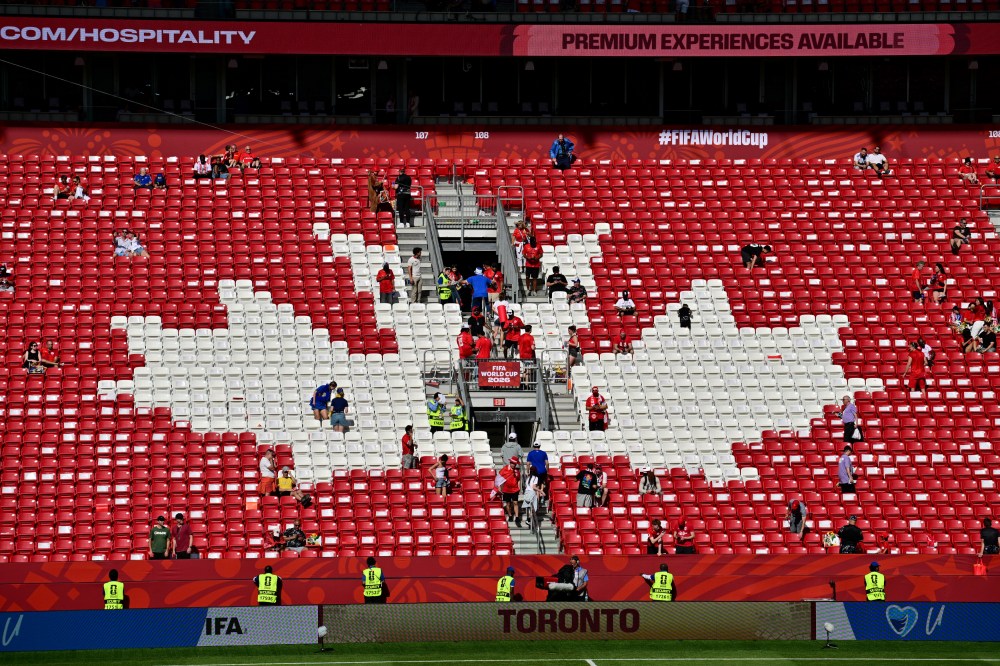
About 12 per cent, or $126 million, will go to infrastructure primarily in two buildings: BMO Field in Toronto and BC Place in Vancouver.
Call it a leap of faith — a hope that spending the remaining $880 million to host a few games will result in enough tourism, economic growth and tax revenue to offset the event.
Considering the political subtext of the event, this is hardly a guarantee, as the three “partner” host nations — Canada, the United States and Mexico — remain in a trade war.
Still, most Canadians probably would say the investment is worth it in terms of cultural heritage and featuring the country on the world stage.
Which brings me to what real investments look like.
On May 31, the federal government ordered an audit of the Office of the Commissioner of Indigenous Languages after receiving reports of financial impropriety and a toxic workplace.
Most complaints related to $10 million spent on a four-day conference in Ottawa studying Indigenous language revitalization held last August.
Critics said this was an egregious amount of money to pay for travel, accommodation, resources and food for conference attendees.
The office was created five years ago by the federal government in response to the many calls in the Truth and Reconciliation Commission related to the importance of saving Indigenous languages.
The office’s budget consists of a complicated set of government funding, grants and contributions totalling about $300 million until 2034, or about $23 million a year.
As anyone who has spent five minutes studying residential schools knows, nothing was more impacted by that system than Indigenous languages.
The ability to communicate, articulate and create relationships on one’s own terms through language is arguably the most important foundation of any community.
Many advocates say the fight to save our languages — many of which are likely to disappear in everyday use at some point during this generation — is the fight for Indigenous life itself.
The Indigenous language office was created to address this need. The office’s first commissioner, Ronald Ignace of the Secwepemc nation in B.C.’s interior, started this work.
Like all efforts to save the nearly 80 Indigenous languages in Canada, the work of the office has been an uphill battle.
Setting up a new federal office comes with a hefty price tag alone.
No Indigenous youth grows up dreaming to be a government bureaucrat, for example, so this takes time, training and essentially the creation of an entire workforce.
It also comes with stress, conflict and jurisdictional disputes — which explains the “toxic” workplace complaint.
Then there’s the work itself.
To put it simply: not only have members of the office had to travel across the country to understand Indigenous linguistic loss and revitalization efforts, but they are also studying something that no government, public education body or Canadian has supported until recently.
War was declared on Indigenous languages. Name something else that has faced such scrutiny.
You can’t.
Every Canadian government and educational system has done everything possible to eliminate Indigenous language use. Jurisdictions that aren’t Indigenous-run do not support anything other than French and English.
If you want an example of how this is still the case, ask yourself how many times a Canadian politician, reporter or citizen obsessed over how former governor general Mary Simon, who speaks Inuktitut, could not speak French.
Indigenous language advocates, many of whom are elders, have spent their lives doing this work in under-resourced communities.
The least that can be done is to pay for them to come and share what they know at a conference.
The meeting was organized by an office that has only been around for five years and was addressing an issue most Canadian institutions have never supported.
A conference is probably cheaper than flying staff across Canada.
Considering the billions — no, trillions — spent to eliminate Indigenous languages, $10 million seems like a drop in the bucket.
It’s a lot of money, of course, but it is a fraction of the Indigenous language office’s budget and an investment that will pay off tenfold in building the cultural heritage of this country and saving the identities of Indigenous communities.
Soccer has never saved anyone’s life, but language has.
» Niigaan Sinclair is Anishinaabe from Peguis First Nation, a professor in the Department of Indigenous Studies at the University of Manitoba and a Winnipeg Free Press columnist.