
Alberta separation no guarantee of success
Advertisement
Read this article for free:
or
Already have an account? Log in here »
We need your support!
Local journalism needs your support!
As we navigate through unprecedented times, our journalists are working harder than ever to bring you the latest local updates to keep you safe and informed.
Now, more than ever, we need your support.
Starting at $15.99 plus taxes every four weeks you can access your Brandon Sun online and full access to all content as it appears on our website.
Subscribe Nowor call circulation directly at (204) 727-0527.
Your pledge helps to ensure we provide the news that matters most to your community!
To continue reading, please subscribe:
Add Brandon Sun access to your Free Press subscription for only an additional
$1 for the first 4 weeks*
- Enjoy unlimited reading on brandonsun.com
- Read the Brandon Sun E-Edition, our digital replica newspaper
*Your next Free Press subscription payment will increase by $1.00 and you will be charged $20.95 plus GST for four weeks. After four weeks, your payment will increase to $24.95 plus GST every four weeks.
Read unlimited articles for free today:
or
Already have an account? Log in here »
Alberta beware.
Ten years ago this month, the United Kingdom held its Brexit referendum. It voted by the narrowest of margins — 51.9 per cent to 48.1 per cent — to leave the European Union. The decade since has seen an economically stagnant Britain, struggling to regain lost financial ground. It has fallen behind its competitors in growth, trade and productivity.
The siren call of “freedom” proved sufficient for the Leave campaign to prevail. It has not proved sufficient to make Britain and its citizens richer and better off. Four different studies show the numbers and impacts. It’s not pretty.
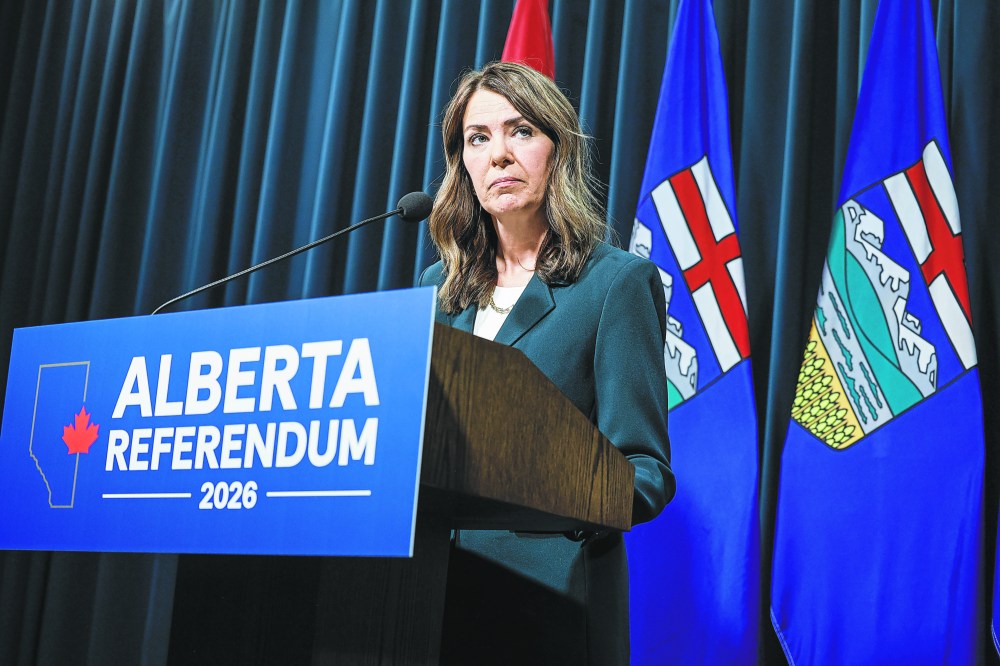
The Office for Budget Responsibility, an independent government agency in the U.K., akin to Canada’s Parliamentary Budget Office, has conducted regular, updated analysis of Brexit’s impact on the British economy.
“Both exports and imports will be around 15 per cent lower in the long run than if the U.K. had remained in the EU,” it found. Brexit advocates said this would be made up by new trade deals with non-EU countries. Not so fast, says the OBR, whose analysis said any such deals “will not have a material impact” on replacing lost trade with Europe.
These findings were echoed by Stanford University’s Institute for Economic Policy Research. Its study found that “Brexit had reduced U.K. GDP by six per cent to eight per cent, with the impact accumulating gradually over time. We estimate that investment was reduced by between 12 per cent and 18 per cent, employment by three per cent to four per cent and productivity by three per cent to four per cent.” Stanford’s study found that “U.K. investment, employment and labour productivity are all estimated to have grown by less than in other comparable countries since 2016.”
Meanwhile, the National Bureau of Economic Research in the U.S. found “longer-term impact of six to eight per cent” GDP loss, exceeding initial Brexit forecasts.
There was no economic cliff over which jobs and investment tumbled post-Brexit, no single shock. Rather, it was cumulative with “fewer firm trading, weaker investment, lower competitive pressure, less integration into European supply chains and a reduced flow of knowledge and technology across borders,” according to an economic analysis from a British think tank, UK In a Changing Europe.
Britain negotiated a mostly tariff-free post-Brexit relationship with the EU. It traded this, however, for new non-tariff barriers such as customs checks and fees and restrictions on free movement of workers. Who paid the most for this? Small and medium-sized enterprises (SMEs) who must now contend with more rules, more paperwork and more delays in what had been free and easy before. If Alberta separates from Canada, the cost of doing business with Canada would rise for Alberta SMEs.
Canada already suffers from weak productivity and investment performance. A form of Wexit would compound this for both Alberta and Canada, making things worse, not better. Less investment means less productivity, which means less wealth for Albertans.
Alberta separatists assume they would be starting from a position of strength as Canada’s richest province. They take for granted that independence would be a springboard up, not a diving platform down. Brexit reality proves this belief as false. There are big economic trade-offs with departing from one fully integrated relationship to a novel, uncertain one that keeps some things intact but not others.
Why is instructive. As Albertans consider voting to begin the process of separating from Canada, they should look to the Brexit experience. It took the United Kingdom almost five years after the referendum to negotiate and implement a Trade and Co-operation Agreement with the European Union — eight years to fully resolve it.
Alberta and Canada would require their own transitional period to negotiate the terms of a new relationship. For how long, no one knows. Brexit tells us it would be a protracted process creating uncertainty that hurts.
Economic uncertainty is the enemy of economic growth. Not knowing the eventual terms of the future Canada/Alberta relationship would chill new investment, maybe even freeze it. Companies currently trading into Alberta would wonder if their current relationships could continue.
Hedging their bets, they would soon contemplate diversification, just as Canada is doing, given the underlying uncertainty with its United States trading relationship. New investment dollars headed for Alberta would be reduced or even halted altogether.
Alberta separatists are waving their own counterfactual argument around.
They contend lost economic opportunity by remaining in Canada, mainly for exporting more oil and gas. Independence would free the province from this constraint. And it would mean keeping Alberta tax contributions to Canada within the province.
None of this considers the price Alberta would have to pay for separating, including taking on its share of the Canada Pension Plan, national debt, national defence, let alone setting up its own new national governing infrastructure. Provincial sales tax, anyone?
Prime Minister Carney’s first response to Alberta’s referendum gambit was to compare it to Brexit’s “bluff.” As governor of the Bank of England, he was charged with helping navigate Britain through the economic consequences. Those consequences have become real and, for now, enduring.
Be careful what you wish for, Alberta.
» David McLaughlin is a former clerk of the executive council and cabinet secretary in the Manitoba government. This column was first published in the Winnipeg Free Press.