
What makes an Opposition leader effective
Advertisement
Read this article for free:
or
Already have an account? Log in here »
We need your support!
Local journalism needs your support!
As we navigate through unprecedented times, our journalists are working harder than ever to bring you the latest local updates to keep you safe and informed.
Now, more than ever, we need your support.
Starting at $15.99 plus taxes every four weeks you can access your Brandon Sun online and full access to all content as it appears on our website.
Subscribe Nowor call circulation directly at (204) 727-0527.
Your pledge helps to ensure we provide the news that matters most to your community!
To continue reading, please subscribe:
Add Brandon Sun access to your Free Press subscription for only an additional
$1 for the first 4 weeks*
- Enjoy unlimited reading on brandonsun.com
- Read the Brandon Sun E-Edition, our digital replica newspaper
*Your next Free Press subscription payment will increase by $1.00 and you will be charged $20.95 plus GST for four weeks. After four weeks, your payment will increase to $24.95 plus GST every four weeks.
Read unlimited articles for free today:
or
Already have an account? Log in here »
There is a famous adage that “the worst day in government is better than the best day in opposition.”
The leader of the official Opposition plays a crucial role in Manitoba’s cabinet parliamentary system. That system concentrates authority in the hands of the premier and cabinet. This means there cannot be accountable government without strong opposition. In the contemporary era of personalized politics, where most of the focus is on the party leaders, the performance of the leader of the Opposition determines to a large extent the effectiveness of the Opposition.
Leading a party which has lost office and is seeking to regain it is no easy task. Nor is judging how well the leader charged with that task is doing the job. Achieving power is the main, but not the only, measure of success for an Opposition leader.
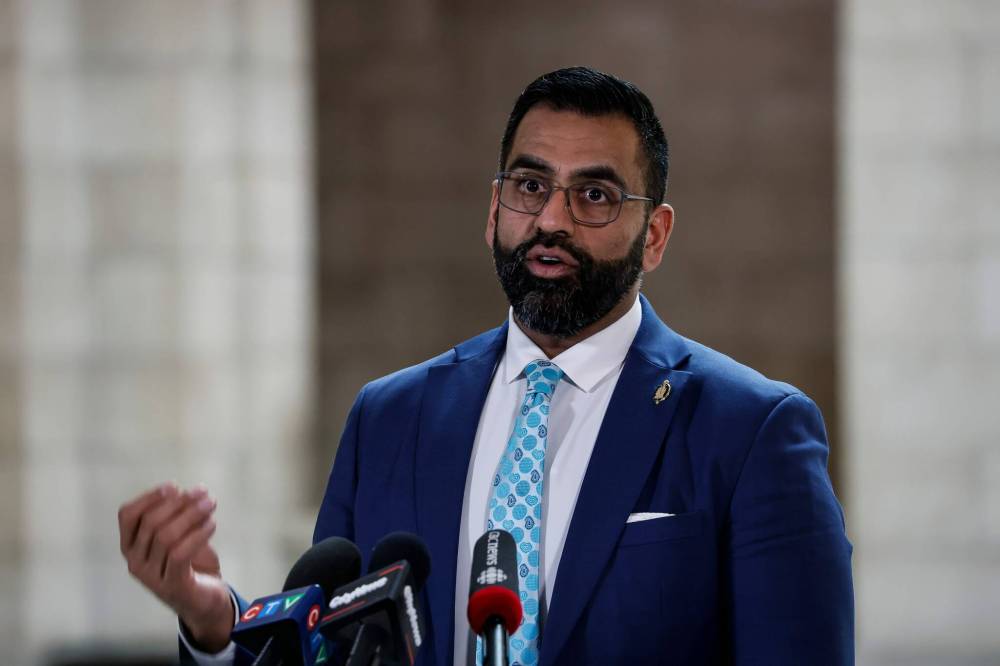
Progressive Conservative Obby Khan, leader of Manitoba’s official Opposition, speaks to media outside the legislative chamber. (John Woods/Winnipeg Free Press files)
While political scientists have developed criteria for evaluating first ministers, not surprisingly there are far fewer evaluations of the effectiveness of Opposition leaders. Such evaluations must examine the context in which leaders operate, the leadership attributes and skills they bring to the job, and how well they perform a range of tasks.
There can be numerous contextual factors which affect the chances of success for an opposition party.
How recently a party was voted out of office, the types of issues which led to its defeat, and the extent of its political setback are factors. The history and internal culture of a political party is another contextual factor which affects the likelihood of success of an Opposition leader. In Manitoba there has been a history of more frequent infighting and more leadership turnover in the Progressive Conservative party than in its main opponent, the NDP.
There is a popular cliche that: “Oppositions don’t win elections; governments lose them.”
Parties that have been governing for long periods often suffer from the inevitable mistakes that increase in number over time. Generally, it is harder for Opposition leaders to gain political ground during the “honeymoon” period of a new government, when voters temporarily give the premier and his ministers some benefit of the doubt.
The state of the provincial economy and how well voters believe they are doing based on the policies of the government are other contextual factors which affect the fate of the Opposition. The Opposition leader can criticize and ideally propose alternative economic and fiscal policies, but the premier has the advantage in commanding attention and taking actions.
A highly popular premier also makes it more difficult for Opposition leaders looking to demonstrate that their party represents an alternative government in waiting. The ability of an Opposition leader to perform effectively in question period, the part of the proceedings of the legislature that generates most of the media coverage, is crucial to demonstrating a contrast with the government.
Personal attributes such as situational and emotional intelligence are needed for a leader to make a strong connection with voters. In an era of mistrust, even cynicism, the perceived honesty, authenticity and credibility of leaders have become critical to political success.
Considering these contextual factors, what can opposition leaders do to improve the prospects of their party? I would offer a list of five broad requirements.
The first requirement after a defeat is to demonstrate change in the form of new faces, representing a generational turnover and some new policy directions which demonstrate that the party is able to learn and improve.
A second requirement is the achievement of cohesion through effective caucus and wider party management. This involves gaining support from all wings of the party for a general policy direction, while tolerating some measure of internal dissent and avoiding open public revolts. With fewer “sticks and carrots” than a premier, Opposition leaders must use their limited authority to maintain unity. Demonstrating firm control is necessary to gaining the external image of a potential premier who would run a stable government.
A third, related requirement is the capability to build a party platform and the proficiency to communicate it publicly in the legislature and through multiple media channels. Developing an effective “shadow cabinet” of designated critics to challenge the government helps in this regard. Avoiding extreme policy positions that fall outside the mainstream of a pragmatic provincial culture is essential. Enlisting the respect of opinion leaders is important for reasons of credibility and support.
A fourth requirement is the development of the party’s organizational capacity in areas such as recruiting candidates, maintaining constituency associations, raising money, hiring talented paid staff, crafting sophisticated communications strategies and keeping up morale and commitment among party members.
The fifth and final requirement is adaptability — adjusting to changing circumstances to demonstrate that the leader and the party are ready to govern. Standing up to the multiple demands, scrutiny, criticism and frustrations of Opposition provides voters with a test of whether an Opposition party leader is suited for the position of premier.
All of these requirements are more easily described than done. They take time, hard work and perseverance. Political luck, in the form of a scandal which drags down the governing party, can be very helpful to achieving power, but Opposition leaders cannot easily make this happen.
Generally, Opposition leaders get less public respect than they deserve for performing an essential, but often thankless, role in Manitoba’s democracy.
» Paul G. Thomas is professor emeritus of political studies at the University of Manitoba. This column was originally published in the Winnipeg Free Press.