
World gets glimpse of its climate future
Advertisement
Read this article for free:
or
Already have an account? Log in here »
We need your support!
Local journalism needs your support!
As we navigate through unprecedented times, our journalists are working harder than ever to bring you the latest local updates to keep you safe and informed.
Now, more than ever, we need your support.
Starting at $15.99 plus taxes every four weeks you can access your Brandon Sun online and full access to all content as it appears on our website.
Subscribe Nowor call circulation directly at (204) 727-0527.
Your pledge helps to ensure we provide the news that matters most to your community!
To continue reading, please subscribe:
Add Brandon Sun access to your Free Press subscription for only an additional
$1 for the first 4 weeks*
- Enjoy unlimited reading on brandonsun.com
- Read the Brandon Sun E-Edition, our digital replica newspaper
*Your next Free Press subscription payment will increase by $1.00 and you will be charged $20.95 plus GST for four weeks. After four weeks, your payment will increase to $24.95 plus GST every four weeks.
Read unlimited articles for free today:
or
Already have an account? Log in here »
Midway through 2026, two major climate dynamics are emerging in parallel. One is a mass rollout of renewable energy. The other is an ominous El Niño brewing, likely to soon trigger fierce weather extremes.
How nations embrace the former and cope with the latter may offer clues to humanity’s fate in the coming decades as climate change intensifies.
The war in Iran has spurred a new rush away from fossil fuels. A common refrain in the capitals of energy importers has been that the wind and sun don’t need to transit the Strait of Hormuz.
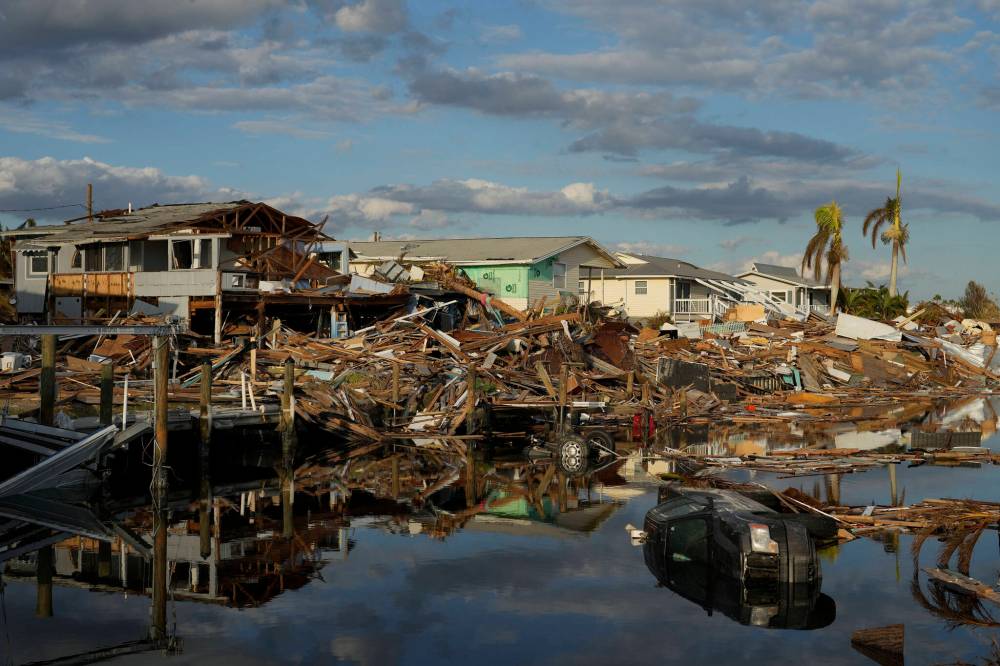
Hurricane Ian, in 2022, was intensified by a strong El Niño system. Another El Niño is now underway and experts are saying it might be one of the most intense on record. (The Associated Press files)
Even the fragile truce between the U.S. and Iran changes little — the war’s underlying issues remain unresolved. Plus, Tehran has learned it now has major leverage. Iran can extract concessions from its adversaries by shutting down the vital waterway. It’s a card the Islamic regime will surely reach for again.
Energy policies worldwide are thus “shifting from barrels and tankers to minerals, grids, batteries and technology,” a former senior U.S. energy security official recently told news outlet Semafor.
This appears in how sales of electric vehicles are on pace to increase 11 per cent compared to last year. Countries in Asia, Africa, Europe and Latin America are also doubling down on their rapidly accelerating installations of wind and solar capacity. In 2025, renewables accounted for 85 per cent of new global power generation.
Having already surpassed its 2030 target for renewables, China now aims to double its clean energy supply within a decade. Even the Trump administration’s hostility toward renewables hasn’t prevented solar from overtaking coal in its share of America’s energy mix.
“That is not a niche trend,” read a blog post from Greenpeace last month, “it is a structural shift.”
Meanwhile, a recent report from investment bank Morgan Stanley talks of a nuclear power renaissance. It’s one being driven by net-zero targets, data centre needs and new government-backed financing mechanisms.
It’s all undoubtedly welcome — but also still insufficient. And it may be arriving much too late.
According to Climate Action Tracker, an environmental monitoring group, even if all existing national climate policies covering until 2035 are implemented, the world will still be looking at 2.6 degrees Celsius of average global warming above pre-industrial temperatures by 2100. That’s compared to roughly 1.5 degrees over the past three years — which has already been devastating.
A UN report from last December says absent radical improvements, severe droughts and floods will increase poverty, hunger and subject billions of people to water scarcity. The global economy by mid-century could start shrinking four per cent per year. That’s similar to the toll of the 2020 pandemic — 3.4 per cent reduction — but annually. Crippling heat waves will be common.
A possible “super” El Niño in the coming months may deliver a grim preview.
The cyclical weather phenomenon happens every few years. A change in wind patterns in the Pacific Ocean causes a rise in sea surface temperatures, which go on to release that warmth into the atmosphere. This in turn heightens global temperatures and alters rainfall patterns.
Scientists confirmed this month that another El Niño is now underway. They warn it may end up being one of the most intense ever, peaking toward the end of the year before tailing off in 2027.
If so, experts predict that Australia, southeast Asia and southern Africa could abruptly become much hotter and drier, straining power grids, damaging agriculture and stoking wildfires. Likewise for the upper reaches of the U.S. and parts of Canada.
Monsoon rains critical to the Indian subcontinent could be both weaker and more inconsistent. Meanwhile areas of Latin America, the southern U.S., Mexico and central Africa may be battered by flood-inducing downpours.
“An El Niño declaration is not just another weather forecast — for millions of people, it is a deadly siren to be feared,” the director of climate campaign group Power Shift Africa told the BBC. “It means failed rains, dying crops, rising food prices and families pushed to the edge yet again.”
It’s also a harbinger of things to come.
“The rise in weather and climate extremes has led to some irreversible impacts as natural and human systems are pushed beyond their ability to adapt,” reads the UN’s sixth climate assessment report, published in 2022. Things have deteriorated even further since.
Yet countries can still influence the severity of impacts through decarbonization and adaptation.
The Iran war is prompting nations worldwide to develop contingency plans in the name of energy security. Catastrophe awaits if similar urgency isn’t applied to the climate crisis.
» Kyle Volpi Hiebert is a Montreal-based political risk analyst focused on globalization, conflict and emerging technologies. This column previously appeared in the Winnipeg Free Press.