
Federal faces missing from flood response in Parkland
Advertisement
Read this article for free:
or
Already have an account? Log in here »
We need your support!
Local journalism needs your support!
As we navigate through unprecedented times, our journalists are working harder than ever to bring you the latest local updates to keep you safe and informed.
Now, more than ever, we need your support.
Starting at $15.99 plus taxes every four weeks you can access your Brandon Sun online and full access to all content as it appears on our website.
Subscribe Nowor call circulation directly at (204) 727-0527.
Your pledge helps to ensure we provide the news that matters most to your community!
To continue reading, please subscribe:
Add Brandon Sun access to your Free Press subscription for only an additional
$1 for the first 4 weeks*
- Enjoy unlimited reading on brandonsun.com
- Read the Brandon Sun E-Edition, our digital replica newspaper
*Your next Free Press subscription payment will increase by $1.00 and you will be charged $20.95 plus GST for four weeks. After four weeks, your payment will increase to $24.95 plus GST every four weeks.
Read unlimited articles for free today:
or
Already have an account? Log in here »
In politics, it’s often just as important to be seen to be doing your job as it is to do your job.
For a case in point, let’s look at the rather odd, casual way in which the federal Liberal government responded to devastating flooding in Manitoba.
Torrential June rains flooded parts of Swan River and surrounding communities. More rain in late June and into early July swamped Dauphin and Swan River again, washing out roads and inflicting massive damage on public and private property.
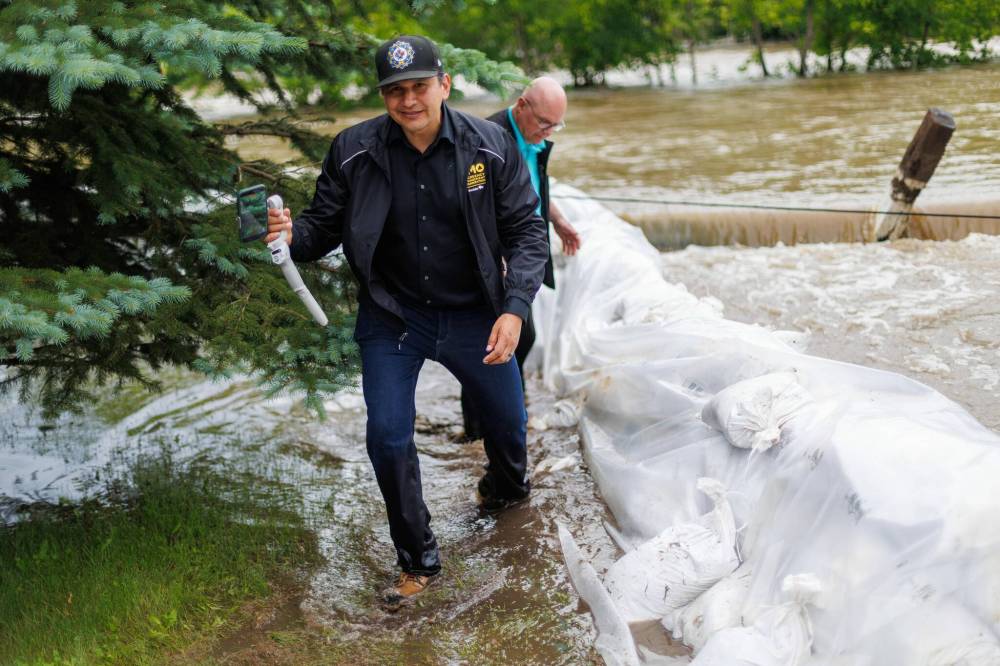
Premier Wab Kinew crosses a flooded street after helping move a generator during a visit to Dauphin and Swan River last week. (Mike Deal/Winnipeg Free Press)
Premier Wab Kinew, a master of not only acting quickly but being seen to act quickly, visited the flooded western Manitoba communities in person and flooded social media with images of the devastation and messages about his government’s response.
Now, it should be said that it’s Manitoba, the province Kinew leads. He has no excuse except to get himself out to the front lines as soon as possible to do and be seen to be doing.
However, disaster response is a responsibility shared between the provincial and federal governments. So, where were the feds as Parkland region residents were fighting back the floodwaters?
For the most part, they were in Ottawa. Which is to say, they were not in Manitoba flying around the flooded areas with Kinew.
Not having boots on the ground, as political types like to say, isn’t necessarily a problem as long as the response from Ottawa was swift and robust. Whether or not that is true in this instance is very much a matter of debate.
Federal disaster assistance, including support from the military, is triggered when a premier asks Ottawa for help. Kinew did that last Wednesday. But it took until Friday before federal and provincial officials reportedly had their first opportunity to meet.
The response from federal Emergency Management Minister Eleanor Olszewski arrived at a very odd time: a statement was released at 9:20 p.m. Friday detailing how Ottawa was going to help. In case you were wondering, Ottawa rarely makes announcements in the late evening on a Friday because there is virtually no chance they will get any media exposure.
Fair is fair, and by all accounts, the response was robust: the federal government was sending a small team of Canadian Armed Forces to provide logistical support and assess the situation on the ground; they were also mobilizing the so-called “Team Rubicon,” a volunteer force with abundant emergency response experience; support for non-governmental agencies like the Canadian Red Cross; and use of the federal Government Operations Centre, which helps co-ordinate disaster assistance responses.
A good and detailed response, but the question is: why did it take roughly two days to issue a statement?
The resources that Olszewski detailed are pretty much clipped and pasted off her department’s home page. Although the extent of support may have been undetermined at mid-week, the type of support surely could have been confirmed the day Kinew asked for Ottawa’s help.
Innocent bystanders may not think there is much intrigue in that 48-hour delay, but for people on the ground dealing with the devastation, watching hours tick by without any word from Ottawa can be excruciating. In fact, all you needed to do was pay close attention to Swan River Mayor Lance Jacobson to get a sense of the anxiety he and his community were feeling.
“If we look at federal support or provincial support, that has to reassure people and move fast,” Jacobson told the Winnipeg Free Press. “Get rid of the red tape and let’s move on it and make these people feel like something is going to happen and support them.”
It should be noted that Manitoba’s only cabinet representative, Northern and Arctic Affairs Minister Rebecca Chartrand, has not yet had her own boots on the ground in the flood zone. Her office issued a statement late Monday saying she is expected to visit the region Thursday. A previous statement attributed to the minister said her work behind the scenes was producing results.
“Public events and announcements have their place, but the core of my job is the steady, consistent work that doesn’t always happen in front of a camera.”
Chartrand’s absence from Manitoba at this time of need is not necessarily, entirely her fault. Prime Minister Mark Carney, like his predecessor Justin Trudeau, discourages ministers like Chartrand from assuming the lead on issues in their home provinces that fall within the purview of other ministers. Hence, the role Olszewski played in confirming federal support.
That said, either she or the staff who helped her write that statement should remember that visiting the site of a natural disaster is not a photo opportunity. The people whose lives have been disrupted or destroyed not only want to see their elected officials, they deserve to know that their needs are being communicated face-to-face.
Kinew clearly knows the value that his citizens place on being able to see him doing his job. Federal officials should take note of his example.
Make the calls, lobby for a more robust response. But make sure you visit the scene of the disaster so people know that you know what they are going through.
» Dan Lett is a Winnipeg Free Press columnist.