
Reconciliation? Recolonization? What Canada can learn from looking abroad
Advertisement
Read this article for free:
or
Already have an account? Log in here »
We need your support!
Local journalism needs your support!
As we navigate through unprecedented times, our journalists are working harder than ever to bring you the latest local updates to keep you safe and informed.
Now, more than ever, we need your support.
Starting at $15.99 plus taxes every four weeks you can access your Brandon Sun online and full access to all content as it appears on our website.
Subscribe Nowor call circulation directly at (204) 727-0527.
Your pledge helps to ensure we provide the news that matters most to your community!
To continue reading, please subscribe:
Add Brandon Sun access to your Free Press subscription for only an additional
$1 for the first 4 weeks*
- Enjoy unlimited reading on brandonsun.com
- Read the Brandon Sun E-Edition, our digital replica newspaper
*Your next Free Press subscription payment will increase by $1.00 and you will be charged $20.95 plus GST for four weeks. After four weeks, your payment will increase to $24.95 plus GST every four weeks.
Read unlimited articles for free today:
or
Already have an account? Log in here »
There has been a surge in anti-Indigenous sentiments and politics in Canada, seen most recently in a rancorous race to lead the British Columbia Conservative Party, as well as in provincial protests denying the harms of the residential school system.
According to the messaging at the B.C. leadership race, repealing the province’s Declaration on the Rights of Indigenous Peoples Act (DRIPA) will enshrine private property, revive the forestry industry and restore democracy.
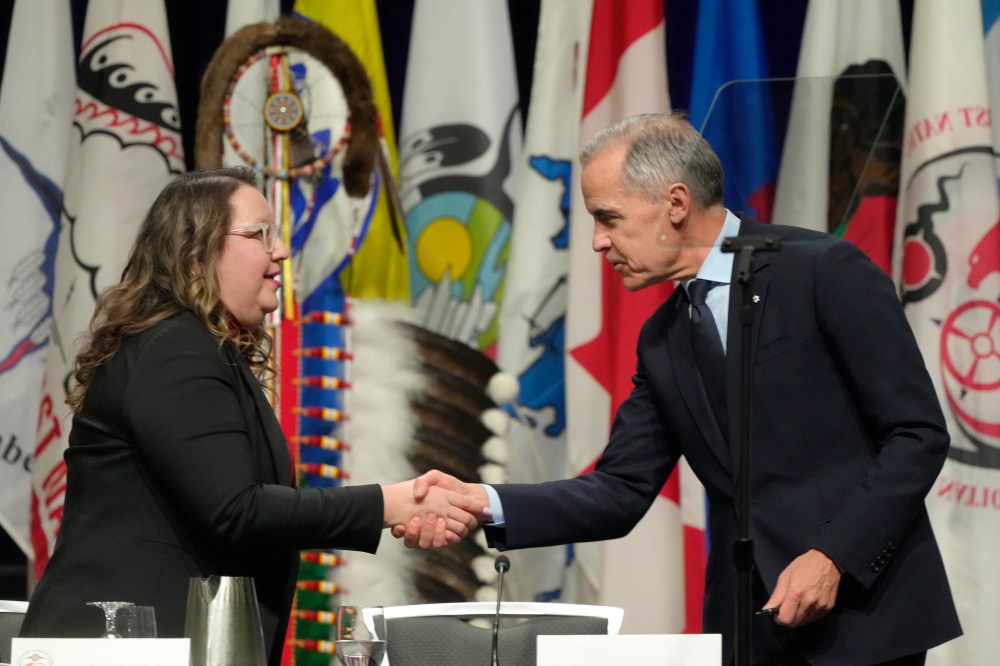
These debates are not exclusive to Canadian conservatives. The B.C. NDP has also been locked in internal debates regarding DRIPA, and Prime Minister Mark Carney’s Liberals have faced recurring scrutiny over whether accelerated infrastructure projects will address their constitutional duty to consult First Nations.
THE SCENE IN NEW ZEALAND
When these issues are covered in the Canadian media, the backlash is usually attributed to something specifically local, like a controversial court case. But our research with partners in New Zealand and Argentina shows that these Canadian attacks on Indigenous rights are part of a clear international trend that’s known as recolonization.
New Zealand’s right-wing coalition government has prioritized the acceleration of major infrastructure projects through the implementation of the 2024 Fast-track Approvals Act. The legislation allows a project to bypass consent processes and to be exempt from existing environmental legislation.
Exemptions for fast-track bills enable these projects to sidestep Maori sovereignty and consultation rights enshrined in the Treaty of Waitangi (the founding document governing Maori-Crown relations). Fast-track 2024 has been used to dismantle government ministries, remove agricultural emissions caps, weaken regional councils and oversight committees, cut public spending and extend thousands of existing and expired resource permissions without consultation.
Anti-Maori rhetoric has emerged from across the coalition government to justify this legislative overhaul. The governing National Party has accompanied its free market economic policy with populist appeals to rural/agricultural communities, portraying farmers as the builders and “the backbone of the nation,” implicitly erasing Maori life.
ERODING MAORI RIGHTS
The populist, libertarian, far-right ACT Party has documented links to the Atlas Network, a non-profit group with a long record of climate denial, as well as ties to anti-protest legislation and disinformation campaigns. Atlas seeks to connect right-wing think tanks across 100 countries.
ACT has repeatedly attacked Maori culture through explicitly racist policy and rhetoric, proposing the Treaty Principles Bill to undermine Maori self-determination and co-governance by redefining the Treaty of Waitangi’s legal interpretation.
NZ First’s deputy leader Shane Jones, himself Maori, has cast Maori or Pakeha who oppose him as hysterical and out-of-touch with (his) working-man sensibilities.
Rhetorical and legislative assaults on Maori sovereignty have led to attempts to fast-track projects like the stalled Bendigo-Ophir goldmine and the failed Taranaki iron sands projects, which could have adverse physical and cultural impacts on Maori people and communities.
These actions reveal how national interests have been positioned as separate and opposed to Maori interests in a worrying trend decried as undemocratic, racist and detrimental to New Zealanders’ individual freedoms.
THE SCENE IN ARGENTINA
In Argentina, President Javier Milei goes even further through his open celebration of Spanish colonialism. In October 2024, Milei posted a video on X honouring Christopher Columbus’s arrival in the Americas as the “beginning of civilization” that “opened a new era of progress.”
For Mapuche women in Patagonia, this rhetoric has led to direct and targeted prosecution based on racism and misogyny after Mapuche communities were referred to as “terrorist groups” and accused of starting wildfires in early 2025. These accusations escalated to a series of raids and police operations in Mapuche and Telhueche communities.
Similar to New Zealand, the rhetoric and its results point to a larger pattern of repression and political persecution aimed at paving the way for larger development projects.
Major infrastructure projects have been expedited by Milei’s government via comprehensive legislative reform enacted in 2024, known as the Regime for Large Investments (RIGI).
In May 2026, Milei proposed an expansion of RIGI, dubbed Super-RIGI, that appears to be closely connected to American entrepreneur Peter Thiel’s visit to Argentina. The desired expansion aims to attract investments from American tech, data and defence companies — including Thiel’s Palantir.
DANGEROUS PATH AHEAD
The rhetoric in Canada, New Zealand and Argentina may differ in tone, scope and transparency, but it reveals recolonization efforts at different stages.
In Canada, a broad coalition of governments and aspiring leaders are looking for ways to limit regulation and reduce Indigenous consultation, a key facet of reconciliation.
In New Zealand, the ruling right-wing coalition seeks to sidestep public consultations through a co-ordinated reinterpretation of Indigenous rights under its colonial and Indigenous co-governance treaty.
In Argentina, its leader is openly antagonizing Indigenous groups and stripping away existing rights and laws giving First Nations a voice.
Canadian citizens should understand where arguments of recolonization and deregulation could lead them — to further colonization. Colonization was, by its very nature, a transnational, highly networked process. So too is recolonization.
» Connor Guyn is a climate policy researcher at the University of British Columbia. Sophia Alex Walters is a PhD candidate in anthropology and a graduate research assistant at UBC. Tariq Harney is a PhD candidate and a graduate research assistant at the Centre for Climate Justice at UBC.
» This column was originally published at The Conversation Canada: theconversation.com/ca