
New book invites questions: What media? What message?
Advertisement
Read this article for free:
or
Already have an account? Log in here »
We need your support!
Local journalism needs your support!
As we navigate through unprecedented times, our journalists are working harder than ever to bring you the latest local updates to keep you safe and informed.
Now, more than ever, we need your support.
Starting at $15.99 plus taxes every four weeks you can access your Brandon Sun online and full access to all content as it appears on our website.
Subscribe Nowor call circulation directly at (204) 727-0527.
Your pledge helps to ensure we provide the news that matters most to your community!
To continue reading, please subscribe:
Add Brandon Sun access to your Free Press subscription for only an additional
$1 for the first 4 weeks*
- Enjoy unlimited reading on brandonsun.com
- Read the Brandon Sun E-Edition, our digital replica newspaper
*Your next Free Press subscription payment will increase by $1.00 and you will be charged $20.95 plus GST for four weeks. After four weeks, your payment will increase to $24.95 plus GST every four weeks.
Read unlimited articles for free today:
or
Already have an account? Log in here »
A new book addresses problems in today’s media and also prompts big questions. “The Trust Spiral: Why the Media Needs Objectivity” is by Canadian journalist Tara Henley. Reading it, I found myself asking: What are the media? What should be their message?
Henley follows two key themes in today’s media environment: responding to the new economic reality and responding to the Trump era. Both have transformed the media landscape and created new problems. Securing paying subscribers and advertisers is a challenge. Journalism is caught between goals of objectivity and advocacy. Public trust in institutions — including the media — has declined.
Henley maps out the territory and includes a Canadian perspective. The latter aspect is difficult as most of the media events she examines are American. Besides Trump, examples include the media coverage of the police killing of George Floyd in Minneapolis, the “great awokening” and the failing health of Joe Biden. As well: the kerfuffle in 2020 over the Tom Cotton op-ed in the New York Times.
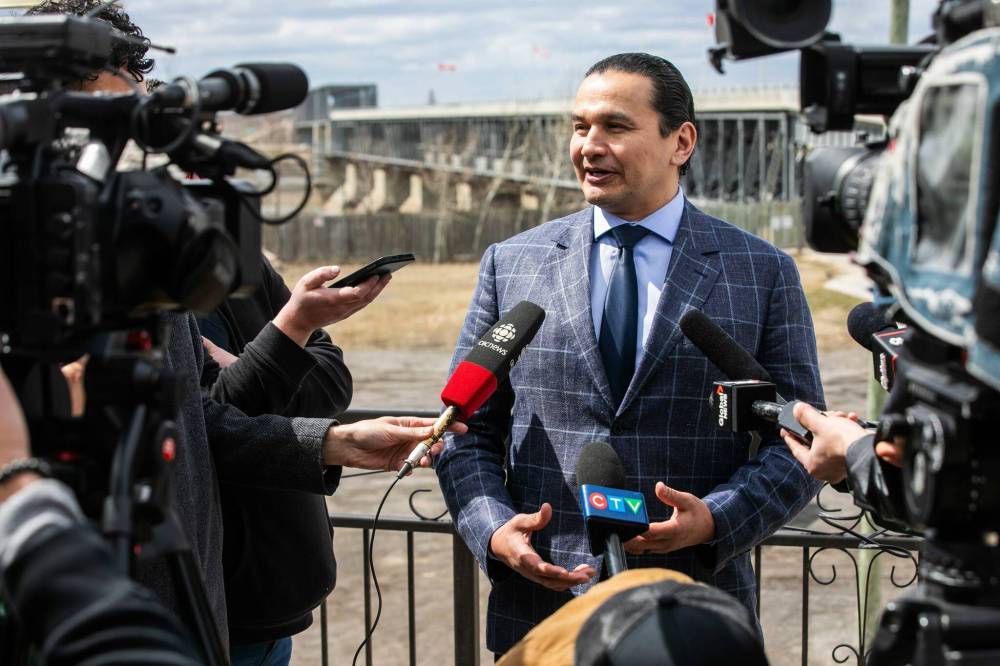
Manitoba Premier Wab Kinew speaks to media at the state of the region address in Lockport in April. (Mikaela MacKenzie/Winnipeg Free Press files)
She notes Canadian events, including the departure of Wendy Mesley from the CBC, the firing of radio host Jamil Jivani by Bell and the general media coverage of the 2022 truckers’ convoy.
The Trump era has been a challenge for the media. Should the media take advantage of Trump as a “ratings boon”? Should journalists aim to be objective reporters of facts? Or should journalists aim to be advocates for moral clarity? These questions, Henley points out, are complicated.
And considering the varied portrayals of Trump in everywhere from newspapers to TV to magazines to social media to podcasts, I return to basic questions. What are the media? What should be their message?
During the COVID pandemic, Henley asserts that in both Canada and the U.S. there was inadequate media questioning of official policies. These concerned lockdowns, vaccine mandates, school closures and also the origin of the virus.
But focusing on media coverage of the individual pieces could result in missing a larger picture altogether. For example, I checked with an AI chatbot and it said that COVID death rates in Canada were less than one-half of those in the U.S. Shouldn’t an overall perspective — including positive news — deserve more media scrutiny?
And what about the media failing to pay more attention to other larger concerns like growing personal isolation, distraction and addiction? Or climate change? Or the impact of artificial intelligence? By the way, I wonder if my consulting AI is an example of how news will increasingly be accessed. Hey, chatbot: what’s today’s news?
I am a Tara Henley fan. I enjoyed her memoir and reflection, “Lean Out: A Meditation on the Madness of Modern Life.” I am an avid reader of her Substack newsletter and listener to her podcast, also called “Lean Out.” I struck up an email correspondence with her and she spoke with me for her feature, “Meet a Subscriber.”
Henley is an incisive podcast interviewer. She has a wide range of guests and covers much ground, often in a crisp half-hour. She brought her conciseness approach to “The Trust Spiral,” which explores a large swath of topics in a short volume. Both “Lean Out” and “The Trust Spiral” are available at the Brandon Public Library.
Writing from Toronto, Henley is well positioned to observe that the media are dominated by a snobbish elite who are insulated from most of the population. From out here in the hinterland, I agree with her assessment. Here’s a case in point. Henley identifies the ruckus over the Tom Cotton op-ed in the New York Times as “one of the biggest fights in journalism in the last couple of decades.” Yet, outside the Toronto media bubble, how many Canadians know of or care about that commotion?
Henley notes a conundrum. The public says it wants the media to be more objective, which is the goal Henley articulates as well. But, when given the choice, the public often prefers media that are biased toward one viewpoint or another. As she says on her podcast: “incentives online all go in the direction of more and more overheated rhetoric, more and more opinion, less rigorous facts …”
Henley acknowledges that she emphasizes problems. “I don’t have any particular solutions yet,” she says on her podcast, “but I think as a journalist, the diagnosis is important and I trust that those solutions will come from the public.”
So, there we have it. In “The Trust Spiral,” Henley lays out the problems in the current media scene. The solutions are in the hands of the public. And that means our supporting and paying for media that are fair-minded and far-sighted. Citizens — as readers, viewers, listeners and subscribers — over to us!