
Canada must not accept another Iranian autocracy
Advertisement
Read this article for free:
or
Already have an account? Log in here »
We need your support!
Local journalism needs your support!
As we navigate through unprecedented times, our journalists are working harder than ever to bring you the latest local updates to keep you safe and informed.
Now, more than ever, we need your support.
Starting at $15.99 plus taxes every four weeks you can access your Brandon Sun online and full access to all content as it appears on our website.
Subscribe Nowor call circulation directly at (204) 727-0527.
Your pledge helps to ensure we provide the news that matters most to your community!
To continue reading, please subscribe:
Add Brandon Sun access to your Free Press subscription for only an additional
$1 for the first 4 weeks*
- Enjoy unlimited reading on brandonsun.com
- Read the Brandon Sun E-Edition, our digital replica newspaper
*Your next Free Press subscription payment will increase by $1.00 and you will be charged $20.95 plus GST for four weeks. After four weeks, your payment will increase to $24.95 plus GST every four weeks.
Read unlimited articles for free today:
or
Already have an account? Log in here »
Iran is a state run by a radical government victimizing its citizens and its neighbours. How do we change that? Any regime change that repeats the mistakes of the past is not a solution.
What went wrong in the past that led to the current regime? One answer is the U.K.- and American-aided coup that led to the ouster in 1953 of a democratically elected government headed at the time by Mohammad Mossadegh and its replacement with an American-friendly autocrat, the Shah of Iran, Mohammad Reza Pahlavi.
The Shah imposed his rule through the Iranian National Intelligence and Security Organization — SAVAK, the acronym of its Persian name. SAVAK systematically inflicted torture, arbitrary killings and extra-judicial killings on perceived opponents of the regime. It was only a matter of time before repression of a regime directed to serving foreign interests would be overthrown.
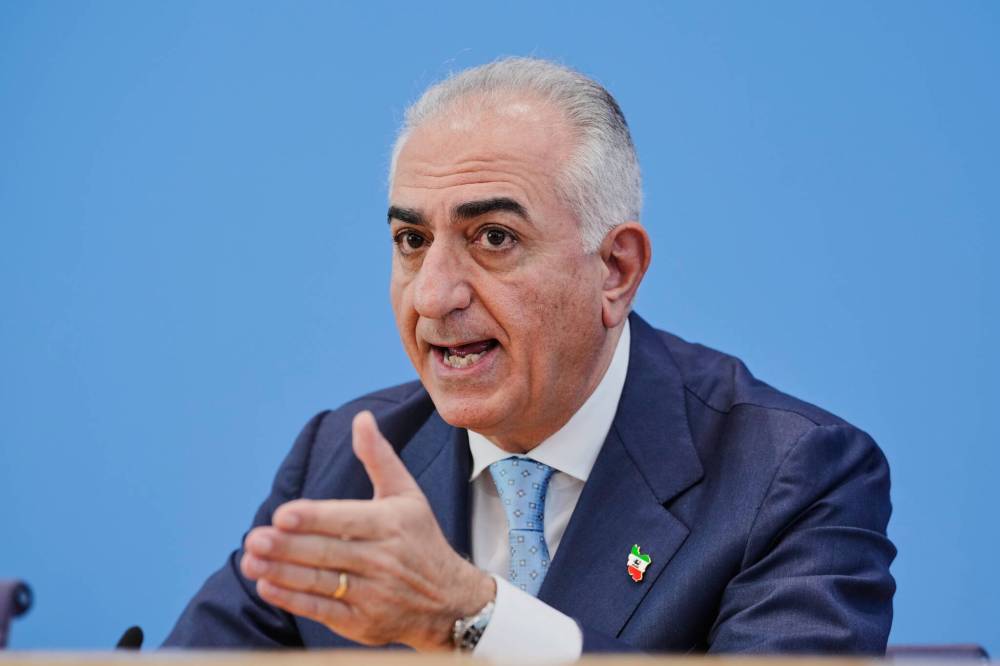
Reza Pahlavi, exiled son of former Iranian Shah Reza Pahlavi, speaks during a news conference in Berlin, Germany, earlier this year. Pahlavi should not take power in Iran if there is a regime change, David Matas writes. (The Associated Press files)
What replaced the regime of the Shah, in 1979, the current regime of the mullahs, is a regime as intolerant and violent as the regime of the Shah and then some. That was not inevitable. But neither was it surprising. The vicious nature of the current regime, following the example set by the Shah, and its hatred for the United States, reacting to the U.S.-aided imposition of the Shah, both echoes and reacts to the past. In 1979, the U.S. reaped what it sowed in 1953.
So, if we are to learn anything from the mistakes of the past in Iran, we would not want to see yet another U.S.-aided regime change with an imposition of a U.S.-preferred autocrat to rule the state. The Shah of Iran died in 1980. His eldest son Reza Pahlavi now wants to succeed his father as ruler of Iran. Reza Pahlavi is American-friendly, engaged in direct communication with those responsible for repression in the current regime and refuses to criticize the repression inflicted by the regime of his father.
Being American-friendly on its own is not a disqualification for any potential regime anywhere. But seeking the support of those engaged in repression, or being silent about repression, certainly are.
Reza Pahlavi is astute enough not to say that he wants to detain, torture and kill anyone who disagrees with him. Yet, he communicates with and refuses to distance himself from those who do, in effect, say that.
Though in 2012 Reza Pahlavi condemned the repression of his father’s regime, his later statements have been nowhere near as straightforward. The current regime embodiment of SAVAK and vehicle for repression is the IRGC, the Islamic Revolutionary Guard Corps. On TV, in 2018, Reza Pahlavi said: “I am in bilateral contacts with the (regime’s) military, the IRGC and the Basij (a militia component of the IRGC). We are communicating. They are signalling their readiness and expressing willingness to align with the people.”
What the IRGC refers to euphemistically, as “aligning with the people” means using the same repression they now use for the mullahs to sustain in power a regime that Reza Pahlavi would lead. The only communication those who respect rights should have with the IRGC should address whether the IRGC would submit to justice and plead guilty to the crimes they have committed.
At rallies supporting the return of the Shah to power in the guise of his oldest son, some have flown banners and worn T-shirts emblazoned with the emblem of SAVAK. The response of Reza Pahlavi, when asked in June 2026 about that support, was: “I don’t want to get into a historical analysis of whether that organization (SAVAK) acted correctly or incorrectly, what it was not. I will only say that it is a controversial issue.”
Whether there should or should not be systematic torture, arbitrary killings and extra-judicial killings of perceived opponents of a regime is not a controversial issue. That sort of behaviour is unequivocally wrong.
The communication of Reza Pahvlavi with the IRGC and his ambiguity about SAVAK are, on their own, disconcerting. Given Iranian history, his language and behaviour are fair warning.
Who should succeed the current regime of the mullahs should be left to Iranians to decide. Yet, we who are not Iranian can reasonably say who should not succeed.
The communication of the son of the Shah with the IRGC and his evasiveness about SAVAK send a signal that his assumption of power could mean the return of SAVAK or the continuation in power of the IRGC, with an inevitable counter-revolution to follow.
If we want deradicalization in Iran, we need more than regime change. We need a successor regime committed upfront to human rights, the rule of law and democratic values. Looking for that sort of change with Reza Pahlavi is looking in the wrong place.
» David Matas is an international human rights lawyer based in Winnipeg, Manitoba. This column was previously published in the Winnipeg Free Press.